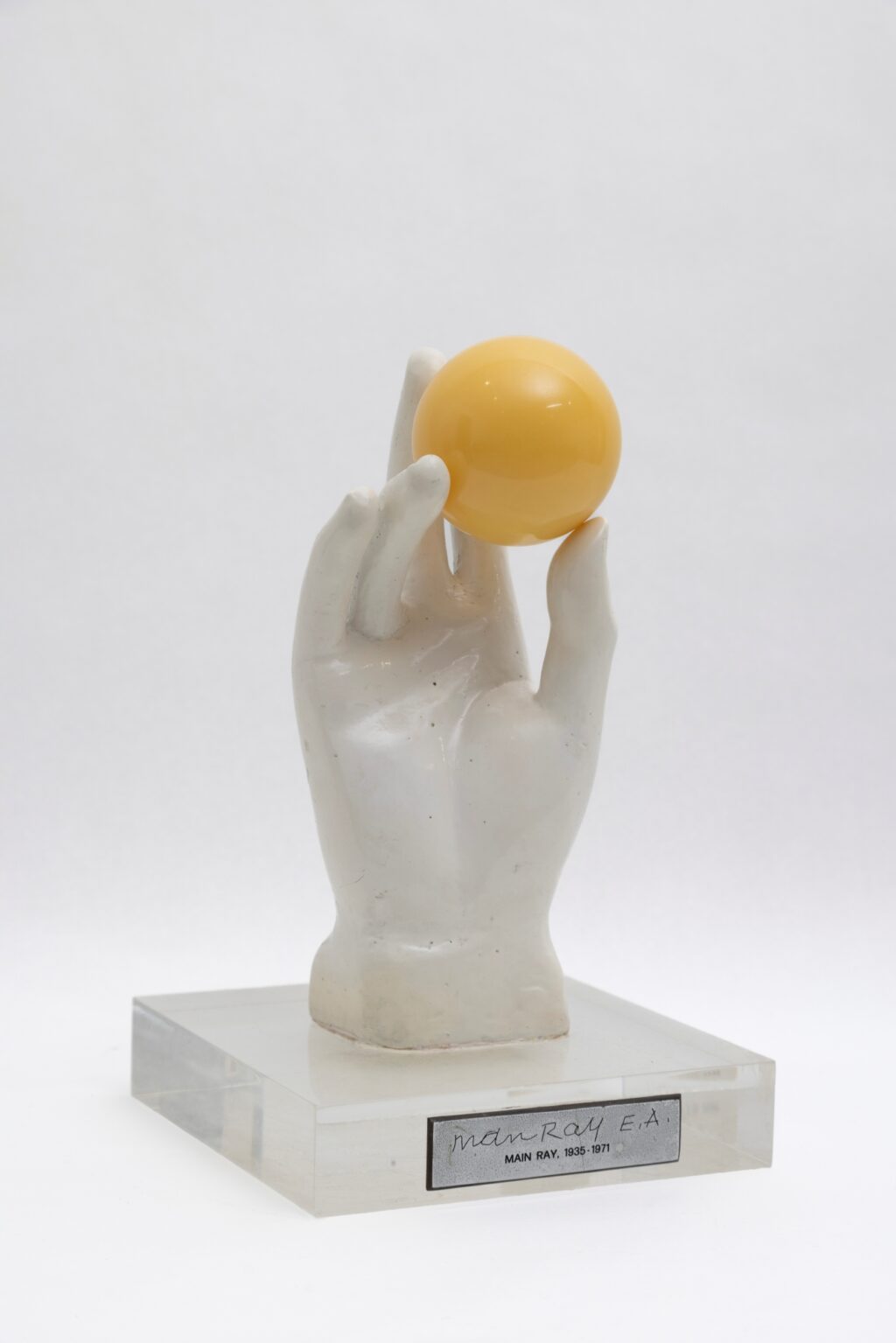
Main Ray, 1935-1971 Painted bronze, ivory billiard ball on plexiglass base Edition of 10
Gaia Sarpietro
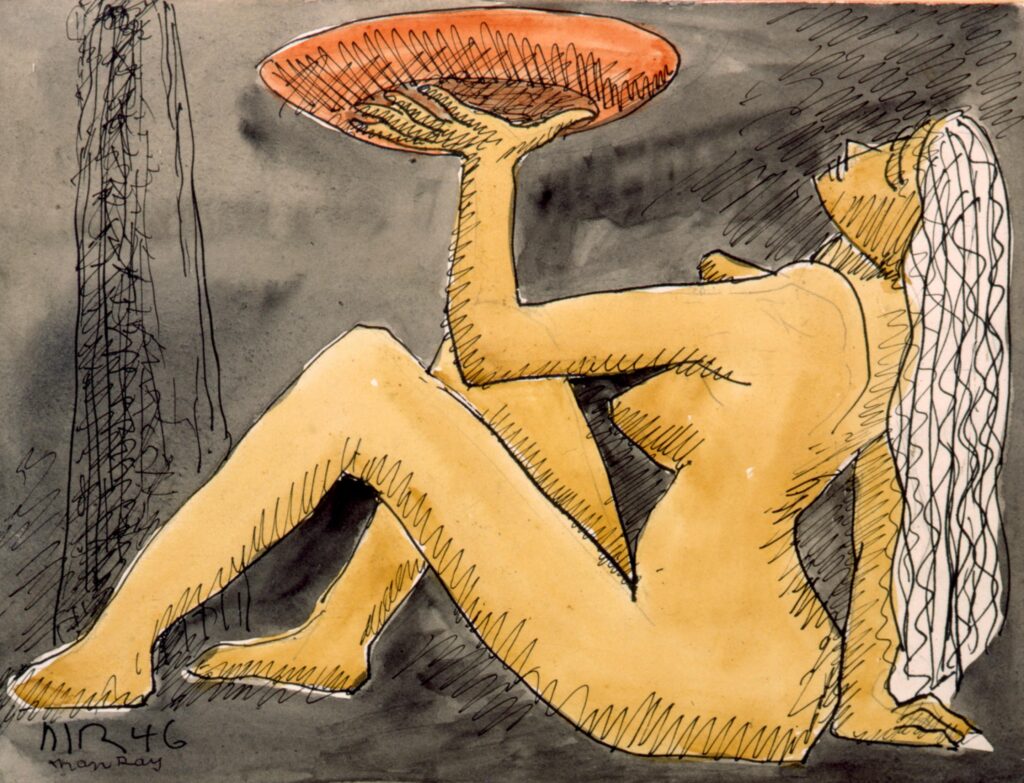
The title is the first joke, and like most of Man Ray’s jokes it doubles as a thesis. “M for Dictionary” sounds wrong — M should stand for Man, or Milan, or Marconi — and that wrongness is the point. A dictionary is the place where words are supposed to behave, where signs line up obediently with meanings. Man Ray spent six decades making sure they never did. The exhibition that Gió Marconi and the Fondazione Marconi have mounted for the fiftieth anniversary of the artist’s death takes this insubordination of language as its organizing principle, proposing that the true medium of this famously multi-medium artist was never photography, nor painting, nor the object, but the word itself — the title, the pun, the caption, the name.
It is a strong claim, and the show mostly earns it.
Begin with the name, as the curators do. Emmanuel Radnitzky was born in Philadelphia in 1890 to Russian Jewish immigrants who later settled in Brooklyn; the family shortened its surname to Ray, and Emmanuel compressed himself into “Man.” It is tempting — and the exhibition does not resist the temptation — to read this act of self-naming as the artist’s first conceptual work: a readymade identity, assembled from found linguistic materials, signed and put into circulation. The reading is seductive precisely because it makes everything that follows look inevitable. One should be a little suspicious of inevitability in retrospectives. But it is true that no other artist of his generation, with the obvious exception of his friend and accomplice Marcel Duchamp, treated naming as such a load-bearing part of the work. Cadeau, the flatiron studded with tacks; Object to Be Destroyed, the metronome with its photographed eye; Obstruction, the cascading coat hangers — strip the titles away and you have curiosities. With them, you have propositions.
The exhibition unfolds across five sections, conceived less as chapters than as dictionary entries — a structure the curators, art historian Yuval Etgar and Deborah D’Ippolito, describe as a visual dictionary, and which the Berlin- and Milan-based studio Kuehn Malvezzi (the architects of the gallery itself) has translated into an installation of considerable restraint. Each section pairs a body of work with a mode of language-use. The sculptural objects, gathered under the subtitle “Objectives” — another pun, of course, the object as objective, the noun as aim — are presented as new words: coinages rich in plural, playful meanings, which seen together begin to constitute an idiom of their own. The final gallery, upstairs, is devoted to Man Ray’s fascination with the so-called mathematical objects, the dusty plaster models of equations he photographed at the Institut Henri Poincaré in the 1930s and later repainted into the Shakespearean Equations — forms that already had names, which he renamed, proving that even mathematics could be made to stammer.
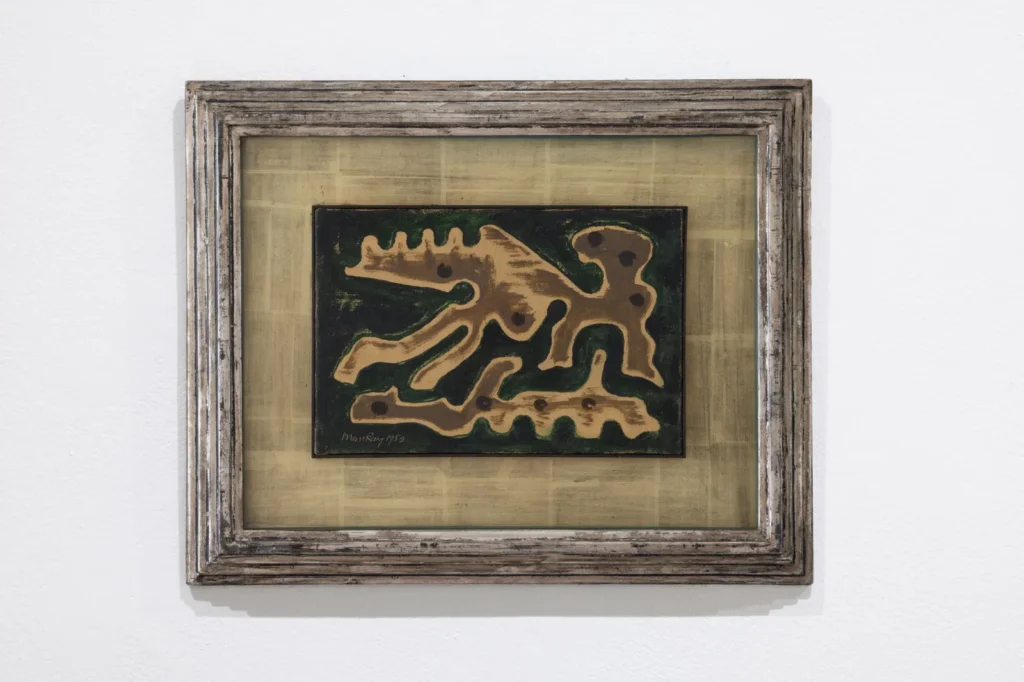
Oil on canvas
Even the rayographs — the cameraless photographs made by laying objects directly on sensitized paper, which Tristan Tzara hailed and which the artist, with characteristic modesty, named after himself — slot into the argument with surprising ease. Man Ray published the first portfolio of them in 1922 as Les Champs délicieux, a title that answers, almost word for word, Les Champs magnétiques, the founding experiment in automatic writing that André Breton and Philippe Soupault had published two years earlier. The echo is not decorative. The rayograph is automatic writing by other means: the hand withdraws, the object dictates, light does the transcription, and chance signs the page. Seen through the exhibition’s lens, the technique that made Man Ray’s reputation as a photographic innovator turns out to be his most literary invention — a way of letting things write themselves, of converting the darkroom into a desk. That the show can absorb even this, the most canonically “photographic” of his achievements, into its linguistic scheme is the best evidence that the scheme is more than curatorial packaging.
The work that stopped me was not one of the famous icons but the Vénus restaurée, the classical torso trussed in rope, displayed in the round. You can walk behind it, and I did. From the back, everything changes. The face the canon never gave her is beside the point; what you see is the rigging: the knot at the nape, the cords crossing at the small of the back, the plaster gone the yellow of old ivory under the low light. The title does the rest — a Venus “restored” by being tied up, conservation as bondage, the classical tradition held together by exactly the constraint it pretends not to need. But the joke only lands whole from behind, where the rope stops decorating and starts holding. I stood there longer than I meant to, looking at the back of a body that has no front. Ruthless introspection, even without a face.
What the linguistic frame accomplishes, critically, is a quiet demotion of the photographs — and this may be the show’s most useful provocation. Man Ray has been canonized as a photographer, one of the most celebrated of the modern era, and the market has enthusiastically agreed. But he resented the label all his life; he wanted, badly, to be recognized as a painter, and he insisted that photography was something he did the way a writer does typing. By organizing the work around language rather than medium, the exhibition restores the coherence Man Ray himself claimed: the rayograph, the painting, the assisted readymade, and the drawing all become utterances in a single tongue. The portraitist-for-hire of Montparnasse recedes; the visual writer steps forward. Whether this rebalancing reflects Man Ray’s practice or our moment’s conceptualist preferences is a fair question — every generation rebuilds its dead artists in its own image, and an artist who “anticipated conceptual art” is simply worth more, in every sense, in 2026 than a surrealist photographer is. The reader should know that the present writer finds the thesis largely persuasive on the evidence of the work itself, while noting that the work has been selected by the people making the thesis.
There is also the matter of where we are. This is not a museum retrospective but a gallery exhibition, mounted by a commercial space and its affiliated foundation, and the Marconi family is not a neutral party to Man Ray’s story. Studio Marconi, the gallery founded by Giorgio Marconi from which both the Fondazione and Gió Marconi’s space descend, gave the artist his Milanese solo debut in 1969 — Je n’ai jamais peint un tableau récent, “I have never painted a recent picture,” a title that was itself a small machine for dismantling the art world’s cult of novelty. Milan in those years was the capital of Man Ray’s late-life rediscovery, and of the editioning and replication of Dada objects that rediscovery entailed — a chapter that made the aging artist financially comfortable and has kept conservators and auction-house catalogers busy ever since. The present exhibition sits squarely inside that history. This is not disqualifying; it is, in fact, part of what makes the show historically dense rather than merely commemorative, and the gallery itself claims the lineage — Enrico Cattaneo’s images of Man Ray at the 1969 opening accompanied the launch of this show like a statement of origin. But a survey that argues so elegantly that Man Ray’s objects function like words might have said more about how those words were printed, reprinted, and sold — about the grammar of the multiple, which is also a grammar of the market. A dictionary, after all, is also a commodity; that is the one pun the exhibition declines to make.
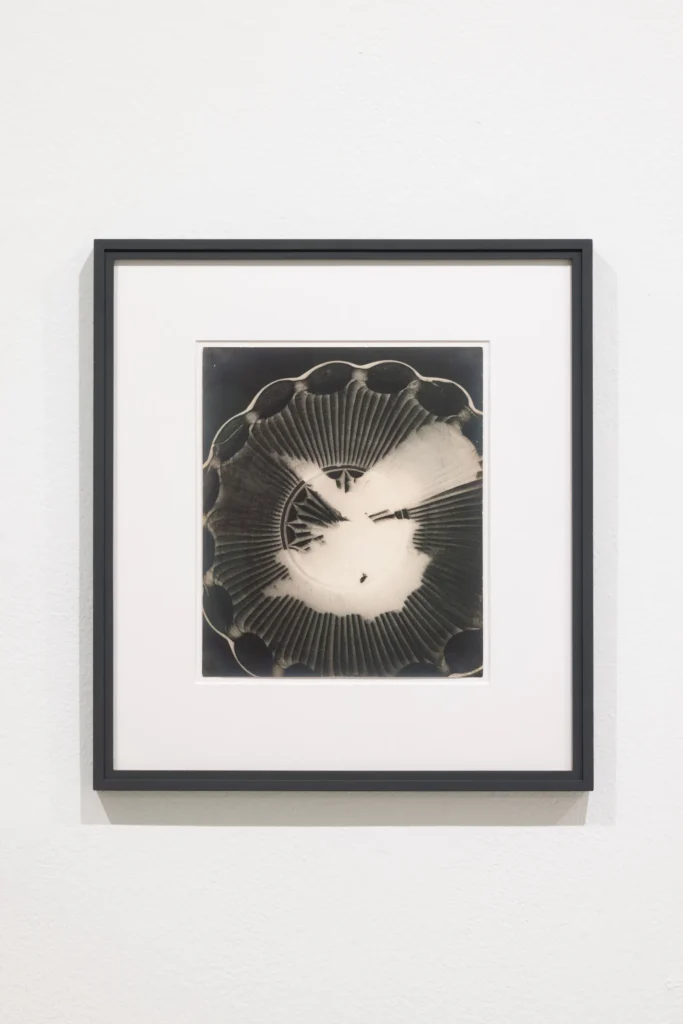
rayograph, gelatin silver print
If the show has a structural weakness, it is the tension between its form and its subject. A dictionary domesticates. It alphabetizes, defines, fixes. Man Ray’s whole enterprise was to keep meaning in motion — to ensure that the iron wounds, that the metronome watches, that Noire et blanche names a photograph, a racial juxtaposition, and a printing process all at once. There are moments when the five-part taxonomy threatens to do to the work what Man Ray would never do to a word: pin it down. The best rooms are the ones where the scheme loosens its grip and the objects misbehave among themselves again. The bound Venus is one of them: no dictionary entry contains her, and she knows it. That is where the exhibition stops explaining and starts working.
Fifty years after his death in Paris, Man Ray remains an artist the institutions have never quite known how to shelve — too funny for the photography department, too photographic for painting, too object-ridden for either. “M for Dictionary” makes a virtue of this unshelvability by proposing that the filing system was the artwork all along. It is a serious exhibition built on jokes, which is exactly the right way to honor a man who built serious jokes for sixty years. The anniversary occasioned it; the argument justifies it. One leaves wanting to look up more words.
Man Ray: M for Dictionary Gió Marconi / Fondazione Marconi, Via Tadino 15, Milan April 11 – July 24, 2026; curated with Yuval Etgar and Deborah D’Ippolito, exhibition design by Kuehn Malvezzi.