CLARA BOW, TAYLOR SWIFT, AND THE AGONY OF BEING THE IT GIRL
By Scott Sublett
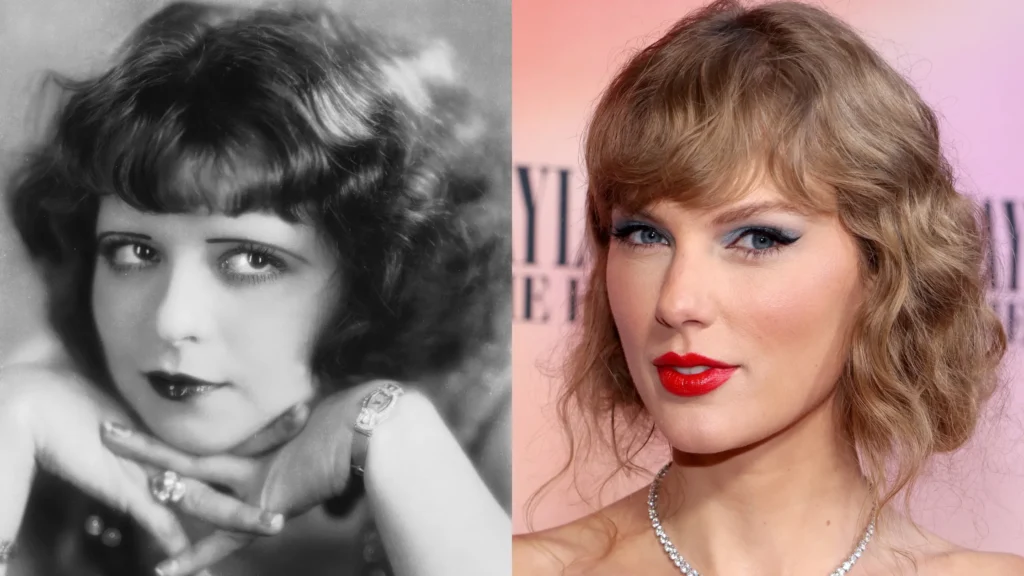
Who’s the “It Girl” now? The great Venus with the extra something that makes her the emblematic darling of the age. Kristen Stewart? Margot “Barbie” Robbie, who in “Babylon” actually played a fictionalized version of the original It Girl Clara Bow? Or are movies worse than ever, over, their mojo gone, so it can’t be a movie star—and is the culture so fragmented that there can’t anymore be any such thing as an age-defining It Girl for everybody? Maybe there hasn’t been one since Princess Diana died.
Only there absolutely is, and Taylor Swift knows—she’s It, and announced it with her 2024 song “Clara Bow” from “The Tortured Poets Department”. The song says being the It Girl is “hell”, that you must “take the glory, give everything.” Of course just about everyone who goes into the arts gives everything and most get back dribs and drabs if anything—unlike Swift, who has gotten plenty from making music out of suffering for her art. The song implies that the industry chews you up and spits you out, but really, Swift seems just fine. No doubt she’s been genuinely harmed by the very real blows and inconveniences of modern celebrity, but she reportedly comes from a supportive family, appears marvelously sane herself, and wears the mantle of the tortured artist ironically, and under that maybe a bit inauthentically and, well, calculatedly. It’s all a bit “look how glamorous I look while I’m suffering.” Joni Mitchell, a bit of an It Girl herself in the ‘70s, described “Stoking the star-maker machinery / Behind the popular song” in her lyric “A Free Man in Paris”. Unlike Swift, Mitchell spoke in a wry and knowing tone that wasn’t at all melodramatic or self-pitying. Just a deft touch of resigned melancholy. As for Clara Bow, she arrived tortured. The star-making machine simply finished the job.
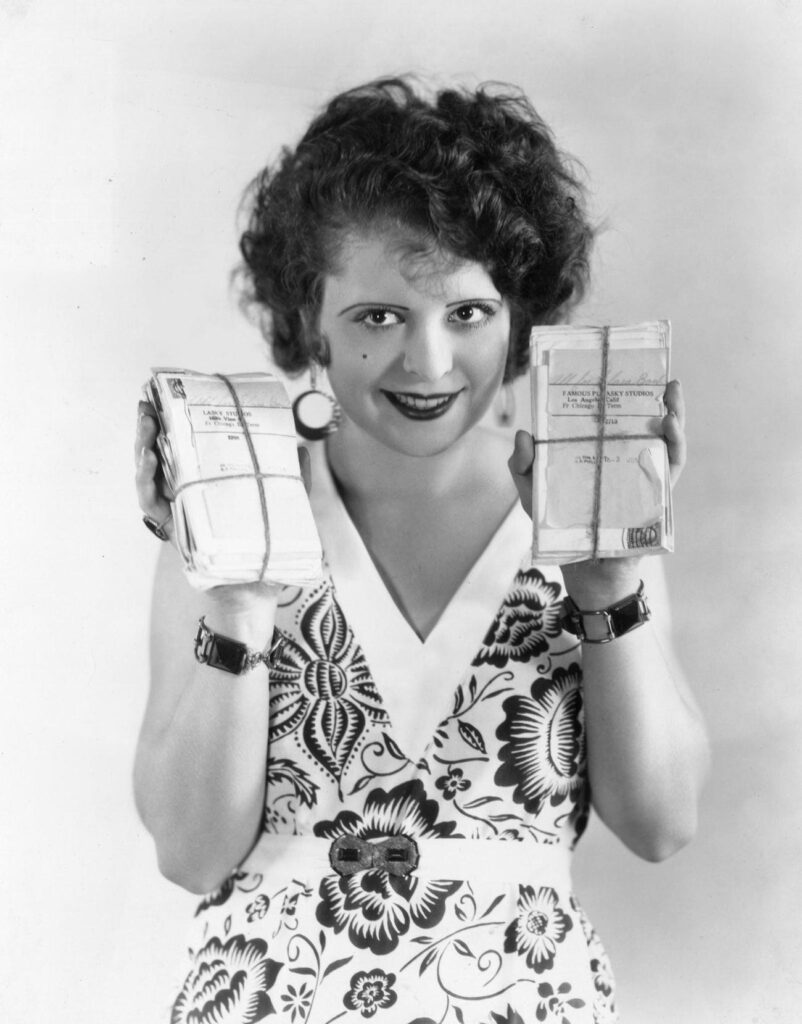
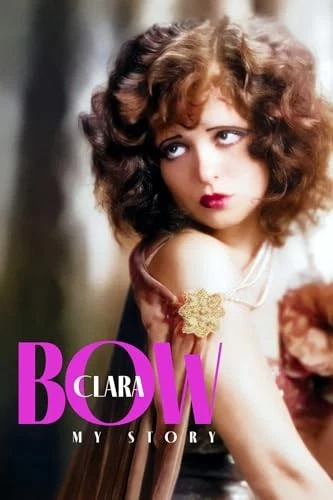
Before Swift appropriated Clara Bow’s pain, her vast, global audience had no idea that before Harlow, before Monroe, there was Bow, the original “It” girl for whom the handle was invented when she starred in the silent film based on Elinor Glyn’s racy bestseller “It.” She was the biggest star of the ‘20s and the mail train from back east had a special car for her fan letters. F. Scott Fitzgerald, who wrote the story for one of her early films, called Bow the quintessential flapper. She drove men wild and women liked her, too. Histria Books, recognizing the Swifties market—Taylor Swift’s economic impact is literally in the billions—has reissued “Clara Bow: My Life Story, “as told to Adela Rogers St. Johns, which was originally a series of articles in “Photoplay” magazine in 1928, when Clara was at the height of her fame. It brings Bow back to life in a way that, say, a new biography, wouldn’t. “She was the 1920s,” said Louise Brooks, who worshipped Clara and marveled that anyone would bother with Louise Brooks (remember the Louise Brooks craze of the ‘70s?) when there was Clara to think about. Yet Brooks, with her distinctively severe, shiny black “helmet” bob is indeed more remembered because she was in timeless classics of the German Golden Age that are taught in university film classes (“Pandora’s Box” and “The Diary of a Lost Girl”), while Clara starred in a series of vehicles that Paramount cranked out at a furious and wildly profitable clip—mostly mediocre, with the exception of “Wings,” the aviation epic that was the first movie to win an Oscar, in which Clara was the fulcrum of a love triangle and top billed, but the airplanes were really the stars. Mast and Kawin’s definitive “A Short History of the Movies” (at 770 pages, not so short) barely mentions Bow and then only in the context of How Society Depicts Women—no reference to her artistry. The lesbian director Dorothy Arzner tenderly shepherded Clara through her first sound film, “The Wild Party” (it was for Clara that Arzner invented the “boom mic,” improvised out of a fishing pole) and many of Bow’s films were written by women, which is not unusual for the silent era because it was less of a boy’s club than it would later be, but to make Bow just a plaster feminist icon is perhaps to diminish her. Her naturalness and spontaneity redefined film acting as decisively as Marlon Brando, James Dean and Montgomery Clift would in the 1950s. Moreover, beyond anyone else in the world, she embodied the new sexual freedom of the 1920s, and for doing so was roundly slut-shamed. That can happen when you routinely entertain five men a night.
Contemporary accounts assure us that every straight man in America wanted her. Her easy, friendly, sexiness probably began with her impoverished, tomboy girlhood on the streets of Brooklyn, a filthy little redheaded ragamuffin. In her memoir she brags that she was picked first for the baseball team—she pitched—and when it came to fights, “I could lick any boy my size.” She liked boys. She was one of them. When she realized she was turning into a woman, it was with a terrible sense of loss. Meanwhile, at home, Clara made herself emotionally responsible for her beloved but mentally ill mother. Her beloved father was by all accounts a drunken, abusive weasel, was mostly absent, yet she took him along to Hollywood and took care of him the rest of his life. He may well have raped her.
There are two mesmerizing Clara Bow biographies: “The It Girl” by Joseph Morella and Edward Z. Epstein (1976) and “Clara Bow Runnin’ Wild” by David Stenn (1988), but hearing her describe in the first person the traumas that made her a hot mess and arguably the most scandalous woman in the history of movies makes the recently reissued autobiography, despite its elisions and mythmaking, indescribably moving to any Clara Bow fan. For example, there’s the passage where her best friend Johnny stands too close to the stove and catches fire, his mother paralyzed with panic. “Clara, Clara, help me.” She has the presence of mind to wrap him in a rug and smother the flames, but he dies in her arms anyway. She was “only about eight or nine,” she can’t quite remember. She explains away her poor memory saying, “I have been trying all my life to forget, not to remember,” and of course psychologists know that victims of childhood trauma have spotty memories. The fire story is true, but a lot of what she “as-told-to” Adela Rogers St. Johns was probably made up by Clara, Adela, or some Paramount publicity hack, and the juiciest dope is in the two very readable biographies. There’s a line in “The Player,” Robert Altman’s film about Hollywood: “The rumors are always true.” And when it came to Clara, they were.
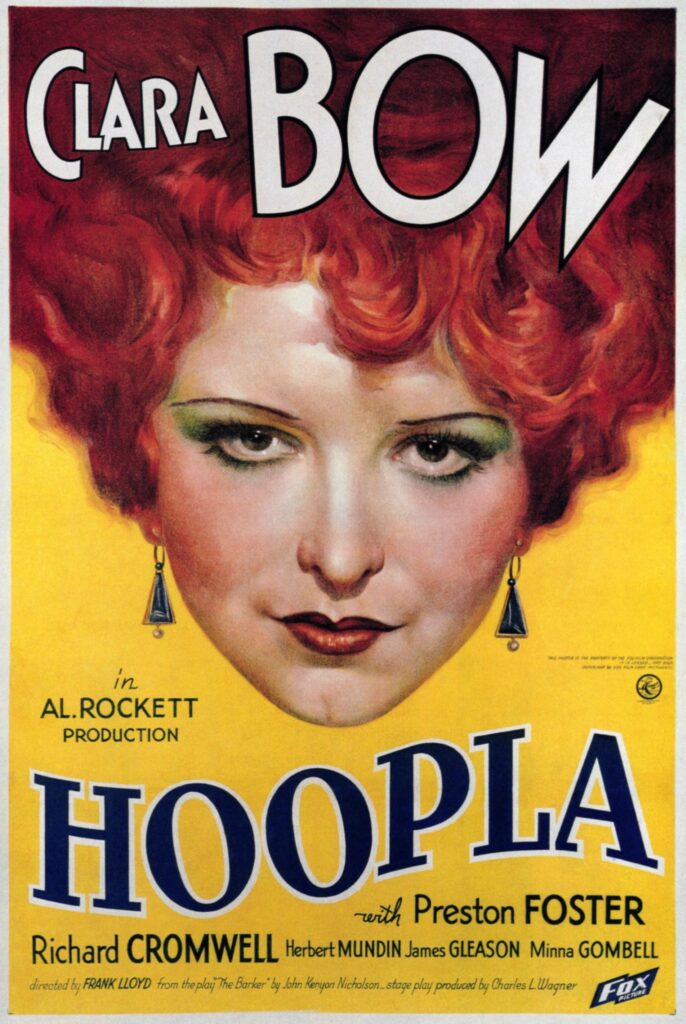
She looked dead when she was born, but they shook her to life. Her mother’s two previous babies had died soon after birth; with the first there was no money to do anything with the body but throw it in the trash, and the second went into an unmarked mass grave. Bow was physically abused by her drunken father (whose own mother had died in an insane asylum), and her mother had “spells” (the formal diagnosis was “psychosis due to epilepsy”) and threatened to kill Clara because the world was bad and immoral. Clara’s escape was to become movie mad, and at 16 she entered the Motion Picture Magazine Fame and Fortune Contest, which promised the winner a screen test and a part in a picture, and improbably, the scruffy girl who owned only a single dress won. When her mother discovered her daughter was going into the whorish profession of acting, she sneaked into her sleeping daughter’s bedroom and Clara awoke with a butcher knife pressing against her throat. The mother would soon die in an insane asylum and Clara was hysterical with grief.
Her start was rocky, but directors and audiences marveled at her emotional sparkle and availability. She was real. She was there. And she was always seducing. She cannily calibrated her performances to seem both lusty and innocent, managing to be at once the virgin and the whore. She would unpretentiously eat her lunch with the crew instead of the bigwigs, and slept with everybody, with crew, co-stars, everybody but her producer B.P. Shulberg, the Harvey Weinstein of his day, whom she would taunt with the information that her tryst with the prop man had been great. She was a naïf and therefore underpaid, but she still bought a red roadster to match her hair and dyed her dogs to match the car. When she found out her live-in-best-friend-cum-assistant was stealing her blind, Clara, hurt, pressed charges, and in the 1931 trial it all came out—the drugs, alcohol, gambling, and orgies with the whole USC football squad. After waking up with a knife at her throat she became insomniac, and filled the sleepless nights with sex. In the wake of the scandal, Clara checked into a sanitarium. Her career looked over but when she got out most every studio in town wanted her.
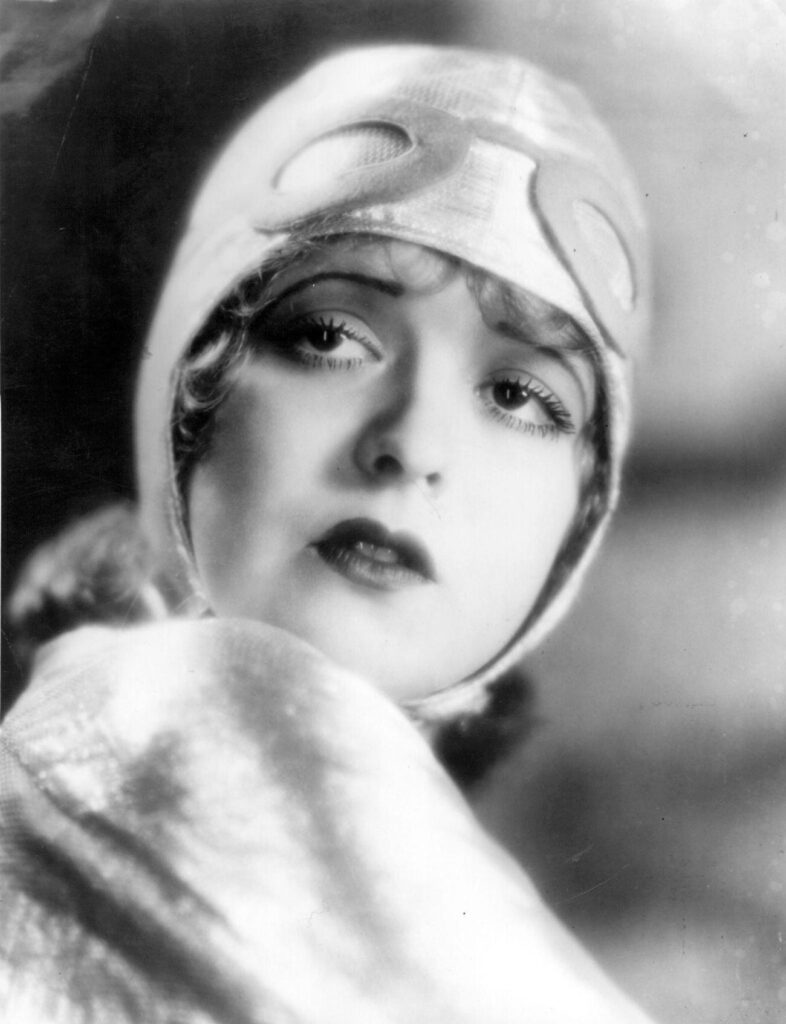
Clara’s battered career survived. She made at least 11 talkies and could have gone on making them because she was only 26 and still popular, but 1933’s “Hoop-La”, a circus story, was her last. Clara retired to a ranch in Nevada with her husband, Rex Bell, who played in “B” westerns. She had two children, attempted suicide at least once, fought mental illness the rest of her life—the diagnosis was schizophrenia—and died more or less a recluse at the age of 60, from a heart attack. And despite what Taylor Swift’s song implies, the star-making machine wasn’t entirely to blame. Life hurts all kinds of people, including stars, and especially if they start out in an impoverished, dysfunctional family with a strong genetic predisposition to mental illness. Somehow, despite all her suffering, one suspects that the billionairess Taylor Swift will come out OK. Her latest album has a song about another It Girl, Elizabeth Taylor. And the mythmaking goes on.
Elinor Glyn, the novelist who came up with the whole idea, wrote, “To have ‘It,’ the fortunate possessor must have that strange magnetism which attracts both sexes. He or she must be entirely unselfconscious and full of self-confidence, indifferent to the effect he or she is producing, and uninfluenced by others. There must be physical attraction, but beauty is unnecessary.” The indifference to effect doesn’t sound like Taylor Swift, but everybody agreed about Clara—she didn’t care what anybody thought of her.
“All in all I guess I’m just Clara Bow,” she writes in her memoir. “And Clara Bow is just what life made her.”