Robert Garnett
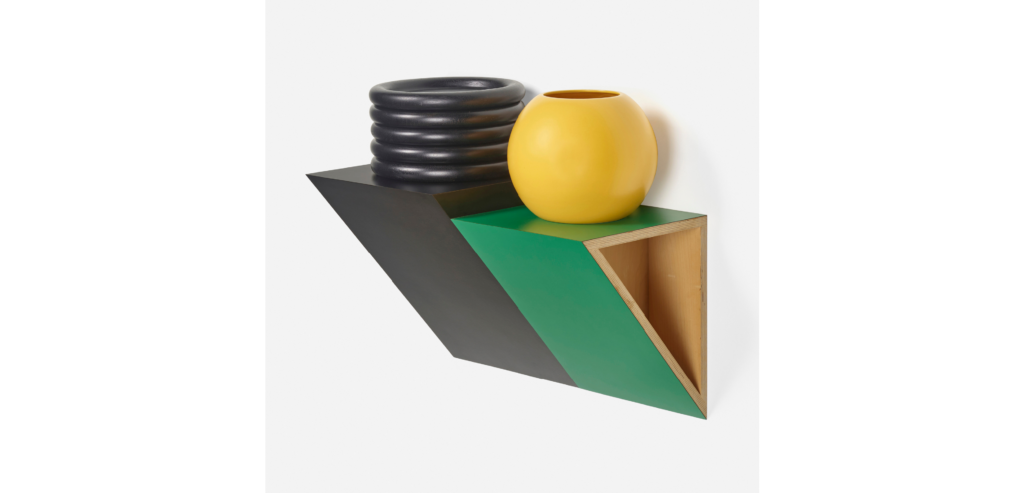
About ten years ago I was taking part in a graduate seminar held in a room at a gallery that was showing a retrospective of the work of the American artist Haim Steinbach. We were all sat in a circle around the artist who was responding to questions from the students. It wasn’t going too well, the atmosphere was a bit stiff and the questions weren’t really that interesting. Most of the students were quite familiar with the work, it being a paradigmatic, almost textbook example of the kind of art we used to call ‘postmodern’ back then. Most of them were familiar with the critical discourse around the work and how it was seen to critically reflect upon the contemporary ‘economy of the object’, ‘exhibition value’ and how it partook of the critique of ‘autonomy’, ‘transcendence’ and ‘originality’. Suddenly, a student got up and walked towards one of the works – a typical Steinbach consisting of a quasi- Donald Judd shelf unit upon which were placed shop- bought commodities. He then started to move some of the carefully arranged objects; he placed one on its side, one upside- down and placed another half over the edge of the shelf. He then asked, ‘how does this change the work?’ Everyone was palpably nonplussed, including the artist. After a while an embarrassed silence gave way to a stilted laughter. A lecturer apologised on behalf of the student and the artist nonetheless went on to answer his question by saying that the altered work would not in any real sense have been transformed; it would just be mis-installed and would therefore not properly represent his intentions. After a few more questions the discussion ended.
On the coach on the way back to London much of the conversation inevitably concerned the student’s intervention earlier in the day. We realised that he’d raised some quite interesting questions. Had the work been transformed? Well, in one sense no, because it was technically still the same in terms of its material constituents and the critical claims that could ostensibly be made for it. In another sense, though, it was transformed in that it looked completely different, looked rather ‘funny’ in comparison with its previous state. The impeccably ‘cool’ ‘ironic’ comportment of the work had been completely undermined by the student’s gesture. We realised he’d made a very good joke. It maybe wasn’t a work of art but it was a joke that reminded one of the similarities between art and the joke.
The student conceded, however, that his action had been quite involuntary. But this only served to remind me of how Freud, when discussing the ‘authorship’ of jokes similarly claimed that they simply ‘occur’ to their author. And this joke lingered in my memory for some time after – unlike a verbal joke that you ‘get’ and then invariably forget until it involuntarily re- occurs to you at a later date. It lingered because it seemed to encapsulate for me a number of the questions and problems presented to me by some of the new art practices that had emerged in the 1990s, particularly in London. One of these was a problem of ‘attitude’; much of this latter work seemed vivid in terms of its demeanour or posture but it was also confounding because one couldn’t precisely work out its critical ‘pre- text’ in the same way in which one could before a piece of ‘discourse- specific’ work from the 1980s, like Steinbach’s was or eventually became. It confounded my sense of what constituted artistic intelligence and at the same time elucidated or uncovered a blind spot in the discussions around art since the ’80s. It showed maybe how superficial we had been in disregarding the surface appearance of a work in favour of its ostensible status as ‘text’.
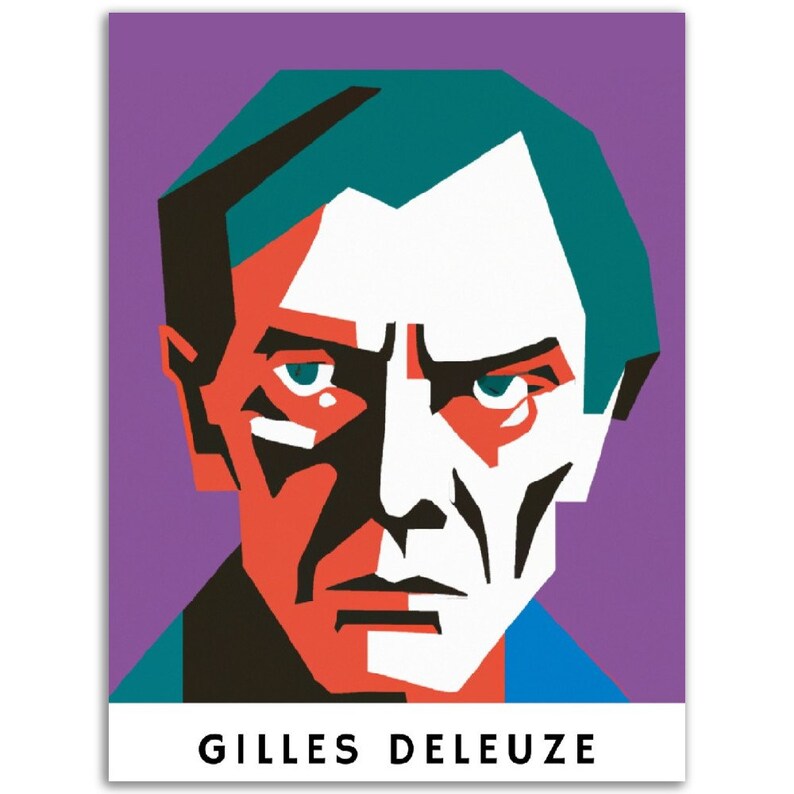
I was later reminded of this joke when I came across Deleuze’s distinction between irony and humour in his book Proust and Signs. Here Deleuze contrasted the way in which ‘irony is always prepared in advance for the encounter’ with the sense-event, whereas humour is the act of being open to the encounter. In humour ‘the intelligence comes after’ the event, the bloc of material affects and percepts, the ‘nonsense’ that constitute the very ‘food for thought’. This is not necessarily a laughing matter, it is more like being placed in a ‘funny’ or ‘preposterous’ situation, like that of the critic encountering a work of art that seems to disable one’s prior criteria for determining the success or failure of a work of art, a work that might only be amenable to sense. This might be a kind of work that is humorous in an ‘abstract’ sense; ‘abstract’ in the way in which Warhol used the term as a studio litmus test for the success or failure of a new work. If a work didn’t add up, didn’t make sense, if it was ‘abstract’, then ‘it might be art’, he used to say.
Humour Noir is the New Black
References to humour currently abound in contemporary art discourse, and it appears that a widespread outbreak of laughter has been underway in recent years that would ostensibly seem to drown out the chorus of melancholy that has prevailed since the gradual demise of the postmodern. This would not be unwelcome were it not for the fact that much of what passes for humour within these discussions functions, I wish to argue, as little more than a perpetual pathos of a refrain of resignation. In Deleuzian terms, I wish to argue, this amounts to irony, rather than a genuinely affirmative humour. A crucial theoretical task is to deconflate irony and humour, in order to foreground the specific city and, indeed, ‘autonomy’ of humour and the distinct ethics and politics of its aesthetic modality. Almost all mainstream artworld and philosophical conceptions of humour are psychoanalytically based, variants of what Deleuze specifically refers to as ‘Oedipus- irony’. ‘Irony rises and subverts, humour descends and perverts’, wrote Foucault of Deleuze. Irony rises to a transcendent Law or Idea and then descends in order to demonstrate its inadequacy to any worldly determinant context. Psychoanalytical (de)sublimation is similarly situated on a vertical, transcendent axis, an ascent to the ‘dignity of das Ding’, the ‘impossible’ Real Thing, that precedes a sublime descent to the abjection of the body and of sexuality.
As one mainstream paradigmatic account of our contemporary tragicomedy goes: The very fact that the comic hero evokes not life’s triumph, but its slipping away, also entails that we are not adequate to the Thing that comedy presents to us. Even as we laugh at and with the comic Thing, it laughs at us, making us look ridiculous. Comedy is the relief that permits no escape from the limited condition of our finitude, the shabby and degenerating state of our upper and lower bodily strata, and it is here that the comic allows the windows to l y open onto our tragic condition.
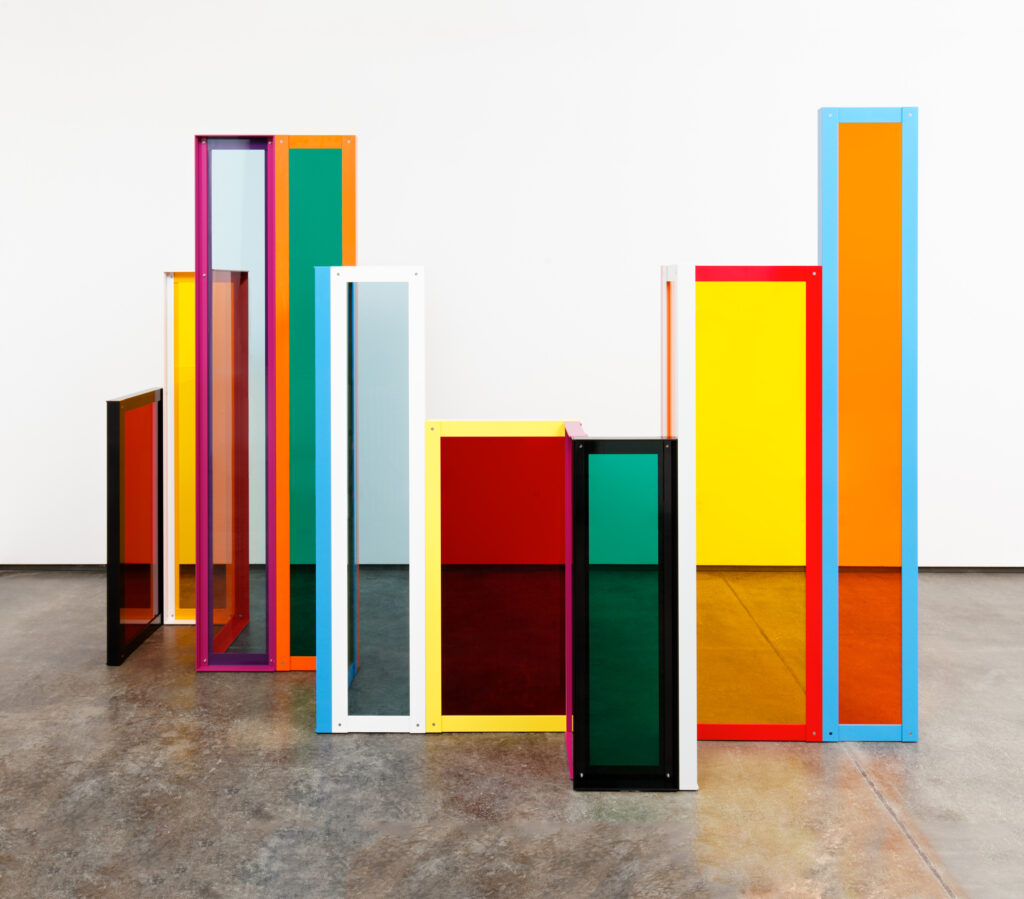
powder-coated aluminium, Plexiglas
That ‘Humour Noir’ is very much the ‘New Black’ is evidenced by the proliferation of art practices that are seen to partake in just such a carnivalesque cartoon Batailleism of the body as abject object – from Mike Kelley to the Chapman Brothers, from Paul McCarthy to Maurizio Cattelan. When read ‘literally’, as they almost always are, these practices display a contemporary obsession with what Deleuze, contra Bataille, referred to as the ‘dirty little secret of sexuality’ that is always, already known in advance. Armed with this foreknowledge, contemporary ‘post- postmodern’ irony always subordinates the saying to the said, always misses the event of the joke, never really gets it, remains detached from the gesture, the qualitative difference that the joke- work produces on and in the utterly superficial depths of its surface. What made the above work vivid, at least to me and my peer group, was not its pre- text but its energising, affective and contagious attitude. Attitude can be seen to be an operative mode of not taking seriously clichéd images of art and the artist, of ‘de- facing’ them. Long before theory, a humorous art ‘senses’ when a problem has become a ‘false problem’, when it has become a ‘critical’ or academic problem.
When a first- order ‘critical’ content can be read straight off the surface a work, it is time to go elsewhere, to create new problems. The ironist, says Deleuze: is someone who discusses principles; he is seeking a first principle, a principle which comes even before the one that was thought to be first. He finds a course even more primary, then he rises. He constantly goes up and down. This is why he proceeds by questioning, he is a man of conversation, of dialogue, he has a particular tone, always of the signifier.
Humour is ‘completely the opposite’, it is ‘completely atonal, absolutely imperceptible, it makes something shoot off. It never goes up or down, it is on the surface: surface effects. Humour is an art of pure events.’ Humour takes one to the Outside of signification; it aims to stop the ‘good conversation’ in its tracks, to confound it in favour of producing new questions: ‘the art of constructing a problem. None of this happens in an interview, a conversation, a discussion’, states Deleuze. Humour is treachery; its agent is the traitor as opposed to the trickster. The trickster plays on words, practices the ironic positionality, of ‘discourse specificity’. The traitor makes gestures, proceeds through Posture as opposed to positionality. One prominent instance of an irony of positionality is that of the British artist Liam Gillick. He is usually associated with ‘Relational Aesthetics’, the most successful curatorial marketing phenomenon of the 1990s. Gillick’s art and parallel writing practice consists of an ongoing process of the referencing of an unproblematically readable series of current critical- curatorial concerns. In his own words, he describes his work as being part of a ‘discursive tendency’ in contemporary art, ‘the key strategy employed by the most dynamic contemporary artists’. This, as he puts it, ‘is an offspring of critical theory and improvised, self-organised structures’. It is ‘self- conscious’ and ‘critical’, is concerned with the ‘movement between subjects without or beyond order’, and constitutes ‘a set of discussions marked by their adherence to one or more models of analytical reason’. Gillick is without doubt a ‘man of conversation’, and his ubiquitous presence on the international circuit of panels and symposia is second to none. And, ‘his tone is definitely that of the signifier’, indeed the constructions he produces are deliberately aesthetically neutered, functioning, as he puts it, as ‘backdrops’ to putatively discursive ‘movement between subjects’. Clement Greenberg once used the term ‘Scene Art’ to refer to a kind of practice that deliberately aligns itself with the prevailing doxa, a kind of art that consists of ‘playing the scene’, that directly appeals to an existing discursive formation, that perfectly ticks all the right curatorial boxes. We might consider Liam Gillick’s work to amount to just such a contemporary Biennale academicism, an always timely art- world professionalism perfectly reconciled with its epoch.
‘Art is One Big Running Joke’ (Martin Kippenberger)
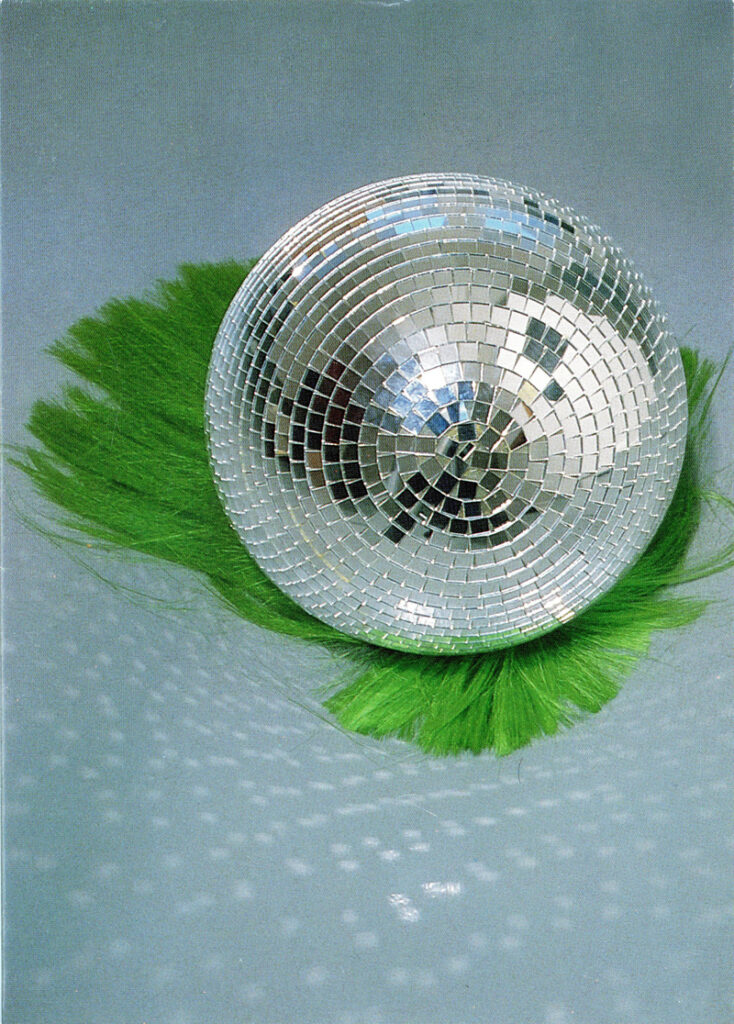
The antithesis of an art that ‘works’ an existing discursive formation is an art that creates its own scene or ‘formation of immanence’. One artist who created a scene wherever he went was Martin Kippenberger. Kippenberger was no more and no less than an attitude, an ongoing series of humorous postures and gestures. His friend and fellow artist Christopher Wool has described his humour as an ‘abstract humour’, that was ‘endless’ and ‘senseless’. Kippenberger’s work never arrived at some dissipative and cathartic punchline, was never aligned on a vertical axis, rising and critically subverting. Rather, his whole oeuvre consisted of a ‘perverse’ and infinite practice of synthetic combination. Take Disco Bomb, of 1989, for example.
A spot-lit dance floor disco ball simply juxtaposed with a fluorescent nylon party wig, the work does no more and no less than harness a surface effect that nonetheless affectively energises the entire space of the gallery, wherever it might be. Like much of his work, it revels in its utter superficiality, while nonetheless creating a spatial- temporal breach in and out of the centre of the art space. Made out of readymade elements, these are not, however, conceived as ‘fragments’ or ‘ruins’; here there is no allegory to decipher. Contrary to the one- dimensional critical appropriation of Steinbach and his ’80s peers, this work partakes in what Deleuze called ‘double theft’ – a stealing and a ‘stealing away’ which produces an excess, an elsewhere in the here and now. It does not partake in the postmodern critique of transcendence; rather Kippenberger’s practice was at all times a future- orientated and affirmative work of ‘un-mourning’. Here, to quote Deleuze, ‘there is nothing to understand; there are only varying levels of humour’. And this was precisely what made Kippenberger such an untimely figure at the height of ’80s ‘discourse fever’. What occurs within his work, to quote Deleuze again, is that ‘we are led back to the surface, where there is no longer anything to denote or even to signify. This is the place where pure sense is produced. It is produced in its essential relation to a third element, this time the nonsense of surface.’ ‘Once again’, he continues, ‘what matters here is to act quickly, what matters is speed’. ‘Witz ist ein Blitz!’, as some of Kippenberger’s German philosophical predecessors used to say. Kippenberger worked at a relentless pace, as evinced by one of his most important works, the Hotel Drawings, the ongoing series of collages and drawings on hotel paper he collected when constantly on the move. Here again there is nothing critically to reconstruct; all one can do, if so disposed, is to go with the l ow of absurd and nonsensical juxtapositions of recurring motifs and phrases. Like Deleuze and Guattari’s ‘Russian Idiot’, however, Kippenberger can be seen to ‘raise the absurd to the highest level of thought’, which, ‘in other words’ they continue, ‘is to create’. Such an affirmative gesture amounts to a kind of extra- rapid thinking that is a kind of thinking, a kind of intelligence, nonetheless. Art Theorist Thierry de Duve has suggested that such gesture- presentations are a means through which ‘art responds to questions yet to be asked’. Art, as in Deleuze, is the process of creating new problems, new questions; it is the task of a differently paced theory to extract the new concepts implied in art’s extra- rapid thought.
However, there are still no really satisfactory art- theoretical readings of Kippenberger’s work simply because theory doesn’t get that there’s nothing in the first instance to theorise, that, initially, the work might only be amenable to sense, to one’s ‘sense of humour’. But this is precisely what Art Theory still lacks, and is largely the cause of the much- discussed ‘crisis in criticism’. It is my argument here that Deleuze’s humorous aesthetics can help us to account for the singular intelligence of not only Kippenberger, but a large part of a generation of artists who have fallen under the radar of the dominant October journal- style ‘serious’ art theory since the 1990s. One could mention artists such as Kippenberger’s colleague and collaborator, Albert Oehlen, other major figures such as Franz West, Pipilotti Rist, Jeff Koons, and not least the YBA phenomenon in London. But I wish to further suggest that there remain obstacles to this, and some of these exist in Deleuze’s own writing, particularly his writing on art. Also problematic is Deleuze and Guattari’s singular, but now rather dated philosophical rhetoric that is reiterated in the secondary literature. The Francis Bacon book is a main case in point here, and one could argue that this more than anything else has prevented or at least stymied the proper deployment of Deleuzian ideas in relation to contemporary art. The vital fact here is that we cannot in the twenty- first century believe in art in the same way that Bacon did. We cannot believe in Bacon’s ‘cry’ anymore – and after the joke-event of Duchamp and Dada it is arguable as to whether it was believable in the first place. Art can’t shock and traumatise us in the same way anymore; art’s affectivity and effectivity is today of a different and more ‘preposterously’ humorous order.
Bringing the Event Down to Earth
And this is where the joke comes in. A Deleuzian rethinking of the joke, or of art as a joke, offers, I wish to suggest, a means of bringing Deleuze’s conception of the humorous art of the Event- encounter a bit more down to earth, so to speak; it offers a way of bringing his thought a bit closer to the art of today. According to Paolo Virno, ‘there exists no attempt as significant as Freud’s to distil a detailed taxonomy, botanical, so to speak, of the various kinds of jokes’. Freud sharply distinguishes between the joke- work and the species of the comic on the basis that the joke is a counter- repressive, counter- narcissistic operation that opens onto the radical alterity, the radical otherness or nonsense of the unconscious; comedy is a function of pre- conscious thought, or thought that can be represented to consciousness. Both modalities, however, are ‘methods’, writes Freud, ‘of obtaining a yield of pleasure through an economy in psychic expenditure’, a principle that forms the basis of Freud’s ‘relief theory’ of humour. They are processes through which one economises on an anticipated expenditure of psychic energy which is interrupted in its nascent state by the effect of humour, the comic object or the joke; energy which is then rendered surplus and expelled in the form of pleasurable laughter- discharge.
A key distinction, however, remains the fact that the comic requires only two protagonists at most, whereas the joke is a collective process. Comedy requires only the witness and comic object to complete its course; humour, or humour-noir, is conducted at the expense of the bodily self as abject object; and the prerequisite of the process of irony is the addressee of the sarcastic remark. The joke, however, has a quite different structure. Freud states, ‘jokes are the most social of all psychical processes that aim at producing a yield of pleasure’. Whereas comedy is produced at the expense of another – hence its ‘superiority’ and ‘exclusivity’ – the joke is a product of a pact. ‘Laughter is among the highly infectious expressions of psychical states’, Freud states, and ‘when I make the other person laugh by telling him my joke, I am actually making use of him to arouse my own laughter’. Freud is implying that one cannot tell a joke to oneself; the joke is always directed towards an addressee. This third listener then functions, firstly, to ‘provide objective proof of the joke’s success’; secondly, to complete my own pleasure by a reaction of the other person upon myself; and thirdly – where it is a question of repeating a joke that one has not produced oneself – to make up for the loss of pleasure owing to the joke’s lack of novelty. In turn, ‘the third listener invariably feels compelled to repeat the joke to another person’, thus creating a collective-comic chain of reaction – a kind of ‘existential refrain’. These distinctions, along with Freud’s insistence upon the ‘recentness’ of the joke that is essential to its operation – the fact that it has to be new to be successful – are precisely those dimensions of he joke- work that, after they have been subjected to a ‘Schizoanalytic remodelisation’, seem to me to be strikingly suggestive in the ways in which they might be considered within the context of contemporary art.
Freud deploys the metaphor of a seduction scene to describe the structure of the joke-work. It is initially a failed seduction attempt. An exhibitionistically inclined boy spots a girl, and moves in by making a smutty remark in order to elicit her sexual arousal. In walks another man. Game over. For now. There’s no chance of the seduction attempt continuing in the presence of the rival, who stands in the position of the Paternal bar, the Law or Father’s ‘No’, who is Freud’s ‘third listener’. A joke ‘occurs’ to the first boy, the teller, and what happens now is that the rival begins to assume the position of the second person, the ‘You’, and finds himself the addressee of the joke, seduced in turn and lured into being a protagonist in a joke scene. This is potentially a very risky situation because the teller puts himself on the line, the joker risks total humiliation, or as comedians put it, risks ‘dying on stage’ before every performance. This is, of course, completely absent from a knowing irony. If the joke comes off, however, the addressee laughs at the punch line, and in the process of getting ‘it’ the Father is disarmed, displaced, and the Law becomes not transgressed or subverted but literally perverted or ‘Pere-verted’. With this switch of position, the Law is in effect suspended, as is the desired object. As in Deleuze’s conception of the masochistic scenario, here is a situation suspended between the ideal and the reality principle. And the game is still not over, because the listener is immediately compelled to repeat the joke to another, ‘fourth’ party – he, in effect, then takes the place of the teller. Freud however, could not build upon the politicality of the joke aesthetic; he ironises it away by tying it to the logos and telos of repression and pleasure- discharge. Nevertheless, we can productively reclaim the joke- work from psychoanalysis in order to conceive of a specific kind of slow- release art joke as a perversely intensive movement of becoming – a kind of abstract humour. What Freud, in effect, creates here is a perfect instance of an affective formation- encounter as collective individuation. The ego of each participant in the joke- scene- event is undone, is dissolved by its intensive suspense- affect; the inter- subjective ‘abstract machine’ breaks down as a residual line of l ight is opened onto an Outside. This constitutes a becoming- Other, that, as Deleuze puts it, ‘spills over and beyond whoever lives through it (thereby becoming someone else)’. This ‘someone else’ is an instance par excellence of what Deleuze referred to as the ’4th- Personal’, the singularity of ‘free- indirect discourse’. When the joke ‘passes through’ via the ‘repetition compulsion’ of the Third- listener, it creates a bifurcation, it contagiously spreads out to form an affective or ‘magnetic’ forcefield, map, diagram or phylum. What passes through is the continuous, infinite – flow, the material flux of the joke- affect. As Martin Kippenberger put it: art is precisely like ‘one big running joke’.
All this takes place in the here and now, or the ‘erewhon’. And we can also think of this in more down- to- earth terms as constituting the kind of virtual–actual ‘buzz’ or ‘vibe’, that ‘something in the air- ness’, which is constitutive of the energetic intensity of a ‘scene’ in its becoming. The performative ‘making’ of a scene provides a distinctive way of thinking Guattari’s ‘existential refrain’, and this whole repetitive movement of the ‘ritornello’ is of course nothing like Freud’s ‘Fort-Da’ repetition of (de-) sublimation, the perpetual ascent and descent on a vertical, transcendent axis. ‘What counts in desire’, writes Deleuze, ‘is not the false alternative between Law and spontaneity, it is the respective play of territorialities, re-territorialisations and movements of deterritorialisation’. Crucially, he further argues, ‘this has nothing to do with pleasure and its festivals’, and it is here that Deleuze enables us to deconflate humour from another oft- cited theoretical resource within current discussions of comedy: the irony of the spontaneous pleasure- discharge of Bakhtin’s Carnivalesque conception of the comic. Deleuze agues that desire pertains to joy, which is ‘the immanent process of desire which fills itself up, the continuum of intensities, which replace both the law-authority and the pleasure discharge’. Becoming- Child is forestalled by the momentary discharge, after which we all grow up and resign ourselves to the Oedipal Law; similarly; when the carnival is over we all soon find ourselves back in our places within the prevailing social hierarchy. It is precisely ‘the relief that permits no escape’ mentioned earlier.
The same writer contends that ‘the comic opens onto the It, the es, id’, which is the impossible Real Thing . To Deleuze, however, It is positivised; It has no logos or telos, It is precisely the going for It, that is prior to any Law and its negation- transgression. ‘Let’s go for It, It’ll be a laugh.’ This is not the momentary dissipative discharge of laughter- pleasure, but the sustained intensity of the making of a scene that is nothing like a Law- sanctioned carnival. What makes a scene is attitude as an affirmation of possibility, which is ‘the production of an unconscious as a social and political space to be conquered’, ‘the construction of a collective machine assemblage as well as an expressive cause of utterance’. It happens, the joke occurs to its mechanic- author as a kind of ‘quasicausal’ auto- production of desire that directly penetrates the social field. It is an event made out of the here and now that trans- forms the here and now.
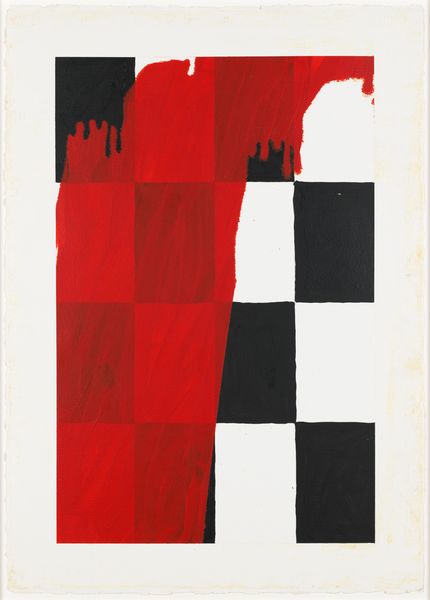
2005
It is unwritten right across the surface of a work; ‘humour is the art of the surface’. Humour is inclusive, ‘superior irony’ is exclusive. The joke is empathetically addressed to a ‘you’. Detached irony is addressed to a ‘them’. You can’t tell a joke to a ‘them’. The ‘third’ as touchstone is undone by the ‘subjectless action’ of the joke- work that constitutes a relationality without relation, that exceeds the oxymoron that is a ‘Relational Aesthetics’. Sometime during the mid- ’90s I was standing in the middle of a gallery in front of a painting entitled Gorgeous Beautiful Kiss My Fucking Ass Painting. I was with a friend, and we both looked at each other as if to say, ‘You can’t argue with this, this just works.’ It was an abstract painting made by Damien Hirst – just before his burnout and descent into super- lucrative self- parody – one of his Spin Paintings. It was made by pouring paint onto a rapidly revolving turntable; a simple method that nonetheless produced what was for us a rather incredible effect. It was, as its title more than suggests, brazenly affirmative. This was odd, was very funny at the time, because it was doing everything that intelligent art was not supposed to do. But this was also what seemed to make it work. It had a right kind of wrongness. Serious painting was supposed to be about painting; one was supposed to proceed at one critical remove. This, though, was empathetic in its mode of address – to say the least. It was addressed to a you; in other words it was not ironic. But it did not at all seem to hark back to any kind of authenticity either; it did not seem to be the expression of the interiority of a sovereign ‘I’. But neither did it seem to be like previous kinds of expressive modern abstract art; it did not seem sublime in the sense of Barnett Newman’s ‘One’; it did not seem to purport to open onto or elevate onto some transcendent void. It was none of these things.
It was around this time that similar kinds of abstract art, such as Albert Oehlen’s ‘Post- Non-Figurative painting’, as he calls it, began to make sense. Then there was work like Mary Heilmann’s abstraction, Wolfgang Tillmans’ abstract photographs, Ugo Rondinone’s Target Paintings. They all seemed of now, and curiously expressive or renderings visible of very similar sensations that good popular music renders sonic. The painting seemed to be expressive in a quite impersonal way of the kind of intensive energy that one sensed was ‘happening’, was ‘in the air’ in London at the time. A kind of energetic intensity similar maybe to what Georg Simmel used to call the Geist of the City, that does not however, precede or exist outside of its expression in art, in music. What gradually became palpable was that this intensity is humour, the electricity that generates and sustains the assemblage. Assemblages, as Deleuze insisted, are constructions of desire on a plane that makes them possible; and all assemblages are collective, ‘every desire is the affair of a people, an affair of the masses, a molecular affair’. Ultimately, ‘the construction of a plane is a politics’. Art as politics? One big joke.