
Mushrooms, Threads and Gondola, On renewal, ruin and soft resistance along the Sussex coast, Unit 2 Gallery, St Leonards-on-Sea, June 2025
David Goldenberg

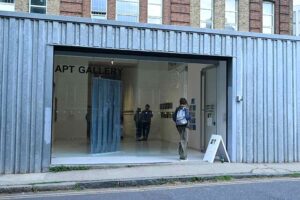
The former vintage shop on London Road, became the incubating capsule for Mushrooms, Threads, and Gondola, a solo exhibition by artist Huan Wang, curated by Haoyue Chen. Both from China, who had a residency in Orkney, Scotland, and shared the same memories of Venice. The show shaped the seaside gallery as a porous structure that absorbs traces of its past life, with the lingering moisture from the basement, uneven light from the street, and salt carried in by the wind. Rather than treating the site as a neutral canvas, the artist and curator turned it into a responsive surface where material, place, and narrative flow into one another. Visitors are guided through the space on a circular route, beginning with light and ending in shadow, as they float on a journey mirroring the movement of the tide and time outside the gallery.
The Light Room
Here, exquisite objects hang from transparent fishing line, catching glimmers of sunlight slipping through the windows. The works formed a spiral circle staircase, vibrating and hovering above the remains of an abandoned set of gilding wheels spotted from a local charity shop, with their sharp metallic edges encircled by a thin trace of coffee grounds collected from coffee shops on the high street. The circle marks both a boundary and a rhythm, persuading visitors’ movements while keeping a safe distance from the suspended works. This quiet choreography of balance, between the delicate and the industrial, the floating and the grounded, gives the room its pulse.
Wooden panels, discovered from the gallery’s storeroom, were stapled together and placed on the floor to construct a travelling ‘boat’. Based on Huan’s residency in Orkney, rather than simply imitating its layered coastal formations, the ‘boat’ evokes the geological rhythm of the rocks from which Huan gathered materials. On top of the ‘boat’, the seaweed and shell-based artworks, reconstituted from natural remnants, echo the condition of objects washed ashore, neither fully alive nor entirely inert. The installation reawakens the living memory of those coasts, drawing the vitality of the original site into the present gallery space. At the centre of the back wall, as part of the Brown Incubation series, Set Off, sits on a disguised dehumidifier, covered by a cloth to form a textile-based plinth. This work is another form of loom and shuttle, creating invisible movements for the possibility of weaving in space, resonating with the ‘boat’ drifting by.
After finishing the circular route, alongside the Smouldering Bird, a cloth once hung in the River Thames blocks the way into the dark room. Visitors are encouraged by the sign on the side to unpack the mysterious water box ahead. The fabric marks a transition from brightness to reflection, its water-stained surface carrying the residue of flow.
Inside, the wall becomes the stage for flickering shadows, expanding the virtual occupation of the artworks towards the room itself. A beam of torchlight projects the small objects onto the wall, where their outlines grow larger, almost spectral, just like echoes of the thoughts and emotions that lie behind the works of He Said. There is also an old garage gate with metal strips left in the dark room to form a gap where Lug for Leaving London is projected onto a suspended cloth, with paddles found on the beach. On the other side, Make Sail is projected on the gate; the flow in the work synchronises with the flow of the strips. The audience drifts through these intervals of light and darkness, tracing invisible currents beyond the gallery walls. In another darker and quieter section on the right, Coffee Break and Delicious Peatland are embedded with the coffee grounds in the bag. There are also names of the donors written on the fabric bag, adding an intimacy of exchange and locality to the exhibition.
What makes Mushrooms, Threads, and Gondola distinct is not its use of found materials, but the way it repositions ‘ruins’ as sites of coexistence rather than loss. Coffee waste, discarded wood, and fishing lines, are not treated as symbols of decay, but as agents of continuity, carrying local stories, gestures of care, and small acts of giving. The exhibition’s rhythm feels tidal: moments of density give way to openness, allowing the works to breathe with the space, just like mushrooms surviving under the concrete societal realities, like us afloat in the undercurrent of contemporary precarity.
At the end of the exhibition, a single piece of cloth reads ‘END’. Yet in the printed exhibition statement, the word appears as ‘END?’.
The contrast between the two versions, the declarative in space, the questioning on paper, opens a loop rather than closing a narrative. It creates a perceptual echo that unsettles closure itself. The show ends twice, and neither feels final. One asks, the other asserts; together, they articulate the exhibition’s underlying tension between flow and fixity, between the urge to finish and the persistence of return.
Mushrooms, Threads, and Gondola closes not with an answer but with a kind of persistence. Like the mushrooms in Anna Tsing’s writing, it grows quietly in the ruins, absorbing what remains, transforming what has been left behind. Within its curatorial and artistic dialogue, this persistence becomes a gesture of renewal, a reminder that even amid collapse, art can still locate its breath and tide.
Unuit 2.