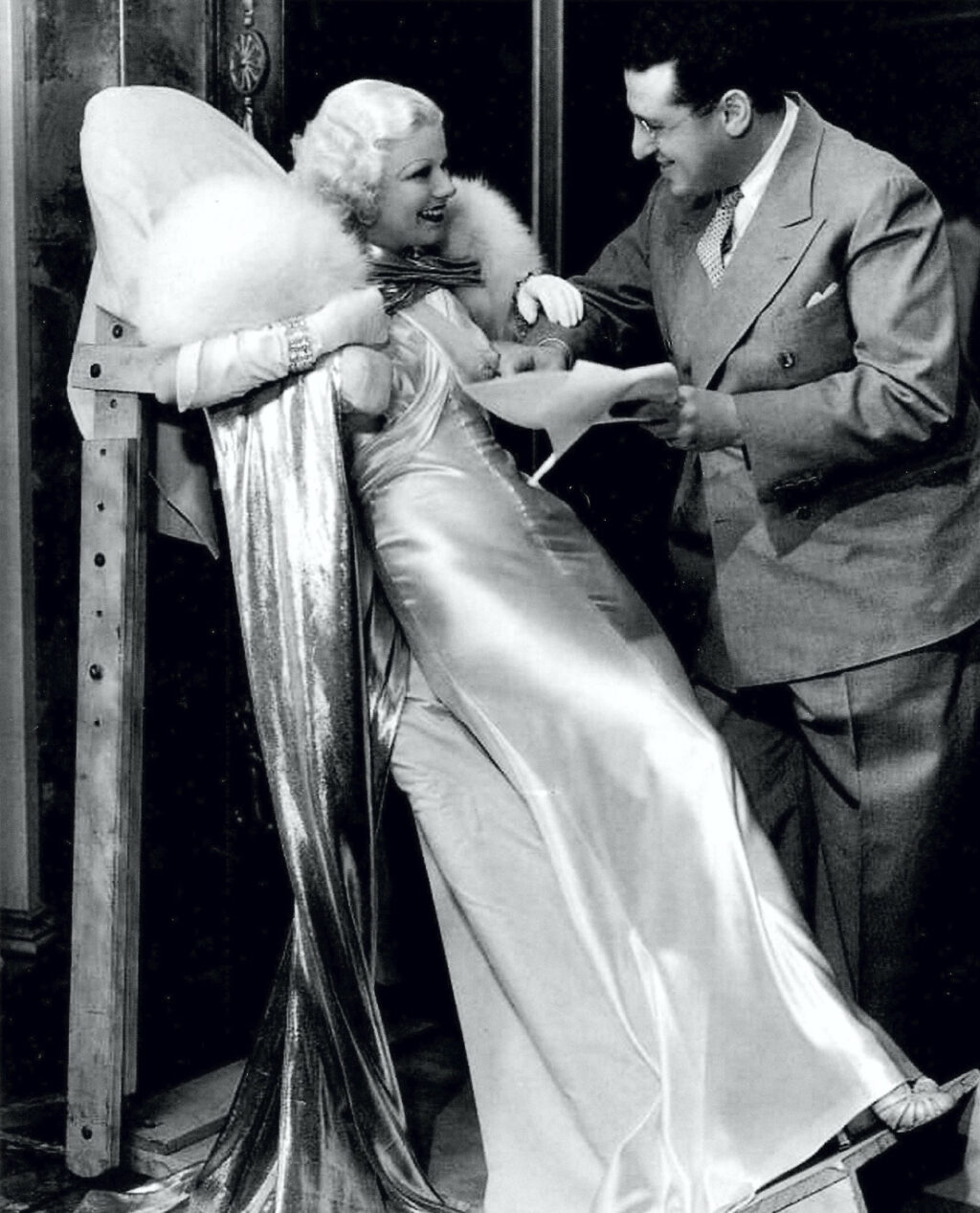
Cukor enjoyed shooting Dinner at Eight on a remarkably brisk schedule with his stellar cast. He posed with script pages and Harlow as she reclined on a slant board between takes to keep her satin dress clinging. Source: MGM.
Scott Sublett
As an auteur, the illustrious George Cukor, known for Dinner at Eight, The Philadelphia Story, Adam’s Rib, Gaslight, and My Fair Lady, more than 50 films in all, had at least two strikes against him. First, he was queer, and even though it was all very don’t-ask-don’t-tell, everyone knew it, and so there was the inevitable condescension and snickering. Cukor was famously labeled ‘a women’s director’ because of his skill in guiding female star performances in what were then called ‘women’s pictures. At the time, women ruled the box office, especially where Cukor was based, Metro-Goldwyn-Mayer, the most star-driven of the studios, and the ability to display Norma Shearer and Joan Crawford to good effect was indispensable, but queers were still queers. Cukor was directing the ultimate women’s picture (and the biggest movie in film history), Gone with the Wind, when Clark Gable (Rhett Butler), fearing that Cukor was throwing the picture to Vivien Leigh and Olivia de Havilland (Scarlett and Melanie), one day announced on the set, loudly, “I can’t go on with this picture! I won’t be directed by a fairy! I have to work with a real man!” Scarlett and Melanie, still in their black mourning clothes from the Atlanta bazaar scene, pleaded vainly with David O. Selznick to keep Cukor, but the star otherwise known as ‘the King of Hollywood’ had spoken. Rumors flew that Cukor knew things about Gable’s past that made Gable nervy, but Cukor, the soul of discretion, bowed out stylishly, and even after he was off the picture, because he was an artist and he cared, worked with de Havilland and Leigh in secret. Not until principal photography was over did each know he was working with the other and in a sense still directing the movie. Both would get Oscar nominations and Leigh would win Best Actress. In later years, when he heard about directors being fired from projects, he made a point of calling them up and telling them it would all be OK, and Cukor should know.
Ironically, the second strike against Cukor was that, because he had come out of theatre and had himself been an actor, his superpower was eliciting performance. When you ask a layperson, “What did you like about that movie,” they say, “Oh, the acting,” but the straight, male critical establishment has tended to exalt distinctive visual style as the mark of a true auteur. Cukor was deeply appreciated by certain critics, notably François Truffaut, but working with actors wasn’t as respected as having a recognizable way with a camera. Cukor did have certain visual trademarks – for example, long takes that gave the actors room to act, and deft close-ups – but even those were connected with performance, and the look of his work was not as distinct as, say, a John Ford or an Orson Welles. In fact, Cukor consciously, intentionally preferred visual style that didn’t call attention to itself and felt, rather self-effacingly, that his influence on the pictures was primarily something that he did through the actors. Furthermore, known for literary adaptations, his mission was to serve the text, not improve a masterpiece. His touch was light. There are those who adapt literature by doing little more than transcribing. That wasn’t Cukor. Carefully respectful of his literary source material, with the utmost delicacy he made novels and plays fully “cinematic” while altering them as little as possible. Again: self-effacing. But the subtlety of his alchemy worked against his getting the credit he deserved for the consistent quality of his films. Of course, screenwriters loved him because his respect for good writing made him disapprove of improvisation.
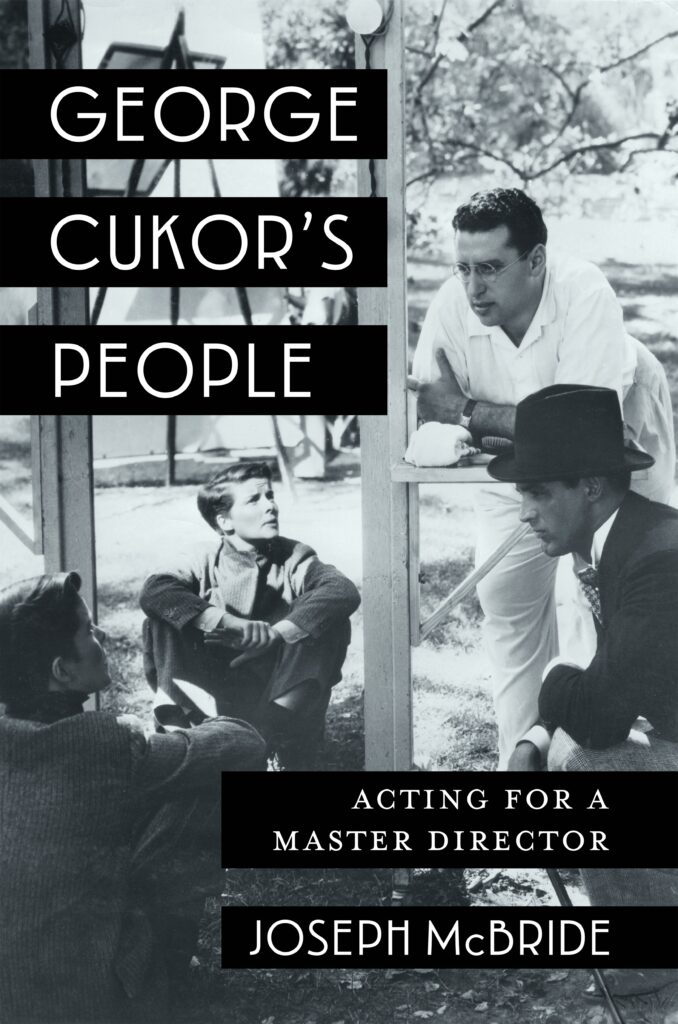
The vastly knowledgeable and wildly prolific film scholar Joseph McBride clearly understands that Cukor’s virtues are unfashionable, and he’s having none of it in his warmly sympathetic critical survey of the underrated auteur’s oeuvre: George Cukor’s People: Acting for a Master Director (Columbia University Press, 518 pages). So much of what Cukor did disappears because of his humility and the invisibility of his style. The fact that he expressed his vision through his actors, and that his stylistic virtues and habits are things that are hard to talk about make Cukor harder to praise and justify. How do you talk about ‘pace,’ which is a moment-by-moment and rather intuitive thing for which there exists little descriptive vocabulary? How do you talk about taste? About the minute adjustments that make a moment cinematic, yet retain the flavors of the text? And how do you talk about the directing of actors? Examining Cukor’s relationships with actors is where McBride’s research pays off, but readers wanting a step-by-step guide to getting your actor an Oscar (after William Wyler and Elia Kazan, Cukor’s films won more acting Oscars than anybody else’s), might be a little frustrated. Cukor’s methods were often as indirect, multifarious and even self-contradictory as was his personality.
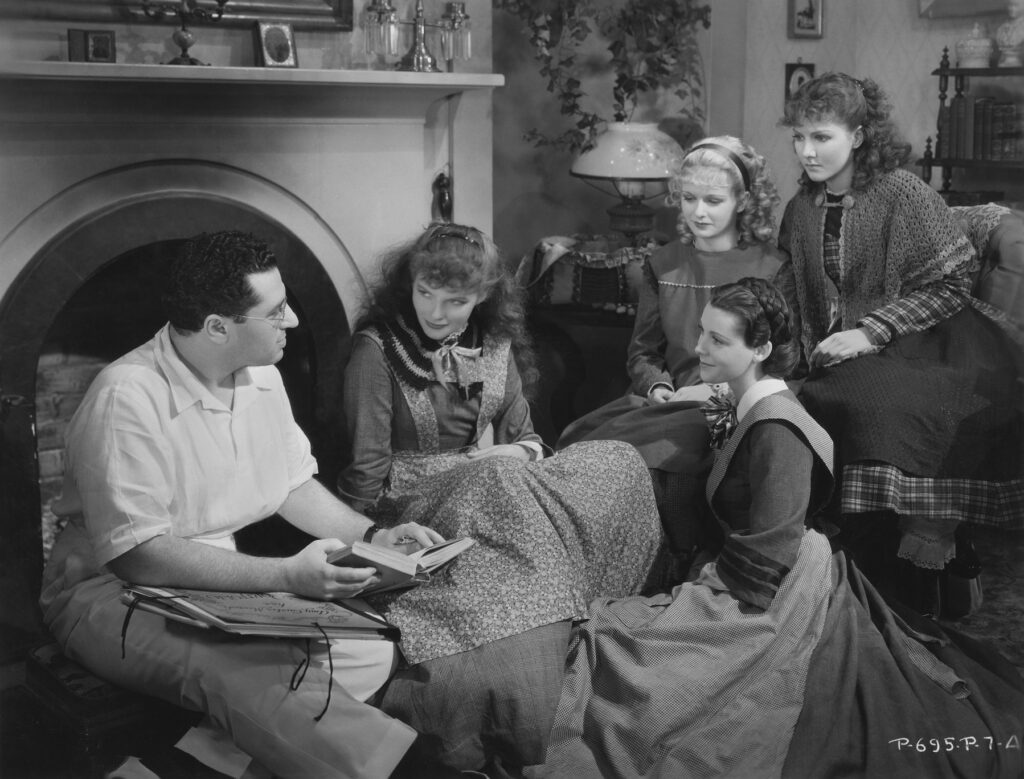
Source: From RKO Radio Pictures photographs of the Margaret Herrick Library, Academy of Motion Picture Arts and Sciences
The foundation of his approach was to create a supportive climate on his sets, where actors could feel relaxed and safe enough to take chances and do their best work. For Cukor, they usually did and, “Then you say, ‘That’s it, you’ve got it.’” That sounds obvious, but when it came to talking to the actors there were great auteurs who got what they wanted by brutally humiliating actors before the whole crew (John Ford comes to mind, and Otto Preminger). Then there were others, like Sam Wood, whose only direction to the actor was pretty much: “Action!” Cukor gave a lot of feedback. And like most good directors in film and theatre, had the wisdom to deliver direction to actors in a private whisper. The problem McBride faced in making us understand how Cukor worked was that private whispers are hard to document. Trickiest of all, how do you generalize about a given director’s way of directing actors when there’s nothing general about the process. The privately whispered instructions are, of necessity, unique to each individual performer, and moreover, particular to every individual scene in each movie. One must understand not just this material, but also this performer. The New York stage director Christopher Scott once said about working with actors, “I have to figure out who I need to be for each actor. Your mommy? Your boss? Your lover?” Cukor knew that, made it personal and tailored his direction to the individual.
He would sometimes give very precise instructions on how the line should be said, but claimed he didn’t do it with first-rate actors. He said he seldom gave actors line readings – actually speaking the line with the inflections one wants from the actor, which nowadays is widely considered rather rude – but sometimes he did with beginners. Mostly – he talked and talked. To illustrate Cukor’s method, McBride points to a scene in Cukor’s 1932 film What Price Hollywood in which the director ‘guides [an actor] through a rehearsal the way Cukor likes to do it, with a steady stream of chattering commentary, alternating diplomatic suggestion and authoritative sarcasm.’ One thing Cukor did, at least early in his career, was to sarcastically caricature a poor line reading in a way the actor would not forget. McBride quotes Ingrid Bergman, who won an Oscar starring for Cukor in Gaslight (the movie that later inspired the now-ubiquitous psychological term ‘gaslighting’) as saying, ‘Cukor explains everything in such detail that sometimes you feel like saying, ‘Please don’t say any more because my mind is so full of explanations.’ I used to tease him by saying if it were a little line like ‘Have a cup of tea,’ he would say what kind of cup it was and what kind of tea it was until you got so worried you couldn’t say the line.’
Jean Simmons, who was quite young but also experienced when Cukor directed her in The Actress, contrasted his direction of her and Spencer Tracy, who played her father: “I had to totally rely on George Cukor, who was so funny because he would get up and play my character – and it was oh so much better than I could possibly do…George would say, ‘This is how you do it.’ And then he would go up to Spence – and they were great friends – and start to do it and Spencer would just walk away. He’d say, ‘Shut up, George.’’ If some of all this sounds contradictory – —don’t give line readings, yet ‘do it this way’ – it’s because directing actors is an individual, in-the-moment thing and there are no rules except when there are.
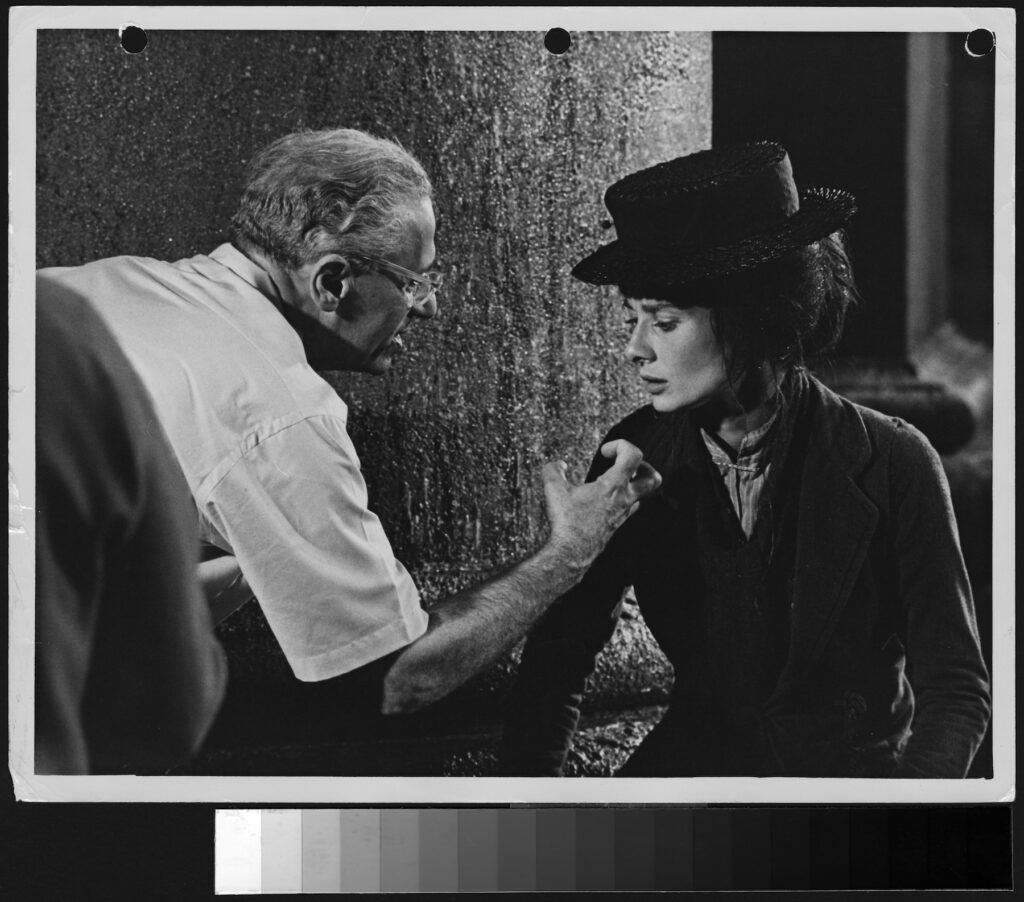
From the George Cukor Papers of the Margaret Herrick Library, Academy of Motion Picture Arts and Sciences.
Cukor also said that the actor on a film set, unlike one in the theatre, had no audience, so the director has to be the audience for the performance. Apparently, he was sometimes so involved with his actor’s performance that he would almost perform it alongside them as he watched, his homely face contorting in ways that Garbo found distracting. She asked him please to situate himself so she couldn’t see him. But in Camille, he elicited from her perhaps her greatest performance of the sound era, because with Cukor, according to producer Irving Thalberg, she let down her guard. Cukor knew how to emphasize an actor’s best qualities, for example with Garbo the ‘hypnotic stare’ that had made her a star in silent film and worked so well in close-up. He understood that being a star was far from incompatible with being an actor and in fact had little regard for the disguises, accents and radical transformations that get Oscars.
Apart from his facility with actors, acknowledged by everyone, Cukor was not the ‘impersonal craftsman’ his auteurist detractors would have. McBride points out recurring themes and motifs in his work, for example, how performing in theatricalized spaces (for example the courtroom in Adam’s Rib and just about everything in My Fair Lady) could illuminate and change character; the glory and nobility of being a dreamer (Holiday, It Should Happen to You, A Star Is Born) and, though not a big drinker himself, his films were sometimes nonjudgmentally insightful about the seductions and pleasures of alcohol. As for visual style, the long, unbroken takes that support performance are easy to notice. McBride gives examples, perhaps the greatest being Garland’s number The Man That Got Away in A Star is Born (a scene sometimes available on YouTube).
Long takes necessitate more elaborate blocking than scenes stitched together out of many discrete shots, where the movement is in the editing. You might think, having directed in the theatre, he’d just transfer that skill, but in fact he felt blocking was even more important in film because in movies you have to keep people moving (which is one of the reasons his adaptations of plays were so cinematic): “You see, on the stage, they did not have much movement. People sat on the stage, and then got up and crossed or made arbitrary movements so that it wasn’t static. I felt that in movies you had to have much more real movement.” Motivated movement. Richly detailed movement. He preferred conversation in a two shot, as opposed to cutting back and forth between over-the-shoulder shots, and in those scenes you can see the care he took to keep things lively. Then there was his pacing – not rushed, dictated by performance, worked out in rehearsals of those long takes – but hard to put one’s finger on. He was also a dexterous master of tonal shift, for example from drama to comedy, particularly in Dinner at Eight, A Star is Born, a “It Should Happen to You. In that, again, the lightness of his touch was evident.
But as skilful and pleasing as his films were, they could never express the whole George Cukor. He was a Hollywood insider, deeply embedded in the system, but being queer made him an outsider, too, and it’s revealing to see him in that light because his queer sensibility was there but not there. It’s also interesting that, compared to other art forms, where queer people are, if anything, over-represented – and that very much includes acting – in film directing, they were historically underrepresented. Few other great auteurs have been queer. There was Vincente Minnelli, but he was snugly closeted with Judy Garland as his wedded wife and unwitting beard. Then there was Dorothy Arzner, who invented the boom mic for Clara Bow, directed Katharine Hepburn in her 1933 film debut as an intrepid aviatrix (Christopher Strong), lived openly with a woman, and dressed, more or less, as a man. It’s hard to say if Arzner’s career fizzled because she was queer or merely because she was a woman. Finally, one of the greatest auteurs of the silent era was Nosferatu director F.W. Murnau, but he was foreign and died young in a car crash, which is what Americans want from their queers: exoticism and tragic demise. None of them did, or could, explicitly express queerness on the screen. Cukor perhaps came closest to doing that in Sylvia Scarlett” (1935), starring Katharine Hepburn. Though she dabbled in heterosexuality, Kate was a lesbian (for more on that, see Kate: The Woman Who Was Hepburn by William J. Mann), and she was the performer most associated with Cukor. He directed her ten times and was instrumental in fashioning her star image. Sylvia Scarlett was their weirdest movie: part romantic comedy, part picaresque adventure, and part gender-bending farce, with Hepburn as a girl dressed as a boy, getting attention from both sexes, and starting a theatre company called the Pink Pierrots with a cockney-accented Cary Grant. It was a colossal bomb, and Cukor never again allowed his queer sensibility to be so literally on display. Hepburn, too, learned her lesson, or would, later in the decade, when she was labelled ‘poison at the box office,’ and realized that for America to love her again her feistily independent star persona had to submit to the authority of a man in the last reel, which is exactly what happened when Cukor directed her and Grant in The Philadelphia Story (1940), which revived her career and reaped six Oscar nominations.
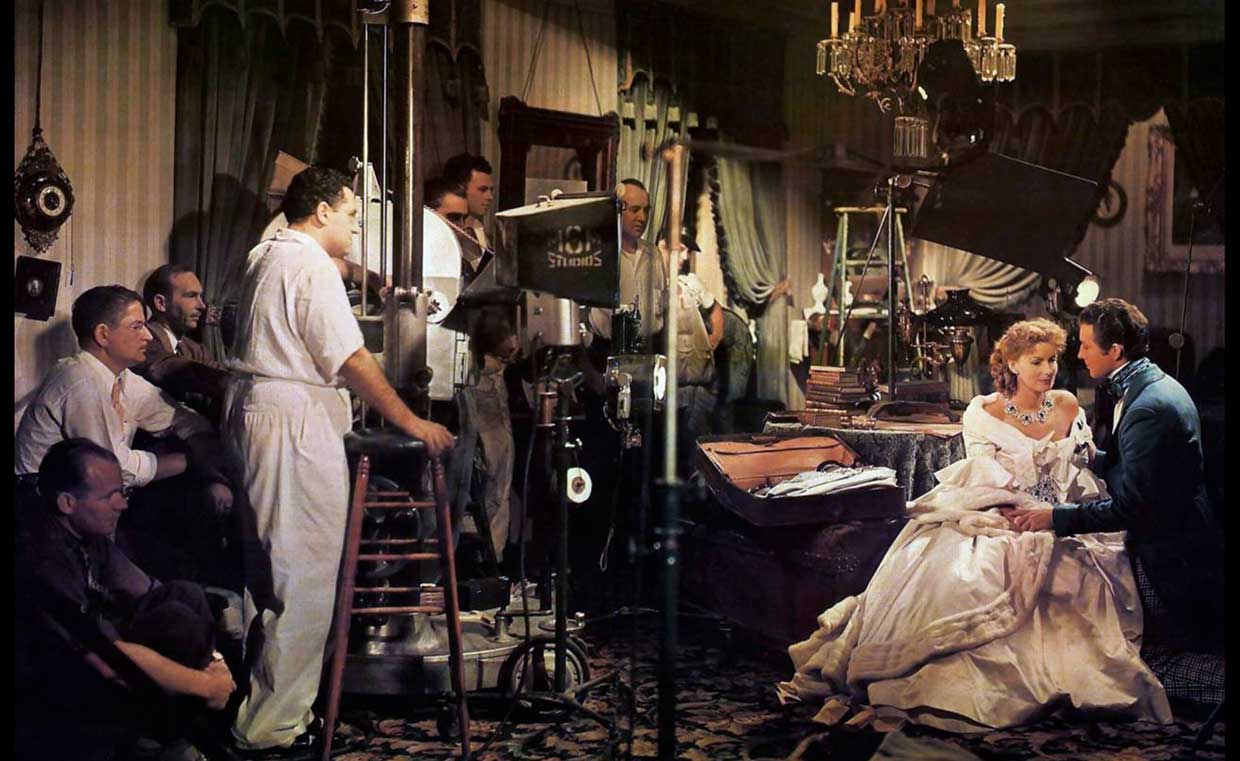
The acting team Cukor was most associated with as a director was Hepburn and Spencer Tracy, and it’s more and more accepted that Tracy was in fact a tormented closet homosexual (see Spencer Tracy: A Biography by James Curtis) and the ‘doomed love’ with Hepburn was a myth. The convenient justification for their secret affair, which all of America somehow conveniently knew about, was he supposedly couldn’t divorce his wife and marry Hepburn because he was so darned Catholic. It was really a friendship and very lucrative professional partnership. They made nine movies together, with Cukor directing four of them and carefully shaping their image. Especially in Adam’s Rib (1949) and Pat and Mike (1952), America’s favorite romantic screen couple were seen working out marriages of equality. That was not a bad thing, and maybe Cukor’s queerness had something to do with his equitable attitude toward the battle of the sexes. But that’s not the same as telling queer stories. The self-effacing director who served the text and the performer was forced to efface – erase – his queerness and therefore one of the deepest parts of himself from his work. Except, of course, for the spirit of queerness that suffused all of it.