(DN): Polly thank you very much for talking with me today
Polly Westlake (PW)W: sure
DN: So, I’ve been to St Jude’s on the Hill before and I’ve seen quite a lot of what is going on but could you tell me how you and your company got involved in the conservation work here?
PW: Yeah, so like a lot of projects I think it was slightly circuitous. There was another conservation company called Paine & Stewart who had been involved for quite a long time with the church. They’d done two previous assessments one in the 1990s and one in the 2000s so we have a really nice record by the way of how the paintings have faired in the last 20 – 25 years. But they were too busy or didn’t want to take on the project, and they recommended me and the Clivenden to the church team here who then got in touch. The work did go to tender but we were talking quite a lot from around that time.
DN: Excellent. So you knew a little bit about what the work entailed or did you know nothing at all about what this entailed when you got here?
PW: Well, we did what we would normally do which was, when the church reached out to us to ask if we would be interested in tendering for the work. So then I did … um … I did an initial site visit. I came with my camera and measuring tape and had a look round and talked To Reverend Emily. Took some photos and tried to get a sense of what the work would entail , and how long and how I would plan to carry out the work. And then we put in our price … our bid for the works.
DN: So it was quite an extensive look at what was going on. You must have spent quite a bit of time here?
PW: So our initial site visit would be half a day or something like that. And then we came back and did some trials which I think was a week on site with myself and my colleague Deb and that was more actually, hands on and getting a sense of how we could … how the paintings were responding and if we could match the previous trial that had been done, how long it would take to do all the work that was …
DN: So …
PW: … and that was all yeah, before we began
DN: So this quite technical. Is it more technical than artists … artistic or do you have some feeling for paintings in order to do your conservation work?
PW: Are you talking about this job in particular or …
DN: Yes
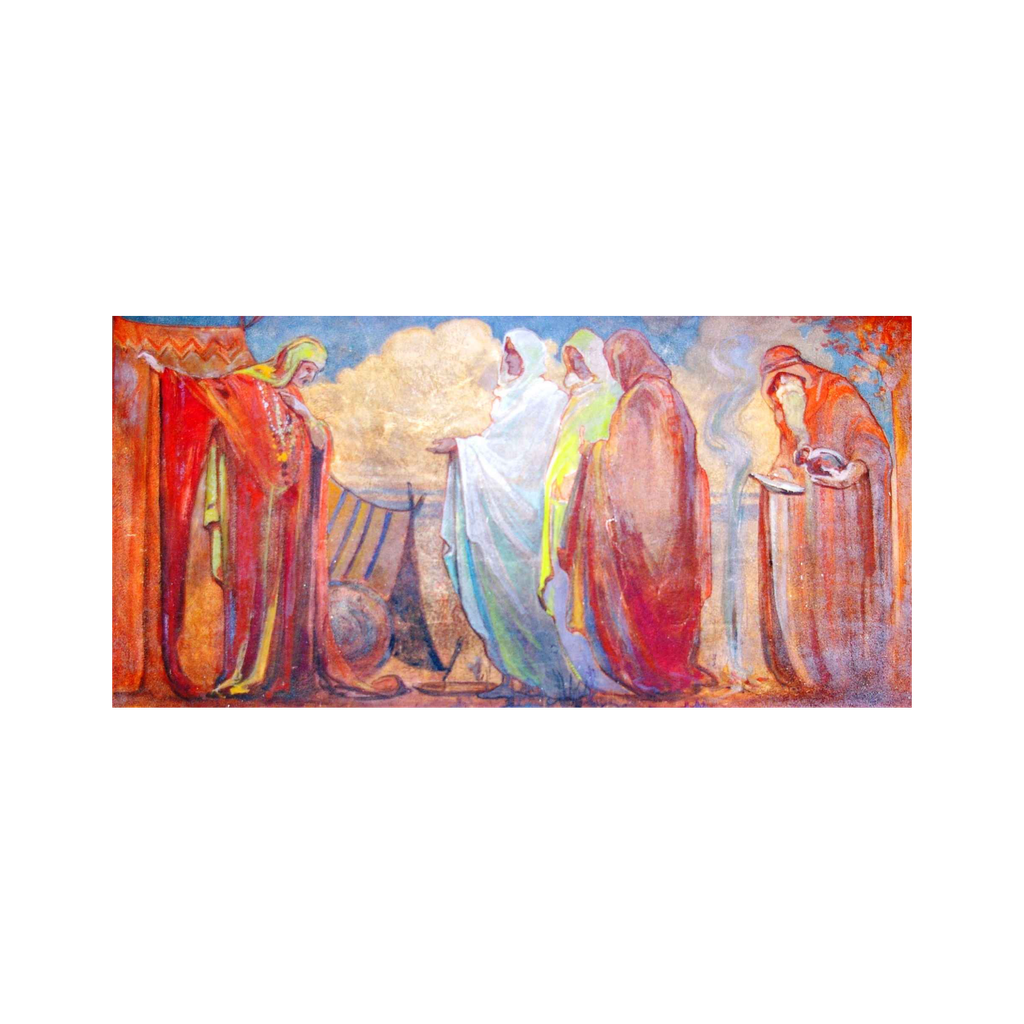
PW: or conservation in general …uum … Yes I suppose you have to understand what the artist’s intention was. You have to understand what the original materials are. You have to understand how they might have changed over time by environmental deterioration, moisture, salt light all those kind of things. Then you have to understand what might have been added since that time. Our paintings here that we are working on, are quite low down so I am quite suspicious that people can easily come and give a little clean and come along with a paintbrush – it happens all the time. And then we have to have an understanding, of course, of our own materials and what we’re then using to conserve the paintings and make sure we’re not causing any further damage. A really simple example of that would be we’re using mainly water, we know we have soluble salts in our paintings – there are some areas you can see the salts have crystallized on the surface or through the paint layers – which can cause a lot of damage. So, you know, we have to be really careful. We have to monitor what we’re doing make sure we don’t use more than we need too even with a simple material like water. So imagine if that’s an adhesive or something that could form a film or cause all sorts of other issues so you have to understand and think through a lot of eventualities.
DN: How much of that do you think you anticipate from your initial and beginning investigations of your investigations and how much do you actually find ‘oh that’s a surprise I wasn’t expecting that?’
PW: Hm, yeah. I don’t know, both really. In this case we’re quite lucky that the other conservation company had done quite a lot of …um … they’d done a condition assessment; they hadn’t done much in treatment trials. So we had a really good idea of how the paintings – how the church has been over the paintings over the last 20 – 30 years so we have that record. Yeah. But there’s always surprises and there are ..(laughs) almost every week.
DN: That’s fine. I mean when I first saw these paintings I didn’t know the artist and I thought there was a certain naivety about them but they grow on you …
PW: Hmm.
DN: The colours are very lovely. I was really surprised when they clean it how it came out. I knew I was anticipating that I would see something like that but it’s still a lovely surprise. Have you … do you find a lot of joy in this kind of work.
PW: Yeah, definitely I think this is a really satisfying job as well because in this case we … yeah … the results are quite immediate and there’s not too much risk to the painting materials. In a job, for example, where you’re taking off a varnish or something it’s a bit heart-in-mouth some of time and this is, you know, you can see the dirt, you can see it come off and it’s quite straightforward. I do think there is some issue with lighting, for example, so we do our work with strong task lights, we finish the area, we move away and then it’s quite hard to see, you know, just how nice and clean they look. So I think another effort should be made with improving the lighting so we can actually see them in their full glory.
DN: Did they think abut that when they applied for the grant? Or is the grant just on the paintings and restoring?
PW: In this … the financial are a little bit specific here because it’s through the Commonwealth Heritage Forum so they didn’t actually apply for something … it was done in a slightly different way in this case. But at some point it would be great if some funding could be found for at least a lighting survey and figure out what we can do safely to light the paintings.
DN: It’s interesting because you’ve got a spiritual space and yet there is potential for exhibition of the works. Not traditional exhibition …
PW: hmm
DN: … but still people would love to see these things …
PW: yeah
DN: …these art works in their full glory and be inspired by them I am guessing.
PW: I hope so.
DN: Is church work a lot of what you do or not? As an individual not as a company.
PW: Yes. I think most of our works … most of the work I’ve done in the last few years have been in churches.
DN: And you also do sculptures
PW: Ok as a company yes we do. Myself I really focus on the painted surface and architectural painting.
DN: So how did you get into this (Polly laughs) please Tell me.
PW: I was studying classics and I was learning about the … ummm … Bronze Age and Bronze Age wall paintings and how they tell a story we don’t have … you know … we don’t have other evidence for and I went down the road of trying to find out more about materials and how frescoes and wall paintings were made and found myself in conservation (laughs)
DN: Ok so accidental but serendipitous.
PW: Yes.
DN: Isn’t that true of so many artists. And you’re in this project for quite a while
PW:: So this particular phase is a year but we’ve been talking today about likely next phase is as well which would be different in terms I think but follow quite closely on this one.
DN: Yes, so talking about the interns. Teaching is something very central to what you do.
PW: That’s quite unique to this project actually though I say that we have two projects as a company that are quite similar and both of them involve interns at the moment but it’s the first job I’ve had like that in quite a long time so … it’s central to this particular project yes.
DN: And that brings its own challenges?
PW: Yeah definitely (they both laugh)
DN: Which also you will surmount obviously. It’s been a pleasure to know this was happening. And to see it actually coming to fruition.
PW: hm
DN: and we’re in the Lady Chapel here so this is slightly different from the main church because this was the Courtauld that did this? Why was there a division?
PW: I think it was just funding and programming that … that the Commonwealth Heritage Forum had a sum of money that they wanted to invest in the training of the interns … so that has been used to work on the Nave paintings that we’re working on at lower levels. The Lady Chapel as a sort of a finite, defined space and also kind of the jewel-in-the-crown of the church has been so far investigated by the Courtauld Institute and will become a student project over the next two or three years I think. That’s my understanding.
DN: Are you involved in any work on the ceilings?
PW: There isn’t any plan son far for the ceilings that going to be …yes …another phase
DN: Quite amazing (looking up)
PW: So the church is talking about the Apse in the Sanctuary – the Apse are the Last Supper and the Ascension painting as a sort of phase 2 and then I guess this is phase 3 … I’m not sure
DN: So the history here … I mean the paintings are saints, bible stories er …
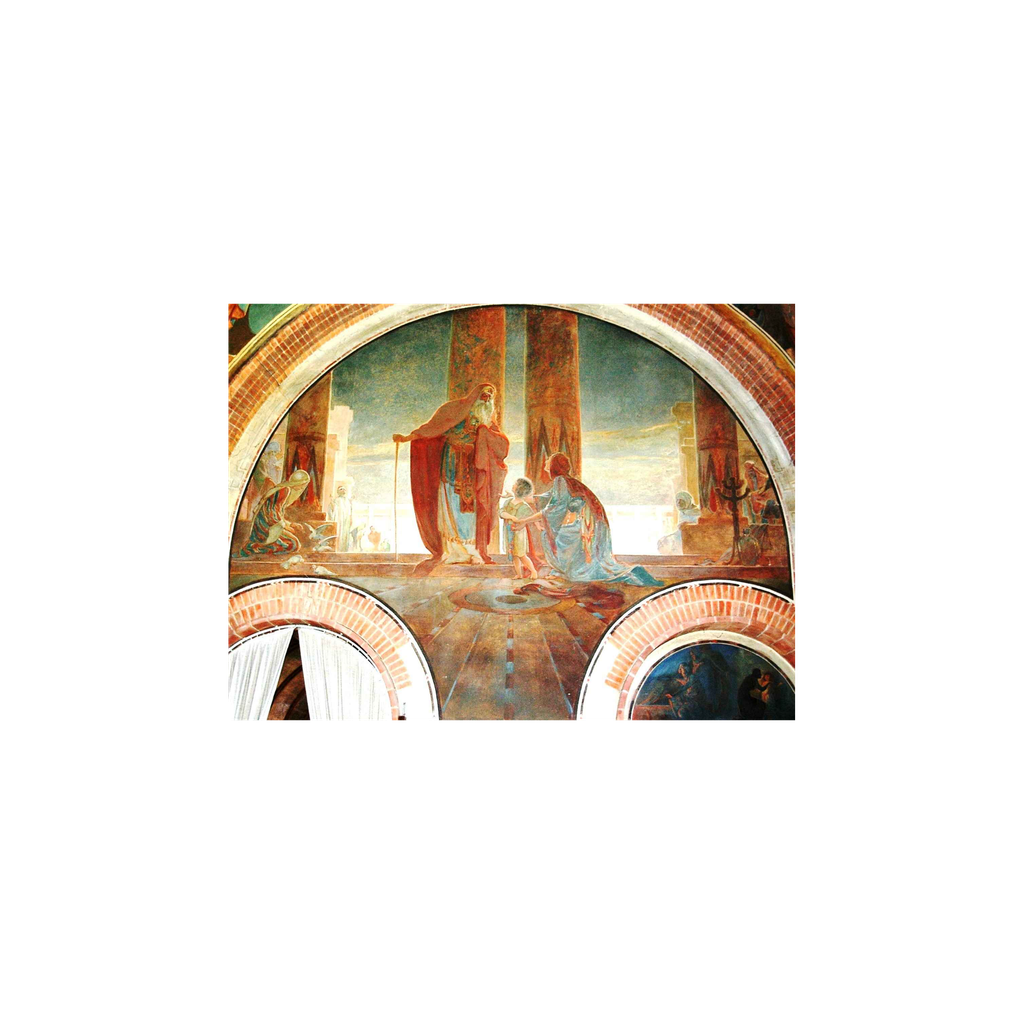
PW: Yeah the Lady Chapel is celebrating women from the Bible and celebrated female figures from that time and the recent past
DN: Lady Chapel … of course
PW: and this is the first … the first kind of commission that Starmer had … he’d had in this church and then he went on to other things and you can see maybe more … I shouldn’t say more effort (laughs) this was a very important commission and possibly in the ten years that he did the rest of the church he actually maybe..changed his style or …
DN: Well they were very effusive on the history of this church that this was a unique set of paintings in a very large imagination …
PW: hmm.
DN: … large space and possibly his … I think I read …his magnum opus as a painter.
PW: Yeah I’m not sure how much else he painted I think there are a couple of examples. I think he was really well known for doing illustrations … children’s illustrations, so I’m not sure this church took ten years of his career and the illustration work as well so I’m not what he would claims as his greatest. But it’s quite a legacy, isn’t it.
DN: And with Lyton too. I think the Lyton Society in America are interested in getting involved at some stage. From our point of view it has been really lovely to talk to you.
PW: thank you very much
DN: and to see how it progresses and we would love to come back at some stage.
PW: and we would love to have you back.
DN: thank you
Following interview:
Maryam Baig is a Heritage Conservator, Visual artist and researcher from Pakistan. She holds an MA from National College of Arts, Lahore and she trained at the Hast-o-Neest Institute, Lahore. Her art practice bridges heritage conservation and contemporary art, exploring themes of vandalism, erasure and materiality.
Iqra Asim received her BA in Lahore and worked on the Aga Khan Cultural Service on the Wazir Khan Mosque conservation project about which she is writing a study. Selected to train with CROM and the Commonwealth Heritage Forum in 2026 she has trained with traditional conservation techniques and materials.