Pablo Helguera
I am often asked about why I reach out to nostalgic, or defunct practices or forgotten disciplines to make my work (singing telegrams, used bookstores, phonographic recordings, and so forth). The answer is not so easy, and I did not to think too much about it until recently, when I have been pressed to posit an overarching theory about what I do because of the proximity of my first mid-career retrospective (more on that subject on another time). But this is a first attempt at making sense of it (at least to myself), hoping that the patterns presented here might resonate to others.
(Medieval trigger warning: this text contains an anecdote involving a donkey, a museum, and a bagpipe.)
The best art theorists provide a kind of X-ray of artistic practice, recognizing and naming patterns that artists themselves may intuit long before they are able to articulate them. David Joselit has done this for me. His ideas about format and circulation have helped me make sense of certain persistent tendencies in my own work, and particularly why I have been drawn to cultural forms that can be inhabited, displaced, and set into motion.
In After Art (2012), David Joselit proposes that we think beyond the traditional category of medium –painting, sculpture, photography, video – and consider instead the idea of format: a way of understanding how images and objects establish connections, circulate through networks, and acquire different meanings and forms of power as they move across contexts and scales. If medium tends to direct our attention toward the material and formal identity of an artwork, format directs it toward relationships and movement. For Joselit, this shift is particularly important in understanding a visual culture in which images no longer remain attached to singular objects but travel continuously through networks.
What interests me about this proposition is what happens if we extend it beyond images. What if the thing being circulated is the format itself? A school, a bookstore, a telenovela, a singing telegram, or a library can also be understood as a format: each is a culturally recognizable structure; with its own conventions, behaviors, roles, and means of transmitting something. And unlike a traditional artistic medium, such formats can be occupied and reactivated.
Thinking about format in this expanded sense has helped me understand why I have repeatedly been drawn not simply to making things, but to adopting existing cultural structures and setting them into motion My interest in circulation goes back to my early work as a museum educator, when I began organizing panel discussions and gradually realized that the content of a conversation could change dramatically when the same format was moved to a different context. In 2002, I organized a symposium titled The Museum as Medium, with one session at the Guggenheim in New York and another at the Centro Nacional de las Artes in Mexico City. Some speakers participated in both sessions, while others changed. The symposium dealt broadly with postmodernism and institutional critique, but the conversations developed in strikingly different directions. In New York, the discussion gravitated toward the economic forces shaping the art world; in Mexico City, it turned toward political power and the relationship between museums and the state. The experience suggested to me that a format is not simply a vessel for content: it enters into a relationship with the context it inhabits. Moving the same format from one social environment to another can alter its meaning and even the kinds of conversations it makes possible. I began to understand that the migration of a format could itself be a generative act.
Part of my frustration as an educator was the somewhat snobbish fascination with format: an academic symposium, for example, carries a certain intellectual sex appeal, but it can be an empty shell when there is no valuable content to animate it. As a programmer, this led me to privilege the idea or problem first, allowing it to determine the form the program should take. Almost instinctively, I began working the same way as an artist: starting with a problem and, as that problem developed, searching for a familiar cultural format through which it might be addressed. The investigation initially determined the format rather than the other way around. But once chosen, the format ceased to be neutral. It acted upon the idea, and when migrated into different contexts, generated meanings and encounters that I could not have anticipated.
What I began to discover was that it was not only useful to adopt a recognizable format – the school, the singing telegram, the radio program, the telenovela – that was aligned with a particular investigation, but also to introduce an unexpected inversion into its familiar logic. The school would be nomadic; the singing telegram would take place over Zoom; the telenovela would be about the art world; the radio station would be mobile and participatory. The inversion was meant to make the familiar format strange enough to become visible again, drawing attention to the assumptions and behaviors embedded within it.
This is perhaps an instance in which method followed instinct. I have always been attracted to topsy-turvydom, primarily through humor: absurd palindromes, word games, reversals, and incongruous situations that produce jokes. But while inversion can be whimsical, its ultimate purpose in these projects is not to deliver a one-liner. It creates a critical distance from the familiar, opening a space in which we can reconsider what a given format does, what assumptions it carries, and what else it might be capable of doing.
I thus became interested in what happens when recognizable formats are displaced – across places, functions, or expectations. And this is where, in retrospect, the ideas of Joselit resonate again: circulation and inversion are both forms of displacement. One displaces the format geographically and socially; the other displaces it functionally. But there is also a third form of displacement involved: inhabitation. To activate a recognizable cultural format often requires entering its conventions and assuming, however provisionally, the roles it produces. A school calls for a teacher or student; a bookstore for a bookseller or customer; a telenovela for writers, actors, and producers. Inhabiting the format from within allows its familiar logic to be experienced, tested, and redirected. As performer, I happily embraced those roles, not to pretend expertise, but to help frame that very format.
But inhabitation becomes more complicated when the format itself begins to travel. Several of my projects have been deliberately nomadic: The School of Panamerican Unrest, which this week marks 20 years of its making, moved from Anchorage to Tierra del Fuego; Librería Donceles has occupied different cities and institutions for more than a decade; and the Instituto de la Telenovela produced different versions of the same basic experiment in Bogotá, Mexico City, Buenos Aires, and Rio de Janeiro. In each case, circulation was not simply a means of distributing the work. It was part of the work’s method.
I began to think of these projects as a kind of mobile laboratory. The format provides a recognizable and relatively stable structure, but each new context introduces variables that cannot be entirely anticipated: different participants, histories, languages, political conditions, institutional relationships, and expectations. The format travels, but it does not remain unchanged. It absorbs something from each place it inhabits.
This distinguishes circulation from touring. A touring artwork generally attempts to preserve itself as it moves from one venue to another. A mobile format, by contrast, can use movement as a means of transformation. What remains constant is not necessarily its content but its underlying protocol. The school remains a school, the bookstore a bookstore, the telenovela a telenovela—but what those formats produce changes according to where, and with whom, they are enacted.
In this sense, circulation becomes another form of inquiry. Moving a format allows it to encounter different social realities and, in doing so, reveal both the assumptions embedded within the format and those embedded within the place that receives it. The project becomes less an object traveling through the world than a question repeatedly posed to different contexts.
There is another recurring observation about my work: that I am attracted to obsolete or forgotten formats, and that this attraction is fundamentally nostalgic. It is not an unreasonable conclusion. I have worked with phonograph recordings, antiquated manuals and rituals, used bookstores, vinyl records, old advertisements, 35mm slides, and other cultural forms that have either disappeared or are gradually falling out of use. I am undeniably attracted to the forgotten, the discarded, and the unfashionable—perhaps partly as a reaction to the art world’s perennial snobbism around the new.
But I have never been particularly interested in recovering these things for their own sake, nor do I necessarily believe that what they replaced was better. What interests me is their usefulness in the present. Once a format has lost its original function, it becomes strangely available again. Detached from necessity, its conventions become more visible, and it can be picked up almost like a readymade and applied to circumstances for which it was never intended.
Perhaps this is a form of strategic nostalgia. An obsolete format occupies a peculiar position between familiarity and foreignness. We recognize it, or believe we recognize it, and therefore know something about how to enter it; but enough historical distance has accumulated around it that its rules no longer seem entirely natural. The familiar has become slightly strange. This combination makes obsolete formats particularly useful as instruments of reflection: they allow us to look at the present through a structure inherited from the past.
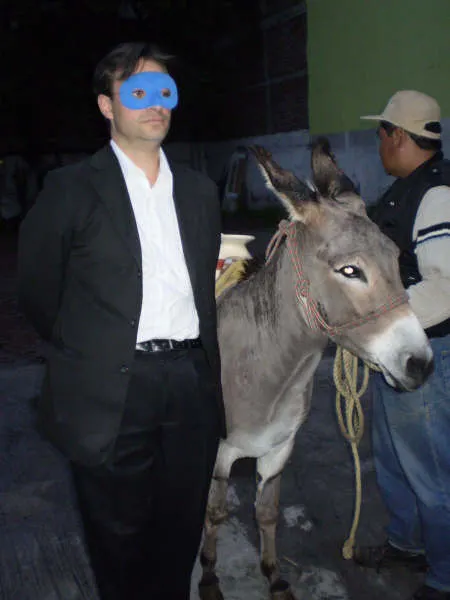
One project that perhaps brings these impulses together most clearly is The Feast of the Ass (2008), which I organized at the Museo Carrillo Gil in Mexico City. The project borrowed its format from the medieval Feast of the Ass, a carnivalesque celebration in which social hierarchies were temporarily inverted and, in some versions, a donkey was brought into the church to preside over the proceedings. Rather than attempting to re-enact the historical ritual, I used its basic protocol of inversion as a readymade for the contemporary art world. After a week of workshops, non-curators presented curatorial projects, non-educators gave museum tours, non-critics offered criticism, and non-artists performed; an actual donkey presided over the event, as the Pope. What interested me was not the recovery of a medieval tradition but the possibility of inhabiting its logic in the present. An obsolete ritual became a device through which contemporary professional identities could be temporarily exchanged, performed, and reconsidered.
The point, then, is not to revive the obsolete format but to reactivate it. A phonograph recording made today does not restore the nineteenth century, just as an etiquette manual written today does not return us to the social world in which such manuals once operated. Their anachronism is precisely what makes them productive. By inserting an old protocol into a contemporary situation, the assumptions of both periods can become newly visible. The past becomes less a destination than a device for estranging the present.
Thinking about these projects in terms of format has also helped me understand the particular roles that performance and language have always played in my work. If format provides the structure, performance is my primary means of inhabiting it, while language is often my means of inverting it.
By performance I do not necessarily mean performing before an audience. I mean the act of assuming a role sufficiently to activate the format from within. To inhabit a school requires someone to behave as a teacher or student; a bookstore requires a bookseller and customers; a telenovela requires writers, actors, and producers. I have repeatedly found myself assuming these identities—not quite impersonating them, since the activities themselves are real, but inhabiting them provisionally. Performance allows the format to cease being a representation and become an actual social situation.
Language often performs a different operation. If performance allows someone to enter the structure, language allows them to turn it around, redirect it, or expose some of its assumptions. This can happen through naming, translation, classification, wordplay, fictional terminology, bureaucratic language, instructions, or simply by introducing into a familiar discourse something that does not quite belong there. Language is particularly suited to inversion because a small alteration in terminology can destabilize an otherwise recognizable system while leaving its structure intact.
Performance and language therefore operate together. One produces proximity; the other produces displacement. Performance asks me to take the format seriously enough to inhabit it, while language prevents that inhabitation from becoming simple re-enactment. Between the two, the format can remain recognizable while beginning to behave differently.
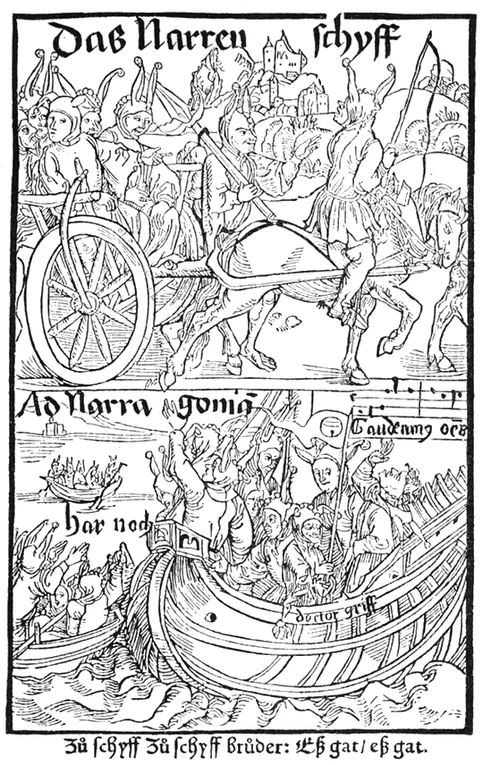
So I have come to believe that making art is a little like boarding a ship of fools and taking it from place to place. I rarely build the vessel from scratch: I prefer to find one that already exists—a school, a bookstore, a telenovela, a forgotten ritual—inhabit it, alter its course, and see where it might take us. The foolishness may lie partly in choosing to work with things that cannot easily be possessed or sold, because when the format is the medium, much of what it produces is impalpable: an encounter, a temporary community, a shift in attention, a different way of seeing something familiar. But the uncertainty of the voyage is also its purpose. Inhabitation, inversion, and displacement are ways of reaching somewhere that could not have been entirely anticipated at the outset. Sometimes one has to board the ship of fools to find sanity.