DN: So ladies what drew you to conservation was it accidental or did you always have something like this in mind when you started to work in the arts?
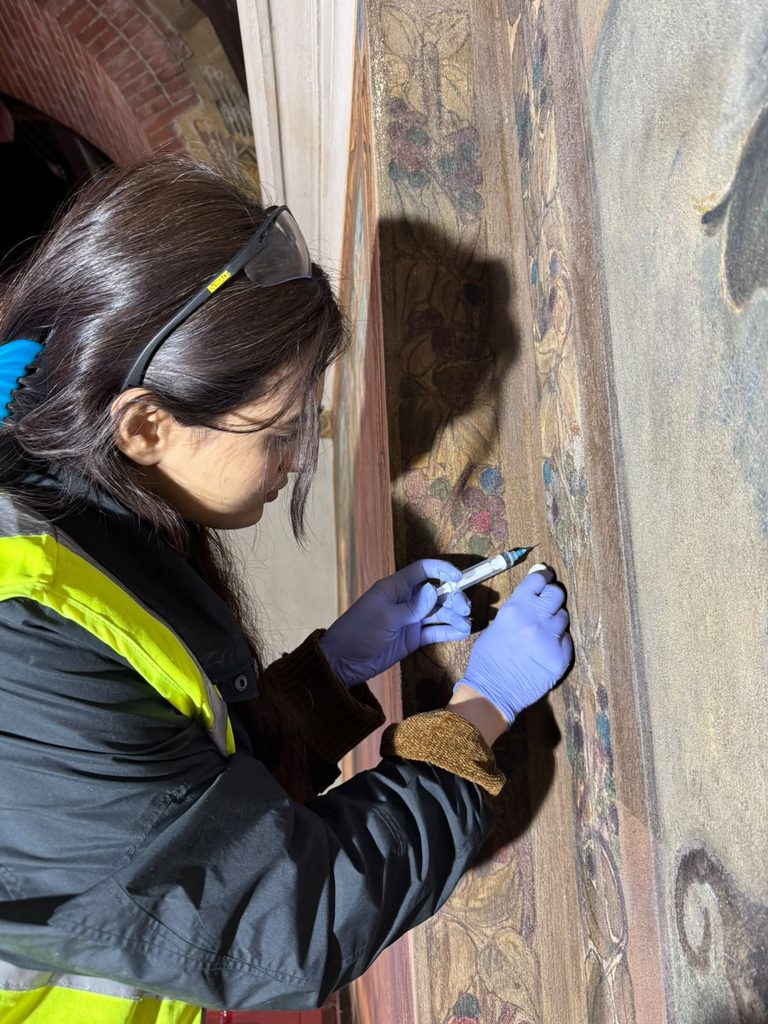
MB: So basically, I’m a visual artist and my art practice was related to heritage sites my paper was about – the one I started doing in Bachelors – I started researching about historical sites and erasure and vandalism on them because in Pakistan they are not considered preserved over there. So I started … my interest was going towards that; how people make marks on them. So the whole of my practice is based on that. And then there was my instructor in my Masters … organised a workshop teaching frescoes and kashkari style work. So I attended that workshop and then I decided that …er … I could just comment on the vandalism and erasure but maybe I could start doing something about it with hands-on work in preserving those sites. That is how my art practice led to …
DN: so you were actually doing conservation work in Pakistan
MB: I took a few workshops and then I did take trainings but hands-on work started over here
DN: I see and you Iqra?
IA: I am Iqra Asim an emerging conservator and visual artist. I have done my Bachelors in Fine Art from Lahore in Pakistan and I always loved art history old buildings and sites. I worked with thee Aga Khan sxervices as a conservator and I was picked as one of the four people who could come and see art culture and everything on sites
DN: Just to go back to Pakistan for a second the problems you face with conversation is that an educational thing people don’t think these are important or are indifferent to them in some way?
IA: Yes. In Pakistan we don’t have the conservation courses there, unfortunately. The education system there we don’t have the conservation courses or anything like that there. Like, this started the brochure showed trainings and things like that but we don’t have a proper degree course … something like that. So it’s really hard for someone like us who wanted to preserve it or wanted to work in that field so we cannot do a proper degree, you know, and go into that field so we have to do some related degrees
DN: hm
IA: and get some hands on experience in towns and after that, you know, that we are able to work on …
AM: also the general public going back to the question you asked, I think yes there is this lack of awareness and education about historical sites and awareness like …er … you know we’re in a Third World country and the problems over there are much more ..er … than worrying about historical sites. But I think they are so linked to identity… people don’t have this awareness …
IA: Yes
MB: … or preserving or not doing any harm to the building because for them it is just another part of history a building or something like that but definitely for us who study about it’s linked to our history, it’s linked to our identity so that’s the lack of awareness, I think
DN: And that awareness is something you want to bring back …
MB/IA: yes.
DN: … to Pakistan
MB: yes. I was doing this through my practice because I used to recreate the historical surfaces and the vandalism to highlight this problem but definitely now I’m preserving so its … I am doing both side-by-side.
IA: So we are representing Pakistan here and we would really love to work here and get experience here and maybe at some point we can go back and teach everyone …
DN: hm
IA: … what we have learned and what we have experienced and everything.
DN: You’re here for quite a while aren’t you?
MB: Yes
IA: Yes we are here for a whole year.
DN: And that goes on ’till?
MB: January
DN: We’re in August now do you feel this last seven months you’ve really improved, understood…gained knowledge?
IA: Yes.
MB: Yes definitely
DN: Just in seven months?
MB: Obviously we need more experience than that and we’re looking for more experience after this project but definitely our approach to conservation and standards of conservation … we’re learned a lot over here. And definitely we see how … what we’re lacking over there and we will definitely try to transfer the skill and the ideas …
IA: Yes
DN: but this is like a hundred years old some of the things you’ll be looking at in Pakistan are five, six, seven …
IA: So I have worked on Wazir Khan mosque that is four hundred years old. Because I have worked there I know where we are lacking and we can do like … new techniques on site and I have learned a lot of new scientific stuff here so we can actually do work on site that is really basic and simple
DN: That’s amazing. xo please tell us you met the people who funded this as interns as a discussion and you put yourselves forward. Was there some sort of interview process?
MB: Yes, so um… so basically we attended a workshop over there and the Commonwealth who funded the workshop …er … two or three people visited there and they announced to the participants that they have these vacancies on the website. So we applied there and then we had to write a cover letter, give our CVs and all … and they short-listed the people and had interviews with them.
DN: And you knew when you did that that this was going to be a very important move for you.
IA /MB: yeah Definitely
DN: you knew what was involved.
IA: actually they selected from the whole of South Asia and they said this is an opportunity fir you guys and maybe you want o apply for it. And we can select from you guys … something like that. We didn’t know … but we tried our best. We made our portfolios, we write the cover letter and we had like two interviews one was on a site with Victoria who is a consultant with Commonwealth Heritage Forum and after that we had an interview with the chief of the Commonwealth Heritage Forum, Phillip Davies.
DN: that’s the person we talked to last time. So, it’s lovely you came and I am sure all enjoy having you here. What specifically have you found challenging from sort of January when it was all new. You haven’t done this before.
MB/IA: No.
DN: So you’re in a different country, you’re in a Christian church, you’ve got these frescoes; have the challenges changed over the seven month or have you moulded into it and really know what you’re doing now?
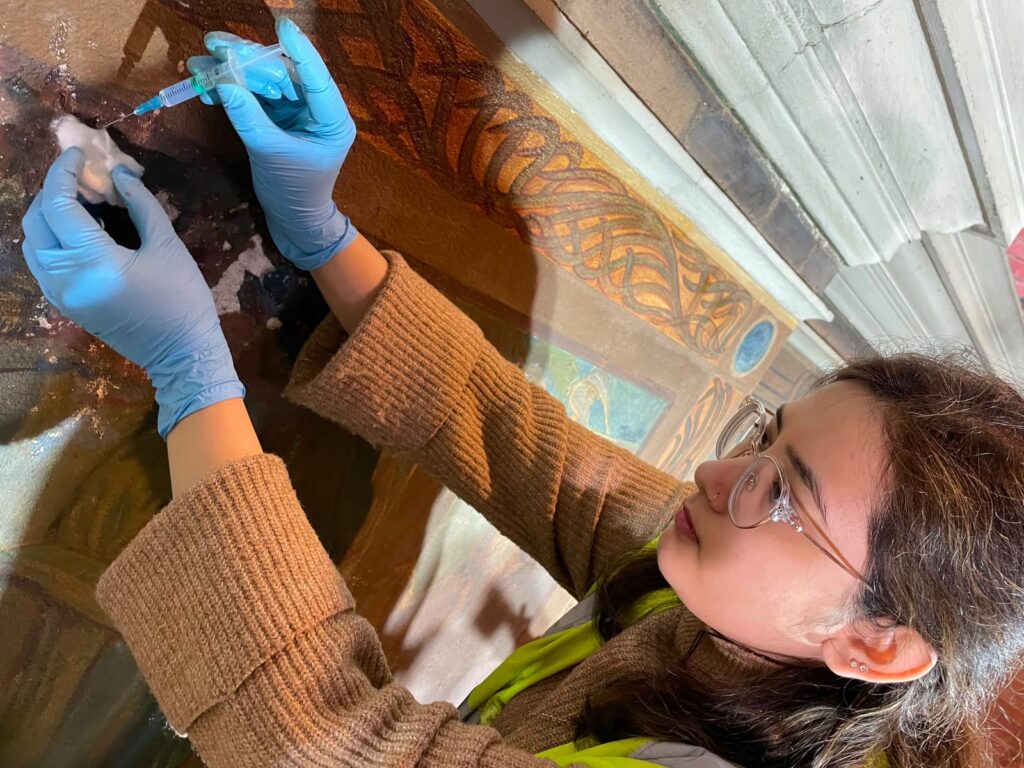
IA: Because I have worked there and when I came here to work on a site; I haven’t seen so much difference the standards of the conservation are like, same, in Pakistan and here we’re doing the same standards of the conservation. It wasn’t that hard for us to like, blend in but we are always ready to explore and learn new things. We are both, like, that we always wanted to learn and explore new things. We are actually enjoying it a lot and we recently trying to learn more courses and we recently learned gilding on site. So, yeah, it’s not a part of our job but we are still trying to explore
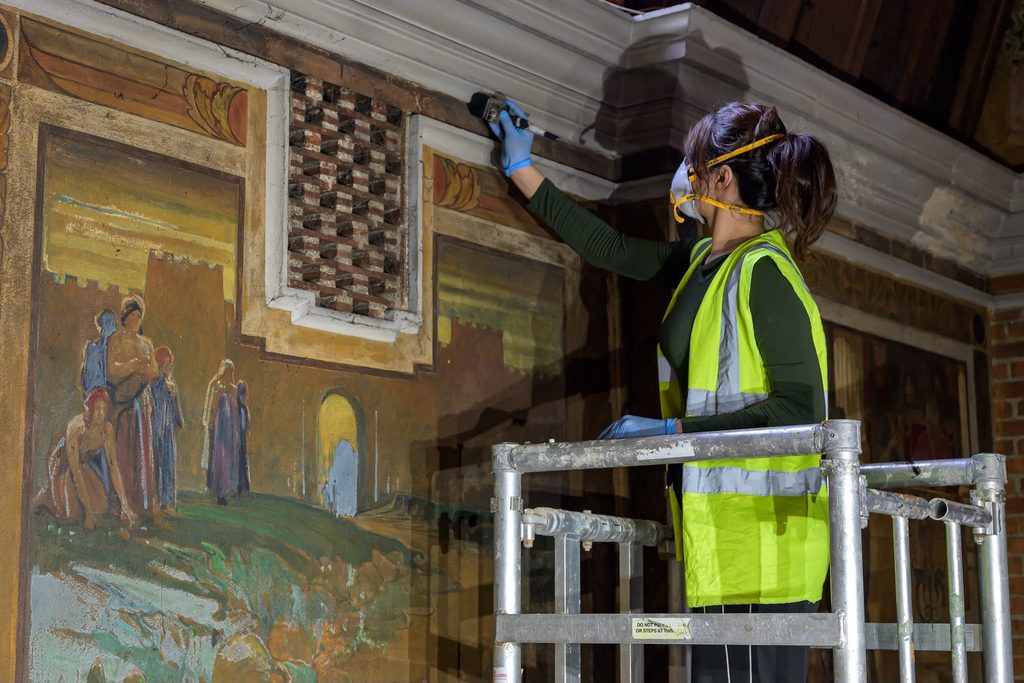
MB: and learn more skills. Also I would like to add it was not a challenge but the frescoes over here are different these are spirit frescoes and usually the ones we have in Pakistan are true frescoes. So the technique of frescoes is a bit different and after coming here we got to know these kind of frescoes which are made for here specifically.
IA: So that was something new to us.
DN: Something new!
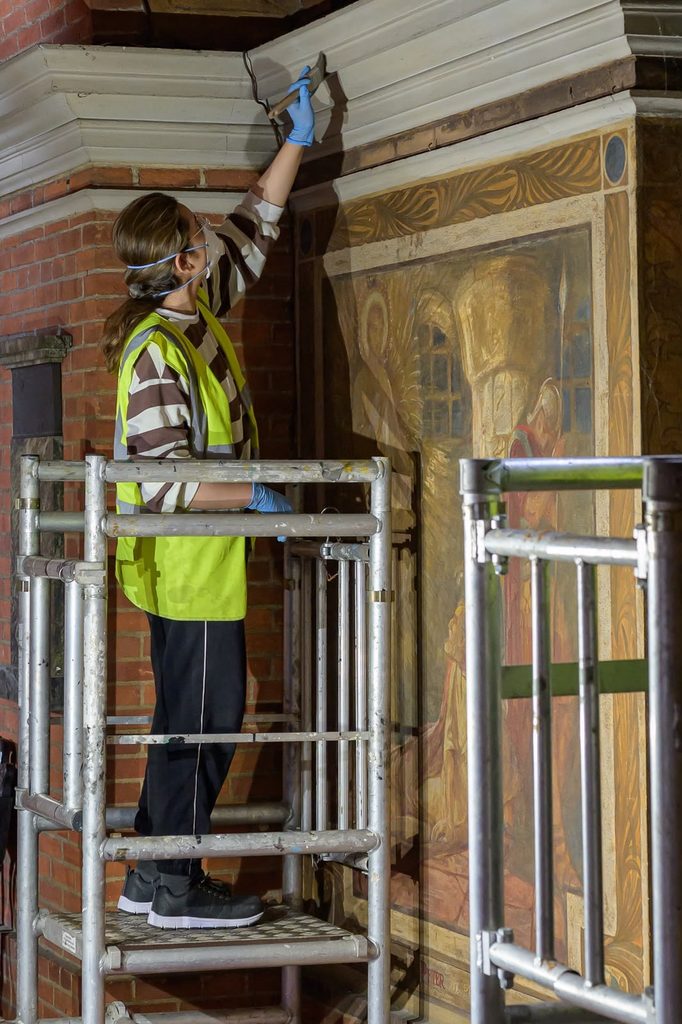
MB: So we studied hard and got to know about the medium and the technique and we approached to these sites differently than obviously true frescoes. And they are more stable here … the paintings over here are much more stable … so the approach is a bit different so yes the standards and the techniques and the materials is kind iof the same obviously we have local material over there and here there is local material here, but the properties of the materials are the same. So if a person has that knowledge it’s not that difficult for them.
IA: For example in Pakistan and here we are cleaning with water
DN: It’s as simple as that
MB/IA: Yes.
DN: but there are some things which are chemical
IA/MB: yes.
MB: and they are a bit different. They have much more material over here that they have introduced us to a team to work with so it’s kind of more efficient; we have more options over here that we don’t have over there.
IA: And we didn’t know that we can do small tests on site
MB: Yeah
IA: So we can do salt tests on site, we didn’t know that, so we just want to tell this to those working in Pakistan. I just told all my friends we can do that on site
MB: Because there’s a procedure over there that we have to take samples because we don’t have proper labs on site. We have to send them to proper labs and they run the tests and they send back the results and everything. So we can some basic tests on the site and those tests tell you a lot about the panels and paintings.
DN: That’s excellent. So you’re learning English history (they all laugh) and this artist Starmer whom I had not heard of to tell you the honest truth. And you’re working with some serious people in the Courtaulds and Clivenden Limited and the Commonwealth Heritage Forum; so will these links, these friendships, progress will you be doing more of this in other countries? Will you be coming back or are you concentrating on doing this and taking your superior skills to Pakistan and teaching
IA: at this point me think we are going to need some more experience then go back and start something so we are finding some more opportunities and trying to get some more experience we would like to try some more … you know … some stone work
MB: Anything
IA: So we are trying to find some opportunities here and at some point we will go back and transfer … you know .. we will be able to share the skills to others
MB: Definitely we will because we have been introduced to so many people and been introduced to so many approaches, thought processes. The Courtauld is working differently, the Clivenden is working differently. So definitely we would like to explore that a bit more and progress, hopefully and we’ve got great supervisors over here who are teaching us.
DN: oh they seem very professional people.
MB/IA: Yes.
IA: We’re earning a lot of things from them
DN: Do either of you ever write about what you do?
MB: yeah..
DN: Here’s my next question. All being well I ill be able to pay proper amounts of money for articles and I would like to keep in touch.
IA: Yeah definitely.
DN: If you have something to write about your experiences
IA: Yes definitely we are trying to find some opportunity to write something about the conservation in Pakistan and the conservation here.
MB: the comparison.
IA: We already wanted to do that for so long
DN: Please. I have writers around the world who love the fact that what the magazine does is allow you to write. We lightly edit we have no agenda. What you want to say, your visual experience and your expertise
MB: We would love that
IA/MB: we would rally like to thank Commonwealth Heritage Forum, Cliveden Conservation and our supervisors – they’re amazing – we are learning a lot of new skills and techniques and methods and we are really grateful for this opportunity