
Art History and the Global Challenge: A Critical Perspective
- In your mind, is there today a global field of Art History? Since the publication of James Elkin’s Is Art history Global? in 2006, art history has become more international, but has the discipline really opened to non-Western(non-North-Atlantic) contributions?
There is a ‘global field’ in the limited, factual sense that art historians and art theorists around the world are researching and writing about the transformations in contemporary art brought about through processes of globalization. The literature on the topic is now vast. It expanded exponentially after 2000: in the period between then and 2007, for instance, the world art market(an index of a globalizing economy) more than doubled in size. Art writers have, in one sense,tried to keep up with these changes and make sense of them. Some of this literature (mostly journalistic in nature) is itself a product of the growth in the size of the market for contemporary art around the world in which Hong Kong is now the third biggest center after New York and London (following Art Basel’s take-over and expansion of the Hong Kong Art Fair in 2012). But ‘global field’ is an ambiguous and weak theoretical formulation. It merely identifies an actual quantity of research and only gestures toward the much more significant ideas of ‘integration’ and ‘totality.’In this sense ‘global art history’ is in continuity with ‘world art studies’ of the last century: it is a recognizable sub-genre in the discipline, it is taught and researched in many universities around the world, but threatens nothing in the edifice of the discipline’s established structure, priorities and interests, with its origins in middle-European kultureschrift of the early twentieth century. For the ideas of ‘integration’ and ‘totality’ to be taken seriously by researchers interested in the global contemporary art world (with its genesis in the second half of the last century) a rigorous,systematic theoretical framework of concepts, working methods and key analytic arguments is required. These must start with consideration of the impact of western imperialism and colonization throughout the world, and their imbrication (via ‘post-colonialism’) in the recent and contemporary global social order forged since the 1980s. Culture and art – and ‘contemporary art’ as the term is now predominantly used – are,at once, material products and complex responses to the neo-liberalization of the world economy in the post-Soviet Union era, when the ‘high’ Cold War gave way to the chaotic power struggles and internecine wars we see now across western Asia and northern Africa. The present global order is patently one of chronic, systemic disorder, because these local wars and power struggles also contain a ‘late-Cold War’ geo-strategic dimension rooted in the US–Russian–Peoples Republic of China dialectic of struggle for hegemony as it is played out across all continents in economic, diplomatic, political, military, but also social and cultural ways. For art historians and theorists to explain this situation, and to muster adequate concepts and research methods with which to deal with specific artworks, new cultural institutions, new key agents and the global ‘mediatization’ of the art world, a critical perspective on the history of the discipline is required. Art history grew up as a discourse focused on national and international styles and forms, in the era of the rise of the nation-state and the glorification of national cultures and styles. ‘Globalization’ is a process which incorporates aspects of the continuing dominance of national interests and forces, yet has seen transnational and extra-national interests and forces increasingly at play in the way the world order has been reshaped (e.g. in the financial markets, in global media technologies, in the power of certain corporations operating across the globe, in the rise of fundamentalist ideologies challenging the legitimacy of existing states, etc.).A truly ‘global field of art history’ would comprise an intellectual intervention premised on a critique of western power in the world as it exists and is reproduced (and challenged) in cultural and artistic terms, and which creates a sui generis set of concepts, hypotheses and analytic methods able to recognize, analyze and evaluate the new phenomena of global culture and art seen since2000. We are still a long way from having anything like that
- Would you say that there are platforms (conferences, journals, blogs, etc.) which play a more important role than others in the internationalization of Art History?
The journal Third Text (founded by British-Pakistani artist and writer Rasheed Araeen) has clearly led developments in the work I am describing as necessary now. Over many years this journal has promoted such a critical framework and enabled researchers from a very wide variety of backgrounds and places to manifest new research findings. In terms of its special themed editions Third Text has been especially significant. Some biennales have also been effective in leading discussion around global contemporary art – e.g. the Havana Biennales of the 1980s and 1990s, and the Gwangju Biennale in South Korea (which has also recently commissioned a similar wide-ranging discussion of globalization, art and technological change).
- What is, or could be, the role of the Internet and the digital in this globalization?
The internet is a very important resource for disseminating research findings in this area, and of course is part of the process and effect of globalization itself.‘Mediatization’ of contemporary global art occurs predominantly now via the internet and digital media—though these are part of a broader ‘media ecology’ within which globalized contemporary art is presented/represented. Online contemporary art auctions—once a tiny part of the world art market—are now much more prominent and significant, for instance. Museums and galleries use digital media and the internet to a much greater extent now than ever before: Tate, for instance, attracts many more visitors to its website than ever actually visit its museum buildings http://third text.org/issues.
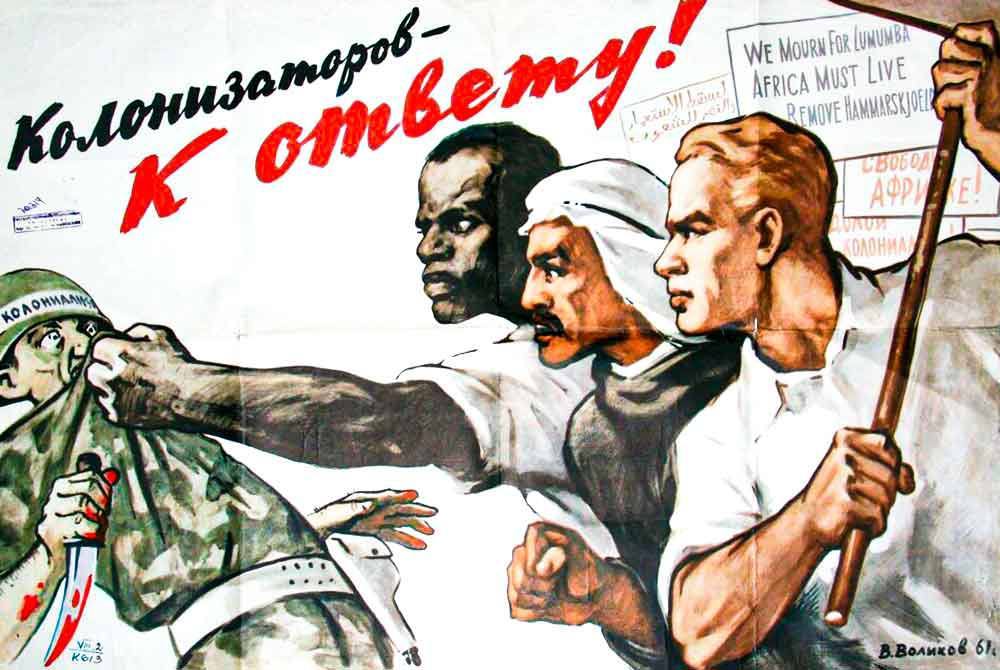
It shows African and Arab liberation fighters with a Russian proletarian
- What is the impetus for this globalization? Does it only rest on art historians’ willingness and political engagement? Or has the global approach also become a career strategy? Do the demands from our universities, which seek to attract more international students and incite us to publish internationally, have a real impact on research?
Globalization in the US, UK and its fellow commonwealth countries (Australia particularly)has been particularly important in the development of universities, in terms of both student recruitment and research projects. About nine UK universities now maintain campuses in China and other eastern Asian countries. These ventures have led to significant economic benefits for British institutions and begun to shape research into globalization and art (from a variety of perspectives, including art history). My own university has partnerships in Hong Kong and China which have led to a research focus on ‘visual arts ecologies’ in post-colonial societies in Asia. The motivations for this research – and the methods through which the research has been carried out – are quite mixed: from genuine partnership activities involving individuals and groups of academics, to economic benefit-led ‘client’ relationships formed between institutions acting in their own self-interest. Yes – ‘global studies’ is a viable professional route, especially when it promises, or appears to promise, direct economic gain for the universities that employ staff with this now increasingly recognized expertise. The links between international student numbers in universities and the direction and quality of their research activities and outputs remains indirect, however, in most respects (except in the ‘learning research’ field focused on international student learning issues, or TNE— ‘Transnational Education’). - Is Art History still dominated today by the “continental frame of art historical narratives,” so much so that the globalization of art history is, in fact the hegemony of a Western way of thinking history, art, and the history of art,rather than a diversification of thinking paradigms? More generally, what do you thin kof the phrase “continental way of thinking”?
This is the broad problem I mentioned earlier: art history, as a discipline, remains broadly a Euro-UScentric discourse that originated in the era of nation-states and nationalism. Its traditional armory of concepts, presuppositions, values,research methods and evaluative frameworks remain rooted in this historical development(though modernism, before globalization, started to put the entire edifice under significant strain intellectually and institutionally). Critical studies of globalization in culture and art, and critical analyses of the ways in which these are now being studied, have to start with this recognition and its consequences. I am no more convinced that art history can escape this imperialist legacy when it attempts to deal with globalized contemporary art(and its antecedent history) than I am that globalized contemporary art can avoid the predominant influence of Euro-US modernism/late-modernism. A truly adequate ‘global art studies’ paradigm would need to be wholly independent of art history’s imperialist and nationalist legacies, which is not to say, however,that it would not draw creatively on the rich intellectual resources western art history mustered in its ‘high‘ phases during the twentieth century. Warburg and Panofsky, at their best, were utopian globalists too! The idea of a ‘continental way of thinking’ is an idealist anachronism – a partial, often nostalgic or conservative representation of an intellectual and cultural formation that had fragmented in the 1980s when critical theory and cultural studies themselves began to become globalized, though in a process led predominantly by variants of Euro-US so-called ‘deconstruction.’
6 Have we, as art historians, progressed in the ‘decolonization’ of our points of view (I am referring here to the ideas of Walter Mignolobo and Boaventura de Sousa Santos)? To speak of “global Art History,” is it still germane to us eframes of interpretation inherited from the reception of thinkers such as Bourdieu, Derrida, or Foucault, and that have been pervasive in post-colonial approaches since the1980s, and the binary vulgate often derived from their writings. Should we, and can we, go beyond the models dominant/dominated,canon/margins, center/peripheries?
This issue is now one of the central problems in the theorization and empirical extension of global art studies. Of course we can still learn from the great post-structuralist thinkers of the post-World War Two period, in the same way that classic art history texts can valuably inform our research. This is in both cases partly because the impact of western imperialism and colonization is felt,registered, embedded, in contemporary art itself – and art history and post-structuralism were themselves, in turn, both complicit within and sometimes offered important critiques of this history. The dialectic of argument and reconceptualization requires a ‘working through’ of these intellectual traditions, their institutional discursive conditions of production and understanding of the broader social orders of which they were a part in the last century. Concepts such as ‘style,’ ‘authorship,’ ‘authenticity,’‘expression,’ ‘originality,’ ‘influence,’ ‘derivation’ – all of the conceptual armory of traditional art history in fact, and the critiques of these ideas and values offered by Derrida, Foucault, Barthes, Baudrillard et al. – are both still needed, and yet are inadequate within the attempt to recognize and understand contemporary cultural production, and the production of contemporary art and its discourses. Binaries such as dominant/dominated,canon/margin, center/periphery are best understood and used as heuristic hypotheses – to be tested and reviewed in empirical research situations. My own new book, The Global Contemporary Art World: A Rough Guide, does this in a series of chapters focused on emerging art centers in Asia (‘emergent/dominant/residual’ is a trichotomy also requiring use in this self-critical fashion: empirically deployed and yet ‘held under erasure’, as Derrida used to say). The subtitle ‘A Rough Guide’ alludes to the provisional, revisable nature of the concepts and working methods we need now, while it also refers to the role of travel book series themselves that constituted part of globalization, and part of the discourse on globalization, since the 1980s.
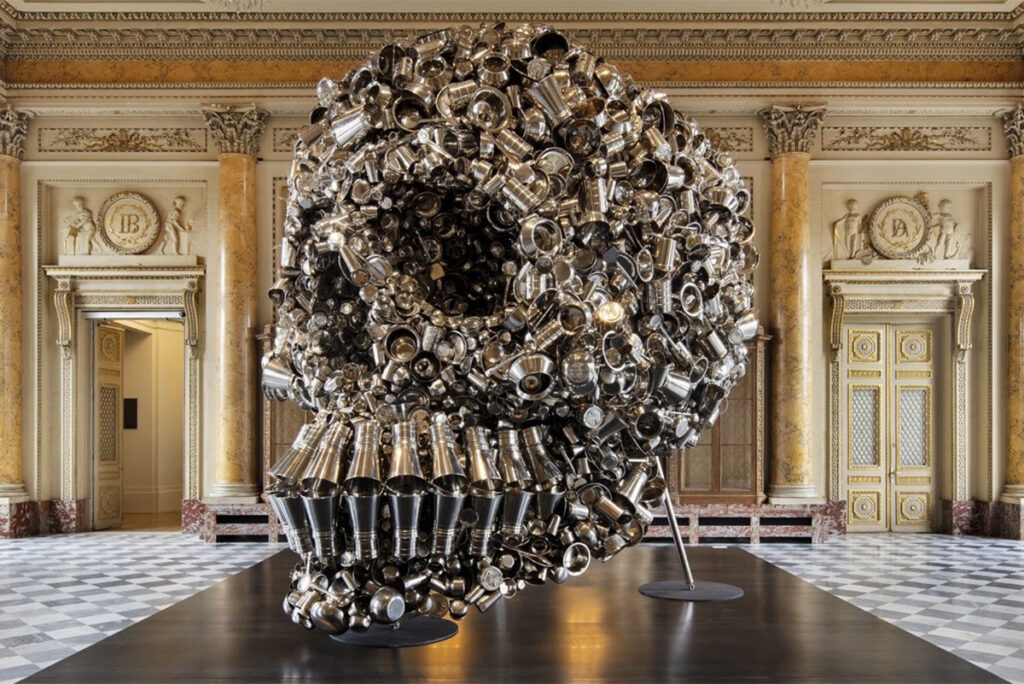
Monnaie de Paris, France and Google Arts & Culture
- In the history of global circulations of art,there have been many Souths and many Norths. Circulations are not as hierarchized and vertical as a quick and easy postcolonial approach could suggest (cf. the convincing positions of Thomas DaCosta Kaufmann and Michel Espagne). Working in the perspective of cultural transfers and geo-history, one sees very well that through their circulations, ideas about art, and the receptions of artworks change greatly—the artworks also change,according to what Arjun Appadurai calls the ‘social life of object.’ A transfer from the North to the South can be used by the South in local strategies that will not necessarily benefit what comes from the North. Do you think one could adapt these ideas to Art History and its globalization? Do you notice, in your own scholarly, editorial, or critical work, a multiplicity of strategies and discourses from the local to the global?
There are ‘Norths’ and ‘Souths’ inside the northern countries as well as inside most of the southern ones – and, of course, inside the major cities of the North and the South too: Birmingham is a good2 Jonathan Harris, The Global Contemporary Art World: A Rough Guide (London: Wiley Blackwell, 2016).example with 500,000 people from subcontinental Asian descent. This recognition (of diversity and huge inequality of access to resources) must not mask the near absolute contrast between the (iniquitously growing)wealth and resources of north western European and North American societies and the ‘global southern’ populations in the continents of Africa,Asia and South America. But the whole world—that is, every place—is now ‘post-imperial’ and ‘postcolonial,’ though in differential ways. The cultural and artistic implications of this are vast,and the way to set up doable research projects of real value is to root them in empirical studies of particular places, people, artefacts and contexts. This work must be developed in a dialectical relation to conceptual and theoretical elaboration: the two must put each other under pressure rather than either one cede to the other primacy in analytical terms. My study of five Asian centers focuses on places that are substantially unintelligible without understanding their relation to the Northern nation-states, and specifically the mega-cities of New York and London where power and influence in the global contemporary art world is still rooted economically and still perhaps discursively too. But the situation is dynamic: it is by no means clear that globalization will continue to largely benefit the western nation-states, capitalist corporations and financial interests that engineered its radical extension in the 1980s.The geo-politics of space—theorized by David Harvey and others over several decades now—must be taken much more seriously by art historians and theorists attempting to deal with late-modern and contemporary art and culture. Place, space and the ‘of-ness’ of art objects and cultural producers now – the meaning of saying that something still comes ‘from somewhere’ – are some of the crucial questions for those interested in the impact of globalization.
- To conclude, what you see as the most important challenges facing the international field of Art History today?
My personal relationship to art history was always‘ negatively dialectical.’ By that I mean that I saw its intellectual resources historically, and I saw that these were
(a) powerful models of how to understand and value notions of ‘art,’ ‘authorship,’‘style,’ ‘context,’ etc., but also that they were
(b)rooted in an era of bourgeois Euro-centricnationalism, and ‘nation-ism,’ that was by turns creative and open-minded, and highly reactionary. I don’t think it’s changed since then, or can. Historical materialist research into culture and cultural studies theoretical paradigms of value and meaning had developed enough by the mid-1980sfor me to be able to develop my own interests without falling back, openly or tacitly, into the standard art historical procedures. I always felt and feel now no affiliation to art history as a ‘discipline’ (in Britain it was also a particularly upper class profession until the 1980s) and have always thought of my research projects as specific tasks that required I took methods and concepts from any available tradition or field of developing inquiry. Antonio Grasmsci, Raymond Williams,David Harvey – these names indicate some of the main places my work has come from, what it has been ‘of,’ over the last 15 years or so. Art history will have no particularly important significance in how creative studies of global contemporary develop—that is, it will offer resources for scholars alongside philosophy, cultural studies, anthropology, film theory,psychoanalysis, history, sociology, etc. Its societal relevance now is an open question, as its marginal place in British university departments has become since the 1990s decline in the numbers of students opting to take it up. Globalization in contemporary cultural terms has itself asked the hardest questions of art history, outstripping it in terms of its apparently chaotic forms, hybrid meanings, new positions, displaced places and fragile/becoming states. Art history, you might say, is on the ropes in a boxing contest with globalization, and shows no sign of being able, or even wanting, to get up and offer a response!