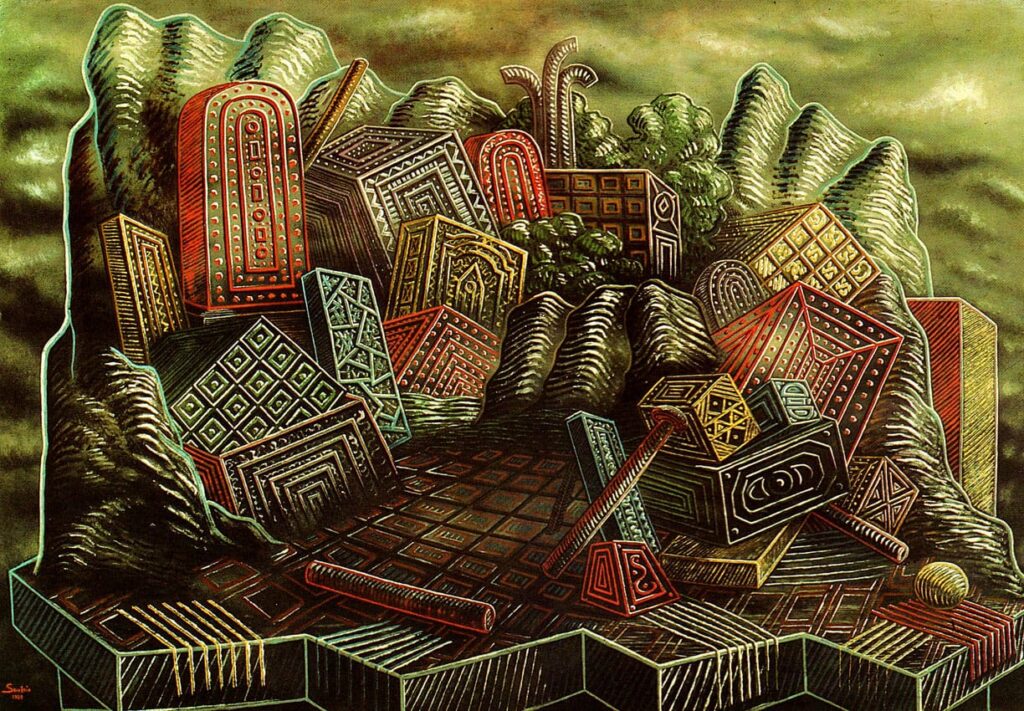
Alberto Savinio: L’Île des Charmes (The Charmed Island)”(1928),
Liviana Martin
In Milan, from January 28 to June 21, 2026, the major exhibition Metafisica / Metafisiche unfolds across four venues – Palazzo Reale, Museo del Novecento, Gallerie d’Italia, and Palazzo Citterio (Grande Brera) – taking the form of a dispersed exhibition project that reflects, already in its structure, the complexity and persistence of Metaphysical art. Born in the early twentieth century, this movement continues to exert a cross-cutting influence on contemporary artistic practices: from Surrealism to Magic Realism, through Pop Art, conceptual art, and postmodernism.
To understand the exhibition’s framework, it is useful to begin with its ideal conclusion: the intervention by William Kentridge at Palazzo Citterio, conceived as a tribute to Giorgio Morandi. Here, a sequence of cardboard sculptures evokes the celebrated still lifes of the Bolognese artist, while a video installation constructs a visual and sonic apparatus of striking intensity: silhouettes of generals, peasants, men and women parade in a kind of ritual procession, accompanied by a brass score. The rhythm alternates rapid gestures and hieratic postures, generating a suspended atmosphere. It is precisely in this tension between movement and stillness, between figure and shadow, that one can recognize a possible contemporary articulation of Metaphysics.
The exhibition path at Palazzo Reale opens under the sign of Giorgio de Chirico, pictor optimus and founder, together with Carlo Carrà, of Metaphysical painting in 1917 in Ferrara. In open contrast to the aesthetics of Futurism – dominated by the myth of speed and the exaltation of war – Metaphysics emerges as a response to a postwar world marked by anxiety, disorientation, and a need for order.
Empty squares, classical architectures, towers, spaces devoid of human presence – or inhabited by enigmatic mannequins, as in The Disquieting Muses – constitute de Chirico’s visual lexicon. Everyday objects, such as shop windows displaying Ferrara biscuits, coexist with a rigorous construction of space and a sharp use of color, contributing to a dimension in which time and reality appear suspended, ‘beyond physics.’
This tension also runs through the works of the other protagonists of the movement – Mario Sironi, Alberto Savinio, and Morandi himself – each with an autonomous interpretation. Savinio in particular, a polymath figure of profound cultural depth, younger brother of de Chirico and, like him, born in Athens and steeped in classical culture, develops an imagery in which memory, myth, and transformation intertwine. Savinio constructs ambiguous, hybrid images, midway between human and animal, as in The Birth of Venus. In the work Île des Charmes (1928), architectural structures and vividly colored forms evoke accumulations of toys immersed in a playful yet unsettling dimension, where irony and memory overlap.
At the same time, both de Chirico and Savinio extend their research beyond painting, producing stage designs for theatre and ballet, as well as textile designs, confirming the interdisciplinary nature of the Metaphysical language.
Quite different, more withdrawn, is the position of Giorgio Morandi, who concentrates his investigation on everyday objects – bottles, vases, boxes – reduced to their essentials. His still lifes, constructed according to a rigorous geometric balance, gradually become increasingly abstract and almost monochrome. Silence dominates these compositions: what matters is not the function of the objects, but their presence, their volume, the way they occupy space. It is no coincidence that Morandi stated, “nothing is more abstract than the real world.”
A sense of suspension and melancholy also pervades the works of Sironi and Felice Casorati, among the principal interpreters of Magic Realism. In Portrait of Anna Maria de Lisi (1918), Casorati constructs a space articulated by geometric elements – canvases, easels, columns – in which the female figure appears isolated, immersed in an immobile time, her gaze directed toward an image that remains invisible to the viewer.
The influence of Metaphysics extends far beyond Italian borders. Artists associated with Surrealism, such as Max Ernst, René Magritte, and Salvador Dalí, rework its imagery. In the exhibition, Dalí is represented by enigmatic works such as Figure in a Landscape and Project for a Stage Curtain (Composition with Tower): nearly monochrome landscapes dominated by earthy tones, in which silent architectures cast elongated shadows and enigmatic symbols – a Star of David, a flag – introduce elements of narrative ambiguity.
In the second half of the twentieth century and beyond, Metaphysics re-emerges in the form of quotations and reinterpretations. In the works of Andy Warhol, Pino Pascali, and Ai Weiwei, as well as in those of postmodern artists – Luigi Ontani, Mimmo Paladino – or figures such as Giulio Paolini and Claudio Parmiggiani, the Metaphysical language transforms into a visual and conceptual repertoire.
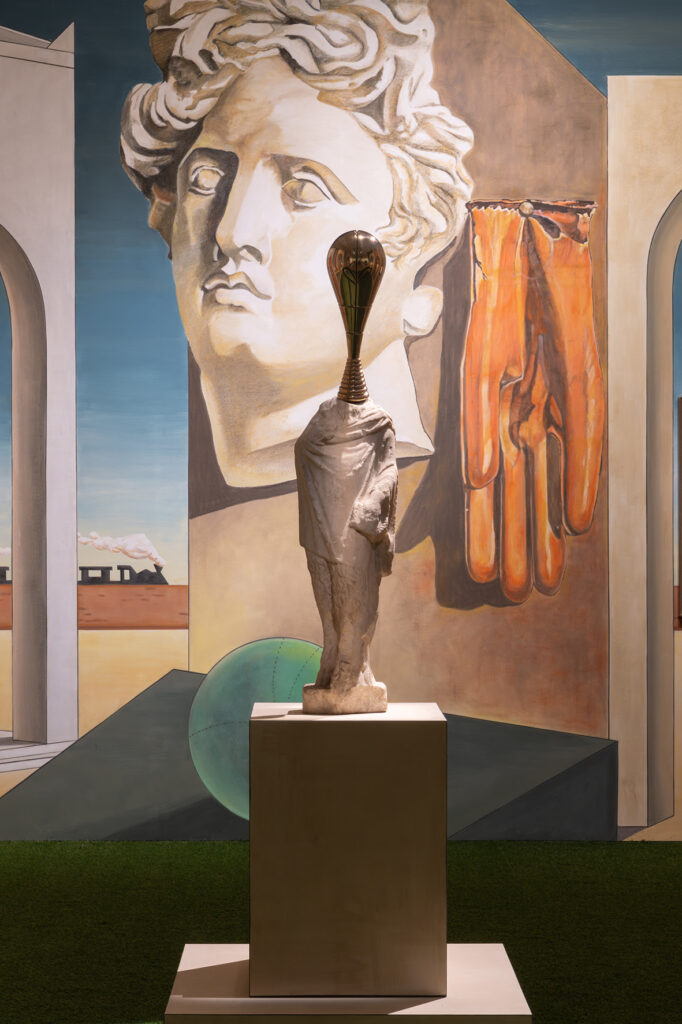
Warhol’s The Poet and His Muse (1982) reinterprets a subject by de Chirico in a pop key; the seriality typical of Pop Art finds a precedent in de Chirico’s own repetitions, as he produced numerous versions of The Disquieting Muses. In the 1980s, postmodernism resumes and amplifies this logic of hybridization, juxtaposing high and popular culture, past and present.
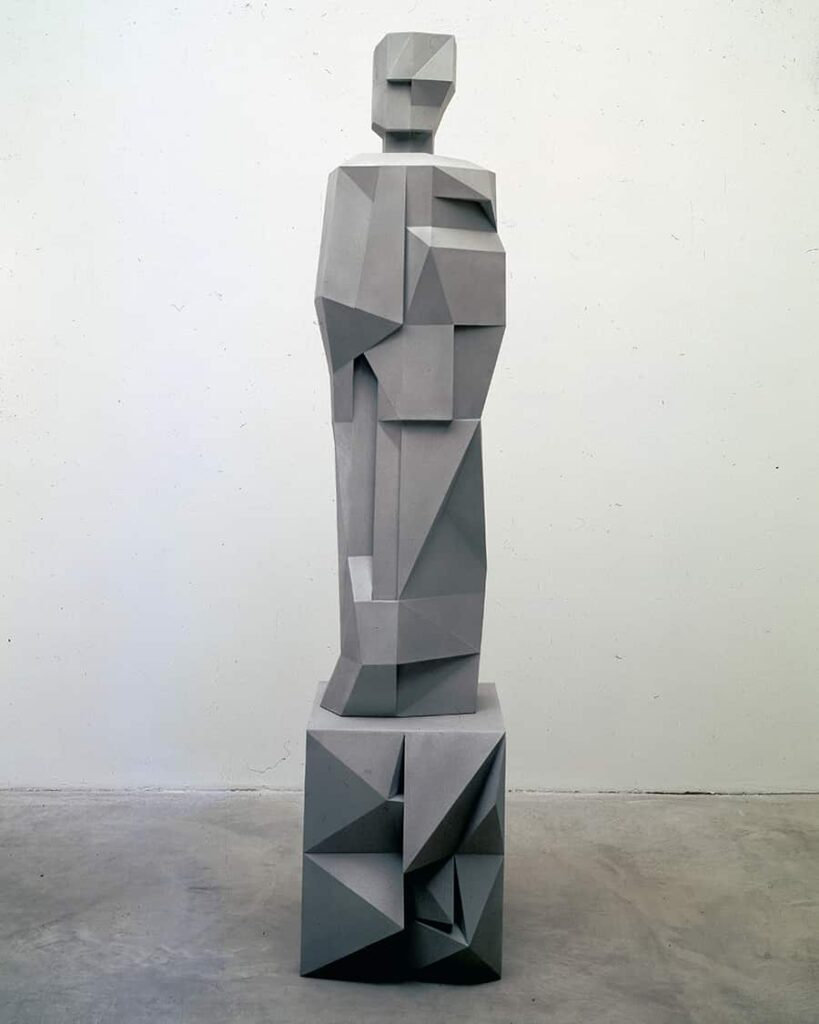
Significant in this regard is La stele (2000) by Mimmo Paladino: an aluminum sculpture composed of interlocking blocks, triangles, and pyramids, which recalls Metaphysical mannequins and configures itself as a threshold figure between tradition and contemporaneity.
At the Museo del Novecento, the exhibition explores the relationship between Metaphysics and the city of Milan, presenting, among other works, ten panels by Paladino dedicated to Savinio’s novel I Listen to Your Heart, City: a further element confirming how Metaphysics, more than a historical phase, is still an active device, capable of interrogating the present through the forms of memory, enigma, and suspension.
More than a historical reconstruction, Metafisica / Metafisiche thus presents itself as a tool for reading the present. It does not merely display works, but stages a condition: that of a time once again appearing suspended, traversed by uncertainty, unease, a lack of reference points, and a diffuse attitude of waiting.
In this sense, Metaphysics ceases to be a chapter of the past and reveals itself as a still operative category, capable of questioning the contemporary gaze. The empty squares of Giorgio de Chirico, the still lifes of Giorgio Morandi, the hybrid visions of Alberto Savinio, and the reinterpretations of William Kentridge do not belong solely to art history: they continue to pose a question.
What do we really see when we believe we are looking at reality?
It is perhaps within this fracture – between what appears and what remains inaccessible – that the force of Metaphysics still resides today. Not as escapism, but as an exercise of vision. Not as nostalgia, but as a form of awareness.
Metafisica / Metafisiche
Palazzo Reale, Museo del Novecento (January 28 – June 21, 2026)
Gallerie d’Italia (January 28 – April 6)
Palazzo Citterio (February 6 – April 5)