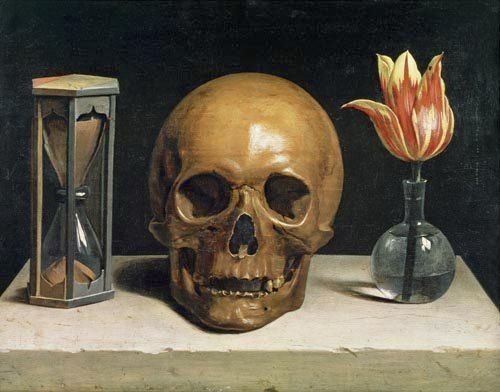
Philippe de Champaigne (1602-1674): Vanity
On final art works and exhibiting social practice
Pablo Halguera
The last work of an artist often carries a peculiar mystique. Critics and historians are tempted to read it as one reads the final words of a famous person: a perfect encapsulation of a lifetime, a distilled final thought – even when those words were incidental. Goethe’s famous last words, “More light!”, uttered from his deathbed, were likely meant simply as a request to open the blinds, yet they have been endlessly interpreted as a symbolic summation of his role in the Enlightenment and Romanticism.
In reality, however, an artist’s final works are rarely remarkable. They may fall in the middle of an ongoing process, belong to a period long past the artist’s creative peak, or represent only a small fragment of a vast body of work from which only a tiny portion survives. In my case, I happened to create the last work of my career somewhere in the middle of it – almost by accident, as part of a process whose path unexpectedly led to that result. What follows is the story of how that came to be.
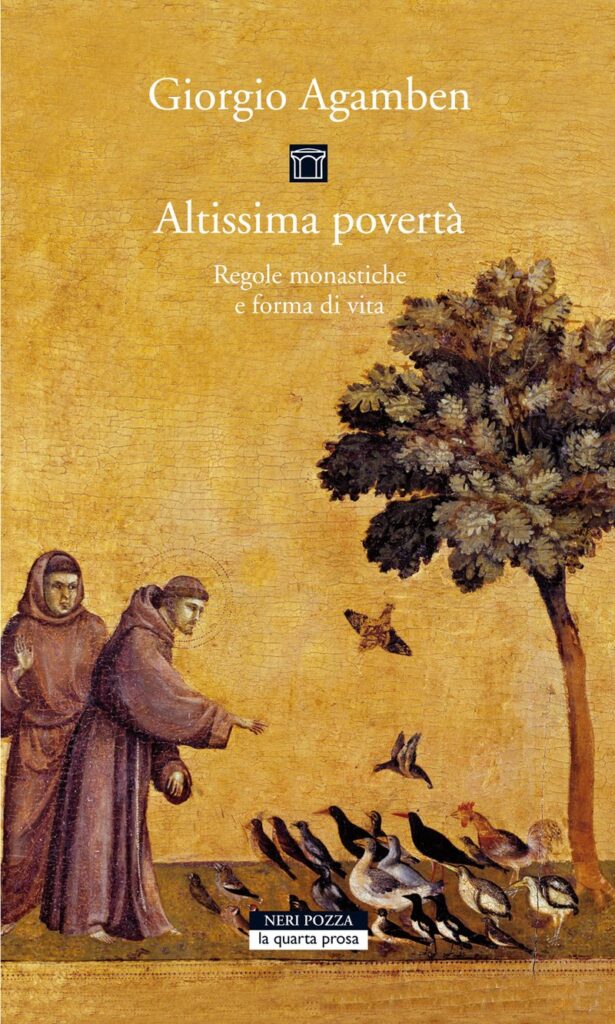
In the early 2010s I was traveling frequently to Italy to work on various projects. As I dusted off my Italian, I made an effort to read as much as I could in the language. That was how I came across Giorgio Agamben’s then-recent book Altissima povertà. Regole monastiche e forma di vita (The Highest Poverty: Monastic Rules and Form-of-Life).
In the book, Agamben examines the medieval Franciscan attempt to live a life of absolute poverty, in which life itself is governed by a rule that abolishes property and possession. He analyzes how the Franciscan notion of a ‘form-of-life’ (vita) inseparable from its rule (regula) challenges legal, economic, and institutional structures by proposing a life that cannot be owned or regulated in conventional terms. I was particularly struck in the book not so much by its main premise, but by the almost incidental mention of how novice monks were given a small manual Vita vel Regula, containing strict rules of conduct that structured their daily activities.
Back in New York, where I was working at the Museum of Modern Art, Italian art was also on my mind. I was involved in the programming of the retrospective of Alighiero Boetti, curated by Christian Rattemeyer and titled Alegghiero Boetti: Game Plan. One work in the exhibition that affected me deeply was a 1971 embroidered piece made during his first visit to Kabul, titled 16 dicembre 2040–11 luglio 2023 (December 16, 2040–July 11, 2023). In it, the artist marked what would be the 100th anniversary of his birth and also attempted to predict the date of his own death: he imagined he would die on July 11, 2023, at the age of eighty-three. As it turned out, he died much earlier, at fifty-three, in 1994.
Boetti’s prediction was connected to his broader interest in systems of order and disorder, as well as to the twin concept that ran through his work – often signing his works as Alighiero e Boetti. In this case, the duality was chronological: the self of the present in dialogue with the imagined self of the future. The subject of games was something we pursued in a Symposium I organized that year titled Critical Play, inspired by a book by the artist Mary Flanagan.
This was also, incidentally, the high point of socially engaged art and a moment of vigorous debate about how museums could, or should, engage with such practices. At the center of those discussions was the inevitable question of collecting, and the apparent impossibility of conceiving a way to properly document, chronicle, and preserve a practice that was deliberately anti-institutional and rooted in the present.
I had observed that performance art had faced a similar dilemma decades earlier. What began as a rebellious, anti-institutional practice in the 1960s and 1970s eventually found its way into museum collections as those artists aged and institutions sought ways to historicize their work. It seemed to me that the question was not whether social practice would follow the same path, but when. If that was the case, then artists would need to find ways to negotiate that eventual institutionalization on their own terms. I had also observed, nonetheless, through various discussions that Klaus Biesenbach had been organizing at the time, that the collective discussion about historic moments in performance, (exhibitions, events, etc) retrospectively created a community of joint lived experiences, sometimes creating bonds between people who had been at the same place and at the same time, but did not get to meet until these discussions took place half a century later.
Thus, Italy, rules, order, anticipated death, games – the latter suggested by the Boetti show – and the question of collecting social practice were all circulating in my mind when curator Julia Draganović invited me to participate in an exhibition in Milan. Almost immediately I felt I knew exactly wanted to do: a game based on simple instructions, that would last for the entirety of our lifetimes.
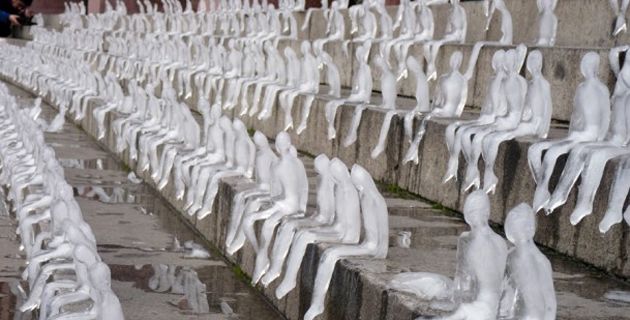
I contacted 20 friends and family members, all of who are younger than me and likely to survive me, to participate in this project. 20 more would be participants that would partake in the project on the day of the opening. These turned out to be local artists and visitors, most of which I had never met before that day (nor ever since seen).
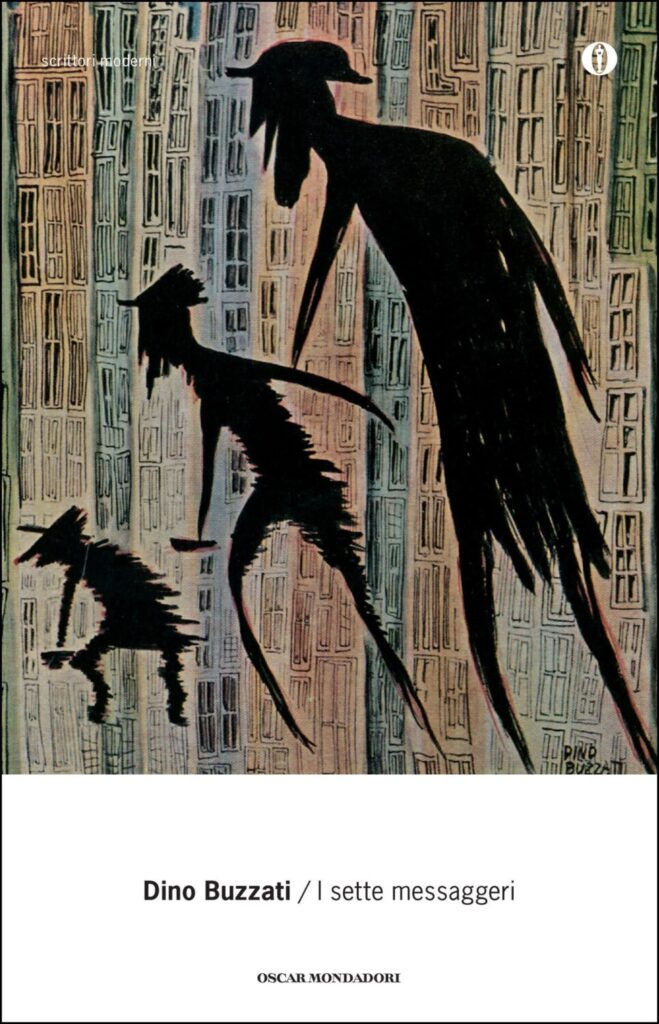
The game was inspired in a short story of one of my favorite authors, long associated with Milan by virtue of having worked most of his life for the Corriere della Sera: Dino Buzzati. Buzzatti’s short stories, which traffic in the implausible and stark situations that become springboards for small existentialist parables, speak to experiences that are deeply relatable.
The story in question is I Sette Messagerri (The Seven Messengers). It follows a prince who sets out to explore the vast reaches of his kingdom while sending seven messengers back and forth to maintain communication with the capital. As the journey continues and distances increase, the time required for the messengers to return grows exponentially. Gradually, contact with the place of origin becomes rarer and more uncertain, turning the story into a meditation on distance, time, and the fading connection to one’s past.
Each participant in Vita Vel Regula was given sixteen envelopes. Each envelope bore a date indicating when it should be opened. The first envelope was meant to be opened on the day of the exhibition’s opening; the second two days later, the third four days after that, the fourth eight days later, and so forth—each envelope to be opened after twice the amount of time as the previous one. Each envelope contains a set of instructions, and the suggestion for a piece of music to listen to. The pieces I selected are personal and meaningful to me; in many ways they are memory containers, as musical works tend to be, of different moments in my life.
Like in the story by Dino Buzzati, the intervals between messages soon expanded from days to weeks, months, and eventually years. In The Seven Messengers, a prince traveling ever farther from his kingdom maintains contact through seven messengers sent back and forth between himself and the capital. As the distances grow, the time between their visits becomes enormous. Toward the end of the story, a messenger finally reaches the prince carrying news from many years earlier – now absurdly outdated – and prepares to return to the kingdom with the prince’s response, fully aware that by the time it arrives it too will be hopelessly obsolete. The prince also suspects that this may be the last message he will ever be able to send, since he himself may not live long enough to see the next messenger return.
In Vita Vel Regula, the dates start on March 1, 2013. We opened the 12th envelope on May 27, 2019. The next envelope will be opened on August 13, 2030, and the second to the last envelope, the last of which I assume will be opened during my lifetime, will be opened on January 16, 2053, when I will be 82 years old – a year younger than what Boetti imagined his lifetime to reach. Bearing a miracle of science I will most certainly not be alive, nor most of the game participants will, on November 23, 2097— my daughter Estela, who I included in the game and who was 4 years old at the time when the game started, will be 88 years old.
Every time a new envelope is opened, I hear from some of the participants. One of them, my friend the artist David Greg Harth, whose work is also inspired in methodical and rigorous following and documentation of rules, is one of the most dedicated participants, religiously opening and following the instructions on the appointed dates. Others might have lost or forgotten the envelopes, but such is he game of the rules of life. The work is in their hands, and they will do with it what they will. Each name with birthday is marked for every participant, and it should be also marked upon the day of their passing.
I wrote two letters: one is set to be read on the day of my own passing (whenever that day might come), and the other to be read when the envelope dated November 23, 2097, the concluding day of the game, is to be opened. This was one of the most difficult letters I ever had to write. I thought deeply about artworks that were made a hundred years ago and the impulse of wanting to have a conversation with the artist who made that work, wondering if they ever thought, considered, or imagined that work speaking to a yet nonexistent audience a hundred years in the future, as a time capsule. Pascal once wrote, “Toute la suite des hommes, pendant le cours de tant de siècles, doit être considérée comme un même homme qui subsiste toujours et qui apprend continuellement.” (“The whole succession of men over the course of so many centuries should be regarded as a single man who lives continually and learns without end.”), in other words,the idea that human knowledge accumulates through communication across generations – that writers and thinkers effectively converse with people far removed in time.
So I wrote the letters with enormous hopes, even though I know I will never see them realized in my lifetime, that they will connect and speak to someone in the future. Which is ultimately why I think we make art in the first place; that everlasting and hopeful search for a receptive interlocutor.
Perhaps ironically, but fittingly, one of my very first essays, written at nineteen and published in a college newspaper, bore the pompous title On Behalf of the Continuous Dialogue. In it, I argued that artists inevitably enter into conversation with their artistic and historical genealogies. The writing was amateurish and, in retrospect, embarrassing, but the sentiment itself has never really changed.
Our time in the world is fleeting, and the immediacy of the present often distorts the larger picture of which we are only an infinitesimal part. Those works that survive into the future—like the unrepresentative last words I mentioned earlier – will likely become little more than footnotes to a much larger whole. Yet one hopes that even such a small footnote might carry with it some measure of humanity, purpose, awareness, and empathy toward those who will come after us, and who will likely feel much as we once did toward those who came before us. And perhaps, like those famous last words, the work itself is simply another small message sent forward into time.
Speech from the Exhibition:
Ladies and gentlemen of 2097,
After having spoken at so many events throughout my life, I have never spoken at an event where the audience doesn’t exist yet.
This is because tonight event is not only for us in this gallery. It is also for a hypothetical audience, most of which have not yet been born. They will be closer to the generation of our grandchildren, or of our great-grandchildren, if we are lucky to have descendants. It is almost certain that not a single one of us present tonight will be alive on the evening of November 23, 2097, exactly 84 years after today. My own daughter, who is three years old today, if still alive, will be 88 years old then. We are a lifetime away from that point. It is difficult to imagine what the world will be like, if it will be a happy place, if it may have become irreparably destroyed by our wasteful society. But in the same way that we can’t know what the future holds, and what we could learn from those hypothetical audiences of the future that will watch the video of this event we are making now for them, it is also interesting that we are often equally ignorant about those who lived in the past. I often think of it when I look at a XIXth century portrait of a great-great grandmother that my family has, la abuela Luisa, of which I know practically nothing other than she was the grandmother of my grandfather and lived in the city of Zacatecas, Mexico. She left no letters or objects and there are no photographs of her other than that painting. Historical records and witness accounts often help us to piece together the past, but it never provides a full insight; so those who lived say in the 1920s are equally distant to us now than we are from those people who will exist in 2097. So this recorded message from us is to them. There may not be a magic insight we can convey to you (and now I speak to those of you, on the other side). What you may find most paradoxical is that our time may be most readable to you than to us, who are living it now. But in any case, how great it would have been to us if the voices of the past had consciously attempted to speak to us directly, if my abuela Luisa would have written me a letter for instance. And tried to make specific efforts to reach out to us and let us know what mattered to them the most. This is what at least we can do for you, the future audiences. We can write to you, we can speak to you now hoping that you may listen later. We can attempt to salvage the natural boundaries of human lifetimes by employing a bit of artifice, in the form of a conceptual artwork, something that we invented and that may not even exist by the end of this century. But it is important, also to say that we are also writing and speaking to another hypothetical, and not-yet existing audience, which is ourselves, in ten, twenty, thirty years. We may find that we were very different people now from what we became later, that we may have forgotten who we once were. It is thus not only the potential of a conversation with you but with those who we may become along the way. This is why I have created this game to be played once, consisting in 15 envelopes which will be opening over the years by the living and willing participants. Each envelope is dated and scheduled to be open in twice the amount of time than the previous one. The gap will thus first be a few days, then will be months, then years, and finally decades. One envelope is scheduled to be opened at my own passing, hopefully several decades from now if I am lucky. After I am gone, and hopefully you outlive me, I will continue to speak to you from what is contained in those envelopes, should you chose to continue your promise to keep them and open them at the indicated time.
I will ask the visitors at tonight’s event to write a private note to the audiences of 2097, who will go in a time capsule that will be opened on that date, hopefully, by this hypothetical audience that may humor us in doing so. I also hope that the second to the last opening of the envelope in 2053, roughly 40 years from now, we may come together one last time to open that envelope, the last time that I may be able to join you. Were I not able to come or be alive then, I would ask you those of you who can to do so. I wish I could say I will be there in spirit, but I don’t believe in that which is not tangible. I do believe in art, I believe in its perseverance and in the perseverance of ideas, and I believe in the constancy of people and the bonds they create, which Is what compels me to propose the current collective experience. So let’s celebrate that bond that we have now
Created. Lets take a photograph that you, the audiences of 2097, will be able to see, knowing that we took it for you, so that you know how we looked, how strangely we dressed and spoke, how innocent perhaps we looked, but that we were here for you, and for our descendants, to open that last envelope with the things that we wrote tonight, and as you open that last envelope, you will bring, finally, to completion an experience that lasted 84 years ago this evening, at a small art gallery in the city of Milan.