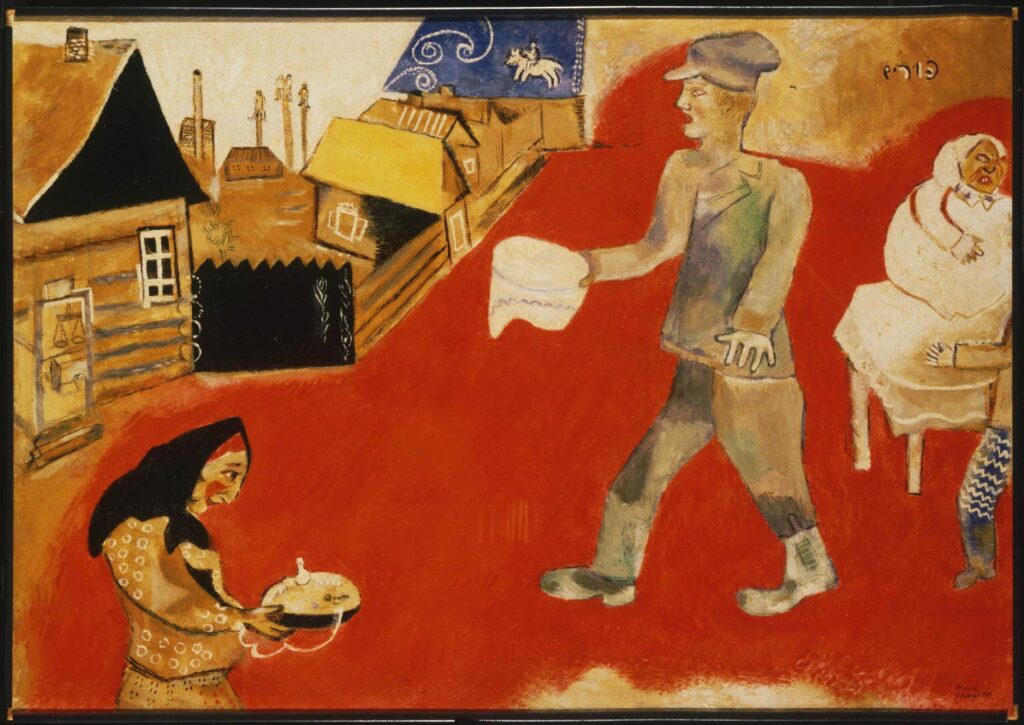
Marc Chagall: Purim (1917)
Erich Neumann
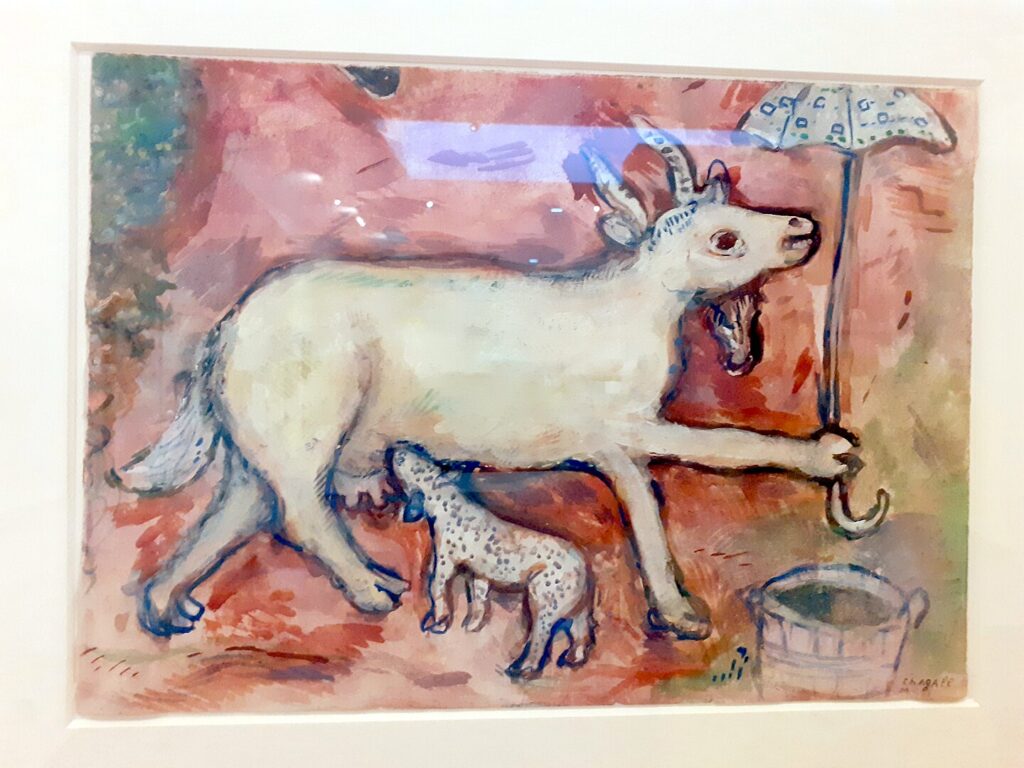
Marc Chagall. The strange painter from Vitebsk is generally regarded as a Romantic, a painter of folklore. Some stress his childlike or primitive quality, others the idyllic aspect of his youth in a small town, or his Jewish milieu. But all these interpretations miss the essential.
He is not a great painter of the kind whose gradual growth takes in greater and greater areas of the outward or inner world. Nor is he a painter of upheaval like Van Gogh, who passionately experienced the nascent modern world in every cypress tree of Provence. But he is unique in the depth of feeling that carried him through the surface manifestations of his personal existence to the fundamental symbols of the world, the foundation underlying all personal existence.
His pictures have been called poems, they have been called dream images, implying that the intention of his painting extended to a plane removed from all painting — even that of our day. Perhaps only the Surrealists, who for this reason called Chagall the first Surrealist, shared his intention, which might in a certain sense be called a lack of intention. But— and this is the very crux of the matter— Chagall is no Surrealist working with the blind unconsciousness of Freudian free association. A profound, but by no means unformed, reality makes itself felt in his work. The dream law of his paintings flows from a unity of feeling, reflected not only in the intrinsic color development but also in the relationship between the symbols that order themselves round the
symbolic center of the picture. These symbolic centers of Chagall’s pictures are unquestionably spontaneous products of his unconscious, and not constructions of his ego.
The consciousness that executes his painting follows the mood and inspiration of the unconscious. The unity and force of conviction in his pictures are an expression of the obedience with which he accepts the intention of his unconscious. Like a medium, undisturbed by the impressions and influences of the world around him, he follows the inner voice that speaks to him in symbols.
Here we touch on a central Jewish paradox in Cha- gall: a prophecy in which the godhead does not, as from time immemorial, speak in words, but in mystery and image— an unmistakable sign of the upheaval that has taken place in the Jewish soul.
Language, and the language of prophetic religion more than any other, is indeed rooted in the uncon- scious, with its stream of images; but Judaism and Jewish prophecy were formed by the ethical accent of a consciousness which derived its own central force from its analogy with the central power of the One God. The imperative guidance of this prophetic will so sharpened the intention of the unconscious forces that stood behind, heated it to so white a glow, that the images lost their colors; the variegated flowers of psychic life were turned to ashes.
But in Chagall for the first time something originating in the very same psychic stratum from which Jewish prophecy drew its power speaks in images and colors. In the new historical situation of a Jewish people transformed through the central depth of its unconscious, prophecy speaks a new language and utters new contents — the beginning of a new Jewish message to the world. The soul of Jewry, compressed by necessity into the shell of isolation, makes itself free, sinks its roots deep into the earth, and manifests itself in a first new flower.
At first glance there seems to be nothing very impressive about Chagall’s Jewish provincialism. Folklore, the village idyll, the Jewish small town with its petty bourgeoisie, childhood memories — childhood memories over and over again. Who cares about this Jewish town, about all these relatives and bridal couples, these eccentrics and fiddlers, these festivals and customs, sabbath candles and cows, these scrolls of the Torah and village fences ? Childhood — that is the milieu from which Chagall never escaped and to which he returns over and over again, regardless of Paris and Europe, of world wars and revolutions. All this may be lovable and touching, unless one prefers to call it sickly and sentimental. Is this all? one is justified in asking. What is all the fuss about? Is all this not a mere variant of modern primitivism, only a kind of colorful, romantic popular art? Chagall would give no answer, probably he would know no answer; he would only smile and keep on painting his colorful world, the same little houses, the same childhood memories, the same colored fragments of his early world: cows and fiddles, Jews and donkeys, candelabra and brides. But in the midst of it there are angels and moons, blazing fires, and the eye of God in the village.
For what is childhood but the time of great events; the time in which the great figures are close at hand and look out from behind the corner of the house next door; the time in which the deepest symbols of the soul are everyday realities, and the world is still radiant with its innermost depth? This childhood reaches back to the earliest prehistory and embraces Abraham’s angels as tenderly as the neighbor’s ass; it experiences the wedding and the meeting between bride and bridegroom with the same joy and the same radiant color as the spring and the moonlit nights of first love. In this childhood there is as yet no separation between personal and suprapersonal, near and far, inward soul and outward world; the life stream flows undivided, joining godhead and man, animal and world, in the glow and color of the nearby. This simultaneity of inside and outside, which perceives the world in the soul and the soul in the world; this simultaneity of past and future, which experiences the promise of the future in the remote past and the guilt of the ages in the anguish of the present— this is the reality of Chagall’s childhood, and the eternal presence of the primordial images lives in his memory of Vitebsk.
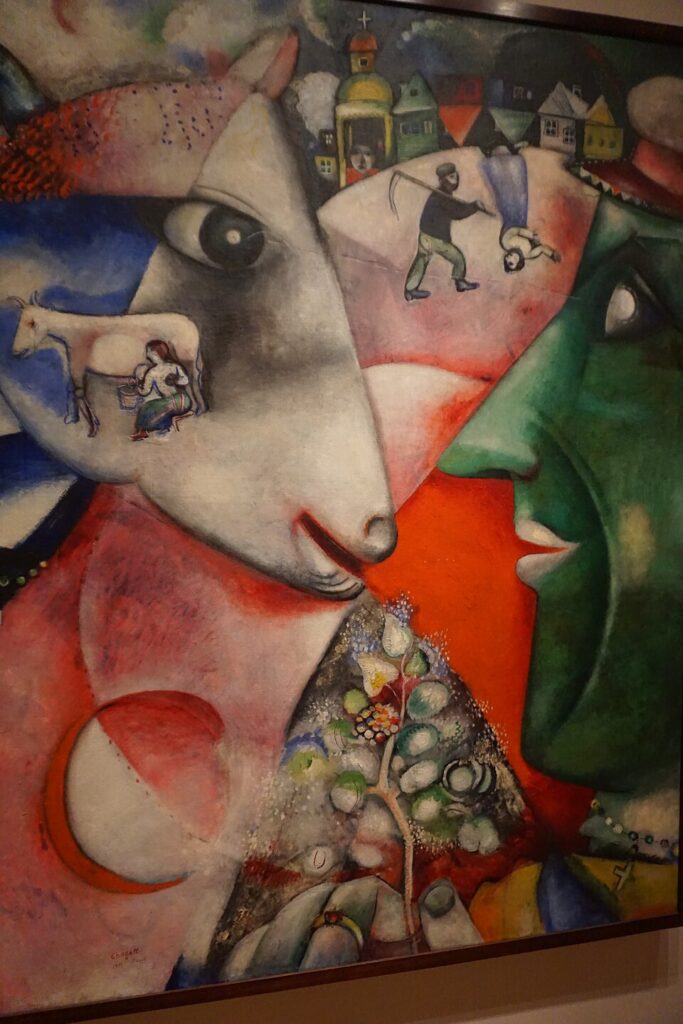
For this reason there is no above and below in his paintings, no rigid, inanimate thing, nor any dividing line between man and animal, the human and the divine. In the ecstasy of love man still wears the ass’s head of his animal nature and the angel’s countenance shines amid calamity and doom. All Chagall’s pictures are permeated by the soulful divine light — unbroken by the prism of the understanding— which in childhood fills the whole world; all reality becomes a symbol; every bit of the world is transformed into a divine mystery.
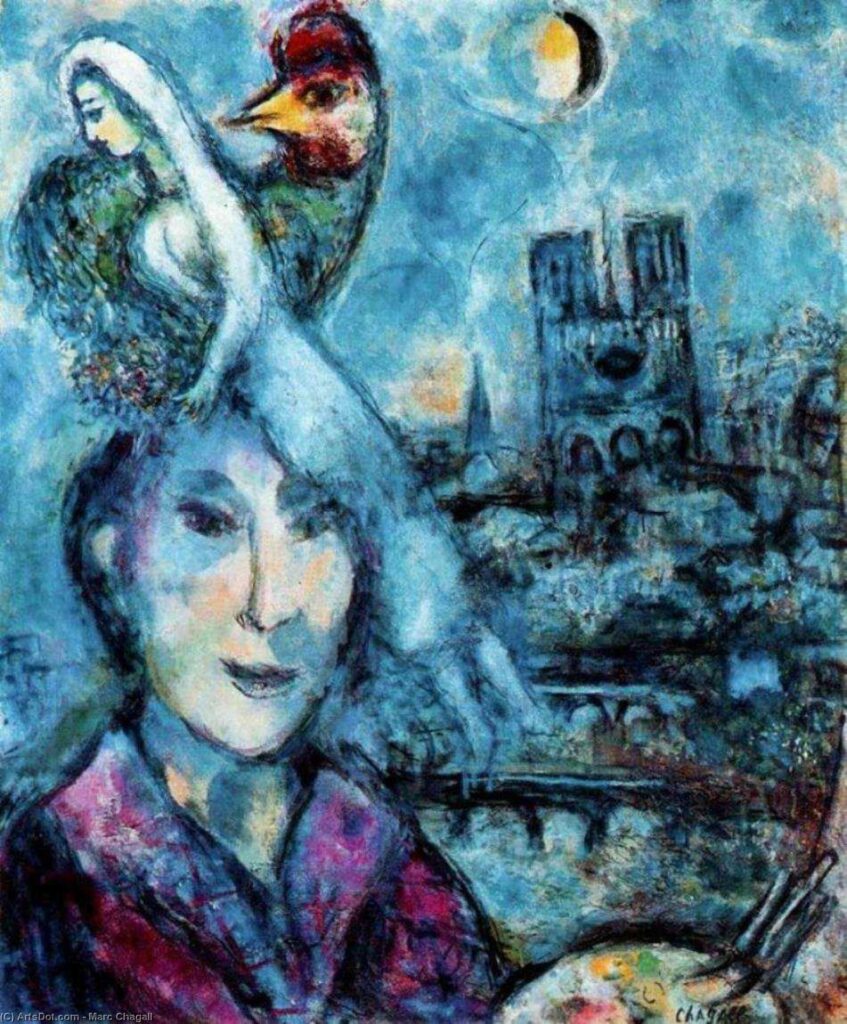
Presumably Chagall ‘knows’ nothing of what befalls him in his pictures, but the pictures themselves know and bear witness to their knowledge. There is the beloved, over and over again, in endless transformations, as soul, as angel, and as the inspiring power of the feminine. In one painting the artist— assuredly without knowledge of the ass Lucius, the unregenerate lower man in Apuleius’ romance— bears an ass’s head as he stands at his easel and the feminine soul figure guides his eyes upward; in another picture it is the angel himself who holds his palette, or else the figure of the anima, the soul, may peer out of the easel. In every case he expresses the unconscious knowledge that his hand is guided and that an earthly creature is receiving inspiration and guidance from an unearthly, suprapersonal force. In all these visions the masculine is dull, bestial, earth-bound, while the feminine blooms in all the colors
of a transfigured, unearthly radiance.
This emphasis on the feminine reflects something essentially new in the outlook of Jewish mankind, which hitherto with its ethic and spirit seemed so fundamentally patriarchal that the feminine, repressed and almost despised, could speak to it only through subterranean channels. In Chagall it is not only the compensating contrary aspect that breaks through, as in the mystical undercurrents of Jewish cultural history; rather, he is the prophet of a nascent new reality, of an upheaval from out of the depths. It is this alone that justifies us in speaking of Chagall’s prophetic mission.
The feminine soul figure that fills Chagall’s world reaches out beyond his own personal sphere and indeed exceeds the limits of any purely Jewish contemporary constellation; for the circle whose center it forms is the primordial circle of archetypal symbols, such symbols as night or moon, bride or angel, loving one or mother.
But it is striking, and characteristic for the situation of the modern man and the Jew, that the mother with child seldom occupies the center of these pictures. The Madonna-like mother with child who appears in Chagall’s paintings has always played a significant role in Jewish life as the collectively regenerating emotional force of the feminine. But she has always remained a symbol of collective forces, and has never become truly incarnated as an individual feminine power in life, or as a feminine force deep within the psyche of the Jewish man.
But the essential is the individual incarnation of the soulful and feminine in man, and this is how the feminine appears in Chagall and dominates his pictures: as a configuration of the magical and fascinating, inspiring and ecstatic soul that transforms the world with the star-fall of its colors.
For this reason the center of his work is the relation of the masculine to this type of the feminine; and for this reason it is in the lovers that the secret reality of the world flowers mysteriously over and over again. Chagall’s Vitebsk and likewise his Paris are full of this bride and bridegroom, whom he never wearies of painting; in them live the darkness of nocturnal drives and the golden light of the soul’s ecstasy. The ass of the body may stagger, it may rise on wings to higher realms; in the form of a gigantic, glowing red angel it may hold the chalice with the sacred wine of drunkenness; and yet again the moon may stand so close to the lovers that the distant bridge, like the rim of reality, marks the limit of the transfiguration in which lovers, angels, and flowers hold out their hands to one another, in which the interweaving of drive and soul, the human and the divine, of color and light, is always the one encounter, which lives behind all the rest, the meeting of the bridegroom with the bride. But this is the encounter of the transcendent God with his feminine immanence; it is the encounter of keter and Shekinah, of God and soul, of man and world, which takes place in the inner reality of every living couple.
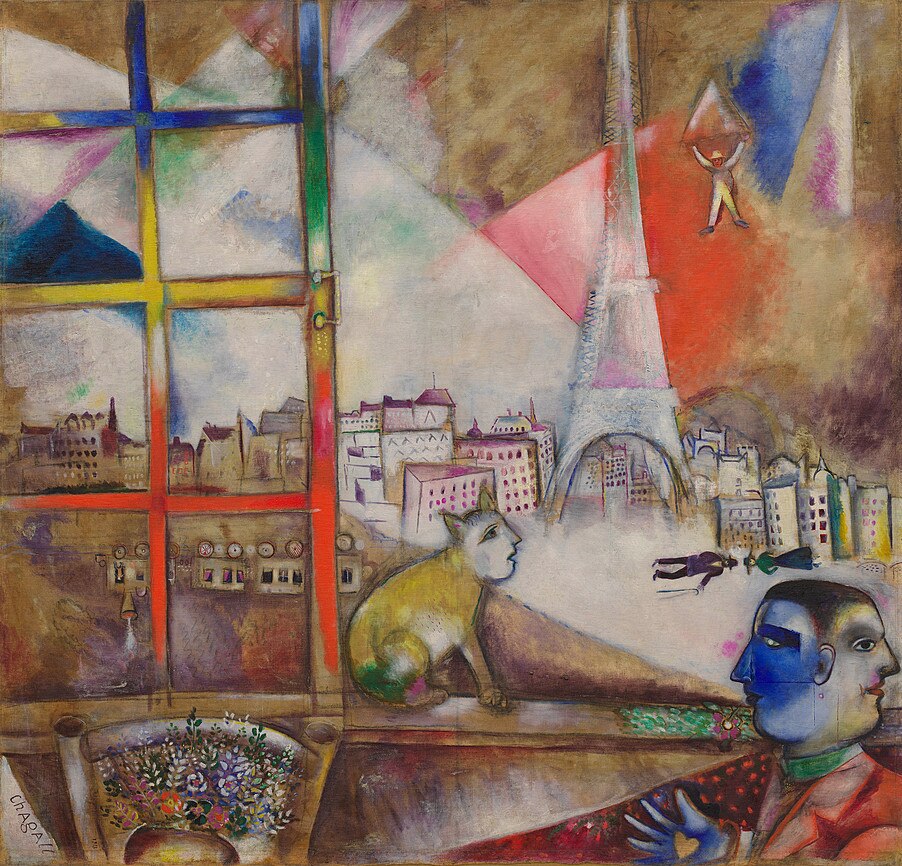
Here the cabalistic and Hasidic symbolism of Jewish mysticism become the reality of a man drunk with love, whose rich palette bears witness that creative man is made in God’s image, and in whose pictures of human life in the world the creation begins forever anew.
The lovers are God’s seal on the world, the seal in which his bond with the reality of man is confirmed like a new rainbow of promise. For despite all the terror, despite all the pogroms and crucifixions, despite all the fires and wars, this earthly life is the consolation of the godhead itself, if it is taken as the symbol that it is.
The white cow lying beside the Jew wrapped in the tallith of his loneliness is the appeasement of the maternal world; and in the nocturnal village whose poor little houses stand low and crooked between the fields and fences, there gleams the gigantic, wide-open eye of God. It watches us always, always it sees the world and us in it and itself; and everywhere it is the center of reality that becomes visible in the stillness as God’s presence. Perhaps the woman milking the blue cow beneath the moon sees this eye less than she sees the chickens and the houses; but nonetheless it dominates the night time world and opens wherever the creature comes to himself. But it is chiefly at night and under the moon, when the inwardness speaks and the world of the secret is unsealed, that the world comes to itself. And that is why the night is the time of ecstasy, when the soul’s firebird in the form of a flaming rooster abducts the feminine and the music of lovers refashions the world in the perfect original unity from which it sprang in the beginning.
Yet this glowing interior world of Chagall— in which things occupy not their earthly place but the place they hold in the soul, the place assigned them by the creation that is even now in progress; this world is by no means an airy figment. Nor is it the world of miracles and magic spells, in which the Jewish mankind that draws Messianic time down to earth in prayer flies in ecstatic concentration over the historical time of reality. Rather, it is an earthly, real world of the soul, whose nocturnal roots reach deeper than the roots of a merely earthly life, down to the primordial stream of the images, which waters every living existence.
In Chagall’s symbol world, the Jewish and the Christian, the individual and collective-primitive paganism and complex modernism, are fused into an indissoluble unity. The persecuted, massacred Jew with the phylacteries hangs as Christ on the Cross of suffering, and the cart, filled with all those terrified fugitives whose home is going up in flames, drives past the figure of the crucified one, who joins their suffering with his; for sacrifice and suffering are everywhere, and crucified mankind hangs everywhere from the Cross of the son of God.
But side by side with this there is the pagan vitality of the animals; ram and ass become Pan-like figures of the primordial pagan era, in which the angelic cuts across the divine. For nature is life with all its direct fullness of color and all its tragic depth, manifested in drives and instincts and in the wild drunkenness of ecstasy. Drunken knowledge pours from the red luminous wine and from the woman’s white body no less than from the crucifix and the scroll of the Torah, and the desperate mixture of higher and lower in human nature becomes a mysterious coincidence of opposites in the one center of life.
Here past and future, higher and lower, fuse into a dreamlike reality; as in Chagall’s enchanted forest, outside and inside appear as mirror worlds, reflecting a third world that hides its true reality behind them and in them.
This reality is just as much alive in the Jew at prayer and the rabbi as in the miserable servant girl and the drunkard, the rooster and the weary little horse. The transfiguration of sensuality in the nude lovers is the blazing fiery rooster, whose ecstatic arc cuts through the night; and the lovers in the boat or under the bridge glow like the sabbath candles or the red sun of the wedding.
All these planes of God’s hidden world become visible in Chagall’s pictures; they appear in the natural, that is, divine, intermixture that determines the world of the soul: natural thing and symbol; specter and reality; harlequinade of life and lovers’ magic; naked drive and religious ecstasy; pillaging soldiers and the silver, fishtailed dancer of the soul; trumpets of judgment and the endless train of mothers with child, of Marys on the flight to Egypt; the apocalyptic end of the world and the October Revolution; scrolls of the Torah, crucifixes, candelabra, cackling hens, ecstatic asses, and radiant violins whose music hovers between heaven and earth. And over and over again the moon.
The godhead speaks in colors and symbols. They are the core of the world of feeling and truth, a truth of the heart, the subterranean dream reality which, like a net of colored veins, runs through existence. For the ‘real world’ is only a feeble illusion that forces itself on the sober; only the drunken eye of the creative man can see the authentic world of images. One of Chagall’s paintings bears the motto that for him embodies the secret of all authentic life or knowledge of God: Devenir flamme rouge et chaude. Only the flame, the passionate devotion that summons up the profound powers of the psychic in man and makes them flow, can reveal the secret of the world and its divine heart.
But all should not taken in a pantheistic sense; it is not a universal statement about the presence of the godhead. Close as Chagall’s work is to Jewish mysticism and to symbols such as hitlahavut (passionate devotion) and dveikut (adhesion to the divine), it must not be reduced to these narrow limits. The depth and scope of a revelation correspond to the depth and scope of the psychic intention for which it is revealed, for which the world as a whole is first manifested as a creative secret.
And we find similar intentions and unconscious insights throughout contemporary painting and modern art in general, and in modern man wherever he attains to the heart of actuality. For the reaction against the mechanized and soulless forces, in man as well as the machine, against the soulless mechanization that threatens to stifle the world, is the rebellion of the soul and the inward plunge of modern mankind.
The irruption and descent of the soul into Jewish mankind— this event with which Chagall is possessed and which he proclaims— was long in preparation. Millenniums were needed before the godhead could descend from the hard grandeur of the all-governing law, from the steep summit of Sinai, before it could make its way through the luminous spirit worlds of the cabalistic spheres and transcendent divine secrets to the warm earthly fervor of Hasidic mysticism.
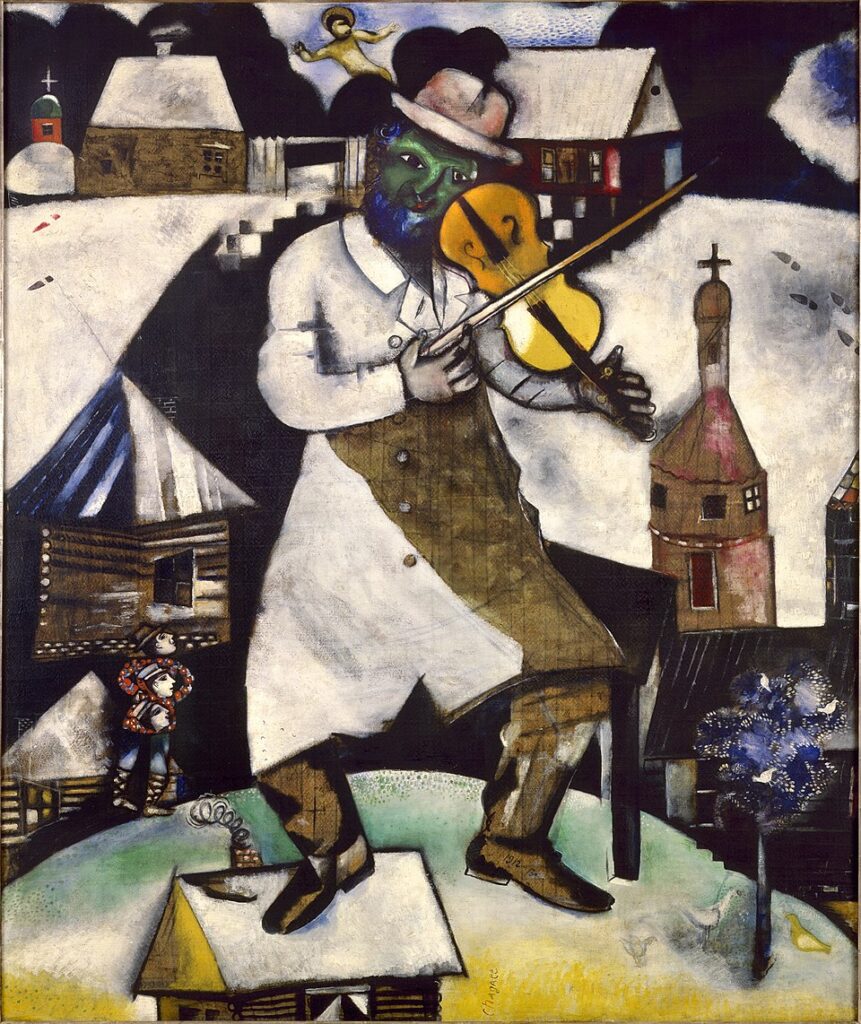
With the Diaspora, the fenced-in Jewish community opened to the world, and this descent into the world, begun in exile, is at the same time— this, in any case, is the secret hope of Jewish destiny— the rise of the Jew’s new psychic reality. This strange people, with its mixture of youth and age, primitivism and differentiation, prophetic fervor and worldly, world-building ethos, of extreme materialism and timeless spirituality — and Chagall is eminently an expression of all these traits — is engaged in a transformation. Regathered in the face of impending doom, the Jews are sowing once more the seeds assembled in centuries of exile. It is an age of degeneration and rot; the primordial world rises to the surface, the angels fall; but in all this the soul is reborn.
Yet like all birth, this birth of the human soul occurs inter urinas et faeces. The supreme values collapse, the candelabra totter, vainly the angels blow the shofar of judgment, and bearded Jews unroll the parchment scrolls of the Torah. Everything is carried downward by the fall of a world, and this catastrophe, this crucifixion, is enacted in a sea of blood, violence, pain, and tears. The crematoriums of the concentration camps and the mountains of corpses of the world wars are the stations in this catastrophe and this transformation. For the catastrophe is a rebirth.
The fate of Jewish mankind is also the fate of Europe, the fall of Vitebsk is also that of Paris, and the wandering Jew is the wandering of countless millions of uprooted men, of Christians and Jews, Nazis and Communists, Europeans and Chinese, of orphans and murderers. A migration of individuals, an endless flight from the extreme limits of Asia through Europe to America, an endless stream of transformation, whose depths are unfathomable and whose aim and direction seem impost c to determine. But from this chaos and catastrophe, die eternal rises up in unsuspected glory, the eternal that is age-old and then again utterly new. Not from outside but from inside and below shines the mysterious light of nature, the divine gloriole of the Shekinah, consoling and healing — the feminine secret of transformation.
Chagall’s aloofness from the events of the world is anything but indifference to the happenings of his time. Perhaps the pain-drenched colors of the dying villages and homeless fugitives in Chagall’s pictures mourn and suffer more profoundly than Picasso’s famous Guernica.
Chagall lacks monumentality because any rigid, monumental form is bound to dissolve in such a swirling stream of emotion, because the pain is too great and its immediacy hollows out all circumscribed form from within. It is the dissolution of a world out of joint, a world whose whole soil is shot through with volcanic crevices; the norms collapse, floods of lava destroy the existing order, but geysers of creativity spurt from the tortured soil. For in this very dissolution a deeper plane of reality is disclosed, yielding its secret to those who, torn like the world itself, experience its primordial psychic source, which is also their own. The divine and the human travel the same road, the world and man are not a duality of one confronting the other; they are an inseparable unity. The moon rises in the soul of every individual, and the house in whose forehead the eye of the godhead opens, is you yourself.
Chagall’s aloofness is that of the lover who looks toward the one unknown that gives him the certainty of his own being-alive. It is the age-old covenant of Jew and man with the God who, shorn of all limits, not only offers his succor, but sacrifices himself to every nation and every individual. In each man Sinai burns, each man is crucified; but each man is also the whole of creation and the son of God.
Like the break-through of the soul in modern man in general, Chagall’s break-through is not so much an act as a suffering of the naked truth concerning the man to whom our epoch does something that it does to every man who truly lives in it. Nothing human remains except for what is divine. Chagall’s aloofness is the experience of a man to whom the divine-human world has opened, because the earthly-human is so drenched in the horror and suffering of transformation that his feeling can only remain alive if he keeps a perpetual hold on the heart of existence.