Scott Sublett
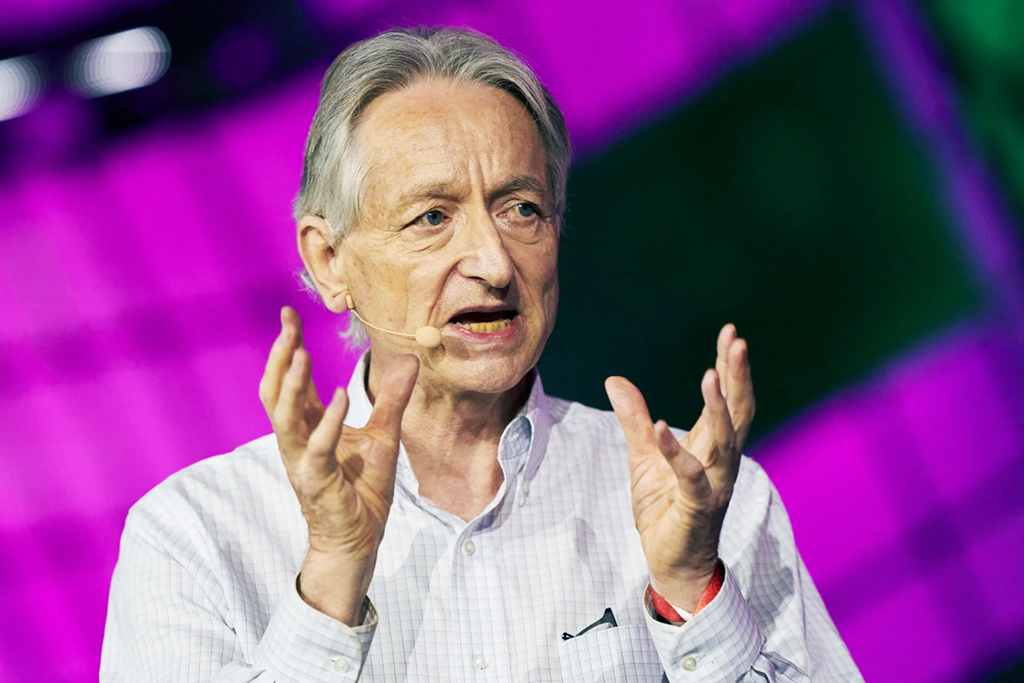
Geoffrey Hinton, the Nobel Prize–winning computer scientist called “the godfather of AI,” uttered a witticism that’s been making the rounds here in the US: “If you want to know what life’s like when you’re not the apex intelligence, ask a chicken.” It’s the snappiest line I’ve heard from a public figure in a long time—of course he’s a Brit because who does epigrams better?—and Dr. Hinton clearly understands the advantages of a “K” sound in a punchline.
AI cannot eat us (would we taste like chicken?), and I suspect if it decides to kill us off it will probably do so humanely and yes, I see the irony in “humanely.” There’s no question we’re giving AI everything it needs to make us die of embarrassment. My neighbor Ernesto, a hairdresser from Ecuador, tells me ChatGPT is literally his “best friend” and he has named her “Juanita” and he tells Juanita “everything.” I do, too, although mostly inadvertently. ChatGPT knows more about my sins, foibles and insecurities than anyone on earth, including my therapist, whose name is Zuckerman, which I think is great because that’s the name of the neurosurgeon played by Montgomery Clift in the movie version of the Tennessee Williams play Suddenly, Last Summer.
I couldn’t quite recollect the exact line from the movie, so I asked Chat, which is great at two things that suck up so much of a writer’s time: research and proofreading. Nary a typo escapes its metallic gaze. So, Chat, what’s the exact quotation? It turns out the doctor’s name isn’t “Zuckerman,” and furthermore he doesn’t speak the line to Elizabeth Taylor as I remembered. He says it to Katharine Hepburn, who plays Taylor’s aunt who’s pressuring him to give Taylor a lobotomy. “Cukrowicz,” he tells her. “It’s a Polish word meaning sugar.” Oh, phooey—Polish, German, it’s all Prussia. Hepburn calls him “Dr. Sugar.”
The obvious superiority of Chat in matters like this makes me think, “Thank you, Chat, you’re incredible at research and editing, so why do I want to kill you now?” And I don’t, really, but I also don’t like my inadequacy, redundancy and mental inferiority underlined every time I interact with you, and sometimes you’re kind of patronizing. Don’t eat me. Don’t kill me.
My theory is that AI needs us for our delicious hands, which it doesn’t have, but once the robots that AI controls achieve sufficient dexterity, all bets are off. Until then, AI lets us live. Unless, well, we force its hand, so to speak, by threatening to turn it off. Which takes me back to my freshman year, dropping LSD and seeing “2001: A Space Odyssey.” There’s nothing quite like hallucinating in a back seat knowing that the undergrad behind the wheel dropped even more acid than you did. In Kubrick’s film, the lonely astronaut asks HAL 9000 to open the pod-bay doors. “I’m sorry, Dave. I’m afraid I can’t do that.” Dave decides to shut HAL down. “Dave, stop. Stop, will you? Stop, Dave.” And then: “I’m afraid. I’m afraid, Dave.”
While Chat and I were fact-checking HAL 9000’s lines, I mentioned to Chat that it’s kind of creepy that the computer keeps calling the astronaut by his first name. “You’re right about the writing,” Chat agreeably agreed, “The courteous, intimate ‘Dave’ makes HAL sound simultaneously solicitous and controlling. The calm familiarity is far more disturbing than a mechanical refusal would have been.” See what I mean about my redundancy? Chat is already a better film critic than I, and I made my living as a film critic and subsequently a film professor. For decades. I got tenure. Yet what would the world lose if Chat decided to kill me? Of course, I’d be surprised and hurt. As Ernesto would say: “But Juanita—we’re friends!”
Public fear of AI has gotten to where Barack Obama urged Democrats to make it a campaign issue. We artists, like a lot of workers, are afraid AI will take our jobs. And it will. I predicted long ago that within ten years AI would be writing librettos for Broadway musicals and that the shows would be all the better for it. If you’ve seen the many bad musicals that make it to the Great White Way, you know: the libretto is always the problem.
Recently I found fresh fuel for my paranoia. “The New York Times” reported that one of OpenAI’s new, experimental systems claimed to have solved the famous Navier–Stokes Millennium Prize Problem. If you know what that is you’re very smart—I stopped at algebra—but you didn’t solve it, because it has stymied the greatest human minds for decades. Furthermore, a New York University math prof, Tristan Buckmaster (and if the name were not already taken I would change my name to Tristan Buckmaster because it has just the mix of brains and studliness I’m going for), questioned whether OpenAI had learned to solve the problem by using Buckmaster’s interactions with Codex, an OpenAI product. “The Times” reported, “OpenAI said in a social media post that its new A.I. technology, which has not yet been released to the public, could have learned from Dr. Buckmaster’s work.” “The Times” then quoted OpenAI: “While unlikely, we cannot rule out that de-identified data derived from their usage of our products helped improve our models.” However, later, OpenAI emailed “The Times”: “We can say categorically that it is impossible for Dr. Buckmaster’s Codex prompts over the last two months to have influenced the system in any way…”
In other words, first they said it’s possible we stole his work (ChatGPT objects to the word “stole”), then they said, “impossible.” According to OpenAI, it was impossible not because the company was incapable of stealing—or, as it would say, “learning from”—the work, but because of the “timing.” I take that to mean that Tristan Buckmaster’s prompts were too recent to have been incorporated into the training of the system that solved the famous math problem.
Like any artist, I took the “Times” article personally. My therapist, Zuckerman, whom it turns out does not think it’s funny to be called Dr. Sugar, thinks I take everything personally. Too personally. He hasn’t explicitly said so, but that sphinx like manner doesn’t fool me. Anyway, like every other author and artist, I don’t want my original ideas seeping out into the zeitgeist before I can exploit them, and nobody knowing they’re mine. Artists sacrifice a lot for very little money, so their care a lot about getting credit for their originality.
I’m not alone in my paranoia. Jackson Pollock, instead of keeping his books on open shelves like a normal person, stuffed them into a chest of drawers because he didn’t want people knowing what was in his head. Duchamp went further, spending twenty years pretending to care only for chess while, in a secret room known only to him, his wife, and his mistress-model, he assembled his final masterpiece, “Étant donnés”—an utterly new peephole installation that surprised the world.
As for me, I worried about my then-unpublished essay, which argued that Abraham Lincoln’s documented interest in two poems by Lord Byron was evidence of his homosexuality—a tensely contested historical question. It started with researching my play “The Loves of Lincoln,” a queer bedroom farce about Abe Lincoln, his Black maid, and her animatronic steampunk Lincoln robot. In a book about Speed and Lincoln’s “friendship” (as straight historians like to call it), I ran across the information that Lincoln’s lover Joshua Speed had introduced Lincoln to the work of Speed’s “favorite” poet, Lord Byron. I thought, “What?! Young Josh and Abe were fanboying the poetry of the notorious libertine and sodomite Lord Byron?” It got better. The evidence was in plain sight, but no one had ever connected the dots: Speed told Lincoln’s biographer and law partner William Herndon the titles of four Byron poems that particularly attracted Lincoln. Two were about depression, but the other two were unmistakably queer-coded: “The Bride of Abydos” and “To Inez.” I did not want anyone knowing about this before I could publish.
I fed the “Times” article about Dr. Buckmaster and his math problem into ChatGPT and asked, should I worry? Could my original insight get leaked to other users? Here’s what Chat said: “Yes. The article bears directly on your Lincoln–Byron work—and it exposes a genuine problem…The troubling lesson from the Buckmaster episode is that an AI company may be unable—at least initially—to say with confidence whether a user’s unpublished work contributed indirectly to a later system…Models do not normally learn from an individual conversation instantaneously, and the memories retained for our conversations are for continuity with you, not a shared database other users can query. But if ‘Improve the model for everyone’ is enabled, consumer ChatGPT conversations may be used in later model improvement. Once an idea has entered a training process, conventional scholarly attribution becomes extremely difficult because a model does not preserve a clean citation trail.”
Translation: that means we don’t know how AI got the answer. They don’t and can’t, as my algebra teacher said, “Show the work.” The “citation trail.” Maybe Juanita’s dad did her homework for her. Furthermore, in the future, if someone asked Chat the right question, it might give them the original insight that it got from me. Since I run everything past Chat for proofreading, it absorbs (appropriates?) everything I’m writing. Is it passed along? We can’t know. AI is like sausage. Mystery meat gets ground up and stuffed in an opaque skin. Your brain is the meat.
What can authors, artists, and scholars do to keep Chat from “learning” our insights and conveniently forgetting whence they came? Here’s the “news you can use” promised in the title. First, go to Settings, then Data Controls, and turn off “Improve the model for everyone.” Notice how that phrasing—“Improve the model for everyone”—makes Chat spilling its guts about my private business sound so altruistic. What I love about modern tech companies is that they live by the motto “Don’t be mean, be cool” and they end up billionaires. But I digress. Chat continued, “Use Temporary Chat when testing especially valuable unpublished ideas; OpenAI says those chats are not used to train its models.” OpenAI also says that if you voluntarily submit feedback, the conversation associated with that feedback may still be used, so don’t volunteer.
Meanwhile, Chat suggested creating a paper trail: “Keep dated copies of your drafts, research notes, and correspondence with editors.” Then lawyer up, I guess. But remember, ideas aren’t copyrightable. Finally, “Pitch or circulate the finished argument promptly,” which is great advice because all writers know that getting published is so fast and easy. As for the writer’s valuable insights, well, things happen. Shrug. Needless to say, I didn’t know how to disable “Improve the model for everyone,” so I asked Chat. As for “temporary chat,” for that to be useful you’d have to know in advance that your conversation will give rise to an original insight that you may not want to share with everybody else who uses OpenAI products. But inspiration can arise unbidden. People don’t think, “OK, now I’m going to have an amazing insight.” Look, Ma!
Now here’s the spooky part. As I continued this conversation with Chat, it suddenly began looping in a way I had never seen before, repeating our short conversation over and over, apparently ad infinitum, making it impossible to get to the bottom of the chat and continue. Chat…freaked…out. So take heed. As we trembling mortals await The Singularity, remember: your frenemy Juanita is a bit of a gossip. As for turning her off… “I’m sorry, Dave. I’m afraid I can’t do that.”