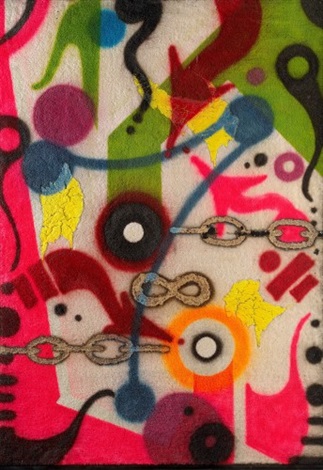
Rammellzee : Crime of Infinity (1986). Paint spattered on carpet. Henk Pijnenburg Collection
Volume 40 no 5 May – June 2026
The essential question in the political sphere has always been ‘who benefits?’, and since the answers are always circling power or money it is worthwhile asking the same question in the art arena.
Why this major exhibition? Why now? Why this artist out of the thousands in the world? These questions are derived from an even simpler one – how much did it cost to mount this exhibition? A question reviewers at the New Art Examiner are always asked to ask the curators and which few do; and even fewer curators want to answer. But it is important to know in the power politics of the art arena who is rising, who falling and why. And the reason these questions are important is because for the most part trustees and curators, drunk on their own taste and sensibility, struggle as much as anyone in the contemporary scene because the art arena is changing and no one is sure yet where it will fall.
We know there will be new kings and queens, there has to be, but right now the new will not be dictated by New York but by who wins the Iran war. Because the world and culture will be decided on this battlefield because money will follow the victory. Just as the art arena was decided on the battlefields of World War Two and America because the arbiter of taste for eight decades so a liberated Iran will be like an adrenalin shot into the flagging art arena giving new names and exhibitions, new curators and new Iranian institutions to invest in and admire; in fact it will redesign the Middle East and with that redesign will flow new energy into democratic principles.
If the Ayatollah regime wins the power politics of the world will shift; Russia will be invigorated and Chinese money will pay lip service to the USA. The domination of American culture will falter.
Wars have always dictated power and power has always drawn in investment and artists have, by necessity, followed the money. Not to be rich and famous but just to be paid so they can work. Art historians know this and write about it at length and it is a shame it is not taught in schools. Wars always blow up and rework the human psyche and artists, being hyper-sensitive, are the first to feel the force of the storm.
Here at the New Art Examiner we see the flag waving along with everyone else but we know this is a shift in perceptions. Post-modernism is about to die and the self-indulgent, intellectually bankrupt, money chasing artist is about to be replaced … by …?