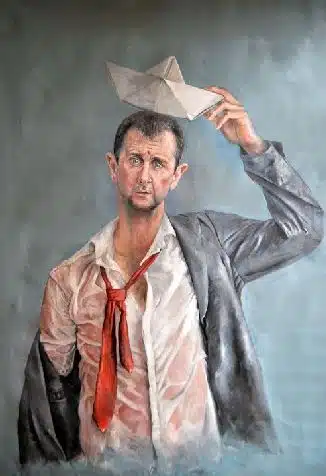
Abdalla Omari: Bashar Al Assad
Nour Asalia
Robin Moger (translator)
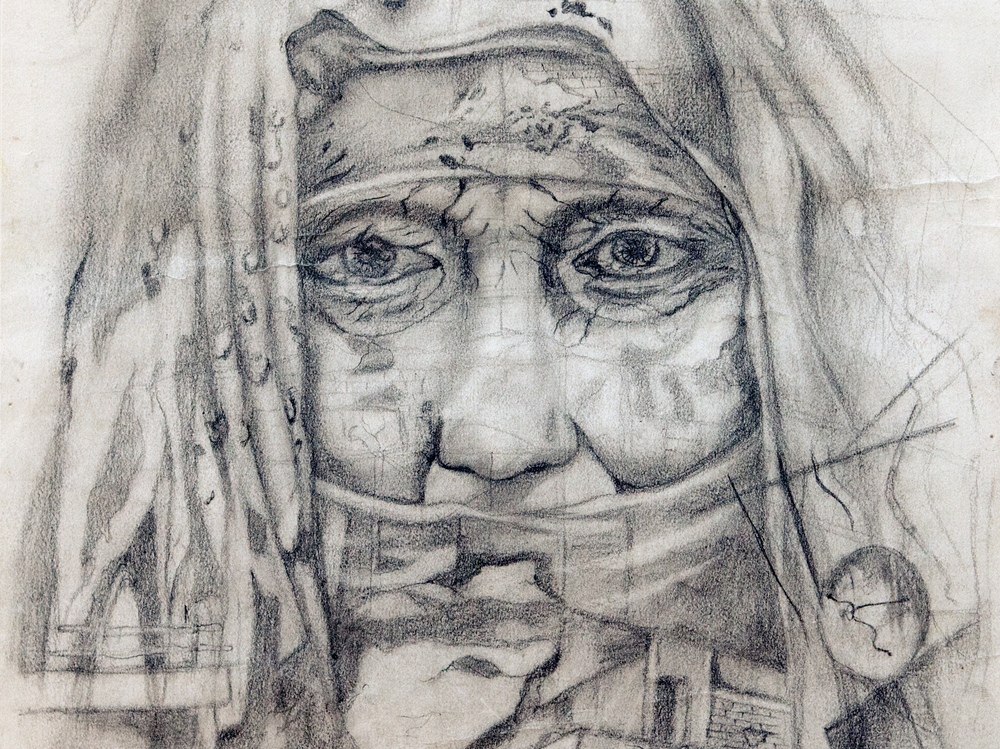
Courtesy of the artist
The war in Syria has generated extremely complex and intertwined questions, both personal and general in their focus.
Existential, cultural, and epistemological concerns rub shoulders with issues of identity and, as they have expanded, have resolved into new lines of inquiry and concepts which have migrated from private to public, from hidden conviction into general circulation.
Over the last decade, a time of dispersal and diaspora, Syrian artists have found new frameworks for creativity and inspiration; the forms and sources of their work as diverse as the geographies over which they have spread and the cultures in which they move. The growing realisation that there was a pressing need to document and bring this art to wider attention sparked a desire to conduct radical criticism, and update the theoretical frameworks through which it is classified and taught.
Almost all serious contemporary studies of Syrian art history reference difficulties that stem from the incomplete, arbitrary nature of the archive – inaccessibility and damage to documents and images, or the paucity of specialist critical and philosophical writing, particularly that related to the period before 2011. These difficulties are primarily the product of the relatively recent recognition of art’s role in Syrian society. Up until the turn of the millennium, fine art was essentially an elitist pursuit, with artists representing a highly limited cohort.
From the 1960s, which witnessed the founding of the College of Fine Arts in Damascus and the emergence of independent galleries, through to the proliferation of private galleries in the 1990s, the majority of locally produced art writing was confined to prefatory critical overviews in exhibition catalogues and press coverage. In the case of cultural journalism, this writing was dominated by questions around the documentary, social or patriotic nature of the art, artist or gallery, with the majority of it published in the culture pages of local newspapers. It was not until 1980, with the founding of al-Hayat al-Tashkiliyya (Plastic Life), that a dedicated platform was created. Published by the Ministry of Culture and helmed by the Syrian art historian Tariq Sharif, this one-of-a-kind magazine did not confine its focus to only Syrian art, but sought to spread awareness of international artistic movements and artists. According to the writer and critic Saad Al Kassem, the magazine appeared on an irregular basis in black-and-white up until 2000; as late as 2013, its images of artworks lacked the necessary image credits and captions.
To understand the roots of the theoretical shortcomings in Syrian art criticism, it is necessary to note that there currently exists no specialist overview that deals with the history or philosophy of Syrian art as an independent subject; study of these fields remains the preserve of courses taught at the College of Fine Arts in Damascus. What writing does exist has been produced by journalists from the cultural press, novelists and poets, and occasionally artists themselves – especially after returning from studies abroad where they were exposed to art theory at art institutes. Moreover, the library of the College of Fine Arts in Damascus has long suffered from a serious lack of philosophical and critical texts, particular in Arabic. As for its art history holdings, one resource for primary knowledge still being used up until the early 2000s was The Eye Hears and the Ear Sees, a series of 28 books first published in 1971 in which Egyptian writer and former minister of culture Tharwat Okasha presents an historical overview of regional and Western art. Aside from these texts, students relied on materials such as the works of Afif Bahnassi, an historian who had taught history of art and architecture at the college since its foundation. While the college’s library contained numerous visual resources (mainly catalogues) for the work of the most celebrated Arab and international artists, the majority of its texts were not in Arabic, at a time in which the fundamentals of foreign language teaching in the country (even at the highest levels) were particularly weak. Students were faced with a lack of dedicated art-related material in the very place that was supposed to provide it for them, and as a result their artistic development and education relied on the vagaries of individual efforts, each according to their ability.
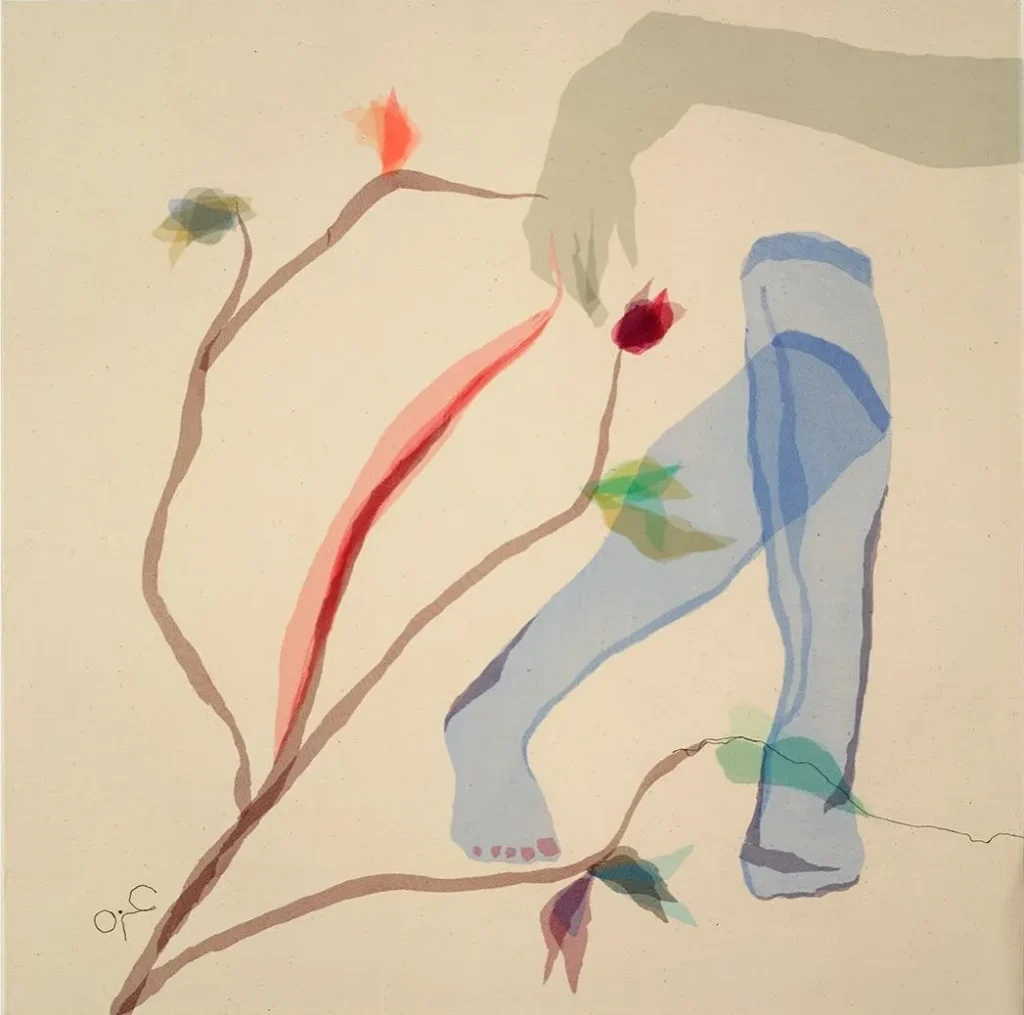
part of a solo exhibition which was held at Saleh Barakat Gallery in Beirut
Tulle laying and Thread drawing. On canvas
It is, therefore, important to note here the importance of translations. In 1978, Georges Tarabichi translated Hegel’s Vorlesungen über die Aesthetik (Lectures on Aesthetics) – one of the foundational texts for the philosophy of aesthetics since it was rst published in 1835 – into Arabic from a French edition. The importance of having this book available to students lies in its focus on concepts of beauty and its apprehension in their relation to the arts, and the contrast it makes with the work of the Arab philosophers, whose spiritual/mystical approach is immersed in the aesthetics and perfection of nature as an aspect of a divine creation, or focuses on artistic practices derived from handicrafts.
Art criticism in Syria emerged in parallel with the foundation of its contemporary plastic arts movement. In his book,Historical Figures in Art Criticism, Abdul Aziz Aloun writes: ‘The first record of a critical introduction in Syria came on 6 February 1948, at Dar al-Homsi in the Azizieh neighbourhood of Aleppo, where poet Omar Abu-Riche and author Sami Kayali introduced an exhibition of a number of artists. Abu-Riche’s poem addressed the subject of sculpture and form,while Kayali spoke about art exhibitions as a civilisational phenomenon. Their introductions were an evolution of the discussions held by Aleppine intellectuals Ghalib Salem and Munib Naqshabandi in the mid-1930s around questions of art and art history.’
One of the principal functions of criticism as an intellectual practice (regardless of the school to which it belongs) is to engage with the public and bring them closer to art through the exercise of judgment and standards, and the processes of classification, evaluation and analysis. In his book Art Criticism and Reading the Image, Afif Bahnassi distinguishes three principle roles for the critic: ‘A classificatory role, linked to art movements; an historiographical role, reviewing the sources of these movements and their mutual influences; as a guide during particular stages of the artist’s development.’
Aloun himself might be described as a critic of many roles. His involvement in Syrian art had its roots in his work for the Modern and Contemporary Art Gallery – for whose spring and autumn exhibitions Aloun had been writing texts from the time it first opened in 1960 – and a period during which he worked for the National Museum in Damascus. In 1962, he discussed the possibility of organising a public conference for Arab artists in dialogue with Mahmoud Daadouch, Fateh Moudarres and Wadie Rahmeh. One of the points raised during this discussion was to affirm the role of the critic and attempt to formulate an anti-colonial art discourse committed to social, artistic and nationalist causes. Aloun discusses the circumstances surrounding this venture in The Sixties: A Turn in the History of the Fine and Contemporary Arts in Syria, in which he relies on the images, documents and files of his own archive and that of the Modern Gallery, because of which the book is cited by a number of contemporary studies of Syrian art. He also reviews the manifesto that he, Daadouch, and Moudarres drew up for a plastic arts movement in Syria. Article 10 of the manifesto (which was published in April 1962) addresses the role of criticism and artistic culture, linking them to the human condition and the creative impulse: ‘Artistic culture – which comprises art history, aesthetics, and art criticism – is one link in the chain that binds the artist to the public; when a person possesses this culture, there is no need to put their humanity to the test. We reject art criticism based on stylistic impressions; in our view, the task of art criticism is to observe direct radiation in the artwork. The critic must discover the indirect and objective aesthetic elements within the piece. We pity the critic who does not believe in time’s arrow, and we call on them to see a window in every artwork, flung open to the future.’
As a consequence, up until the 1990s art criticism was also influenced by social issues – in particular, those around belonging and identity – and a number of Syrian artists themselves came to share the same concerns. Louay Kayyali, for instance, was interested in the mass migration of Palestinians – an influence evident in a 1967 exhibition that included his famous painting, Then What?. Moudarres in turn derived his palette and lexicon of images from the soil of the motherland, while Nazir Nabaa’s work contained elements derived from Damascene homes and traditional women’s clothing. In a video recording designed to document Syrian Crafts – a project that formed part of the programme for Beirut’s year as UNESCO’s Cultural Capital of the Arab region in 1999 – Elias Zayat talks about his formational intellectual and visual influences. He quotes the phrase of Lebanese author and artist Khalil Jibran Khalil, ‘my mother’s face and the face of my nation,’ to express both his attachment to ‘the civilisation of the face’ and to emphasise its local nature. Zayat’s preoccupation with the civilisational value of art and its connection with historical and geographical identity is present in much of his writing, and is powerfully evident in his art. In his text, The Historical Nature of the Plastic Arts in Syria: From their Roots to the Present Day, Zayat writes: ‘Painting, drawing, embellishing, decorating…the term itself is not important. In Syria, the image has always been a companion of civilisation, and is always symbolic and expressive. Thus, writing derived from the image.’ It is worth pausing over this phrase, because it confronts us with the problematic binary of word and image that frequently surfaces in writing about Syrian art. Such writing is often accused of being proximate to – if not actually embodying – purely literary forms, and criticised for its use of florid or ‘poetic’ description. It goes with saying that the coexistence of text and image (the read and the seen, the imaginary and the tangible) are as old as Arabic poetry itself, and Syrian art history offers many instances of such comparisons. In his introduction to the collected correspondence of writer Abdul Rahman Munif and artist Marwan Kassab Bachi, The Literature of Friendship, Lebanese historian Fawwaz Traboulsi writes: ‘The two friends converge over a single, major concern: an artist in search of ways to express himself in words, and a novelist obsessed with art, testing the power of words to express line and colour and form.’ In a letter written by Munif to Kassab Bachi, April 28 1994 we read: ‘Transforming painting into words is a disaster; turning words into a painting is a disaster greater still. I sometimes feel wildly angry when an artist is required to explain their work, to define it.’ It is as though this implicit acknowledgement of a painting’s self-sufficiency has its origin in a refusal to link the visual with the spoken.
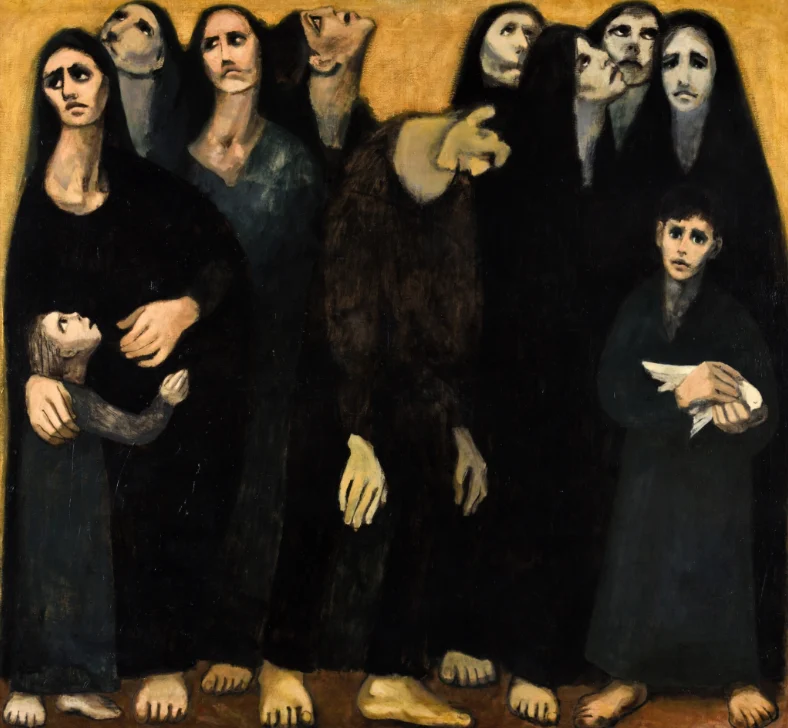
oil on canvas
In the book Elias Zayat: Cities and Legends, we encounter another attempt to define the image through the text – particularly the poetic text. The Syrian poet Adonis writes: ‘The icon appears as primal water between the hands of Elias Zayat. In this water, waves of wings brim and ood, some circling through the field of the image, others flying along the horizons of meaning.’ Adonis goes further, attributing speech to the painting: ‘An icon-painting said: Perception is my only transparent covering.’ But deconstructions of the relationship between the image and its imaginary aspects on the one hand, and the word, with its ability to steer understanding, on the other, reached its philosophical apogee in the ideas of Fateh Moudarres. For instance here, in this conversation with Adonis: ‘Do you know why Al-Maari was wonderful? Because he was blind. If he had been able to see the world with his own eyes, he wouldn’t be Al-Maari … because he never depended on reason in its different manifestations and judgments; he only relied on intuition, a much loftier faculty.’
It is well-known that Moudarres operated with an instinctive freedom in his own paintings, poetry and short stories, away from the rational concerns of definitions and rules. His admiration (if the word serves) for blindness, was not simply a protest at the ugliness of the world, but an afffrmation that the concept of the image cannot not be confined to what is visible.
In Syria, for obvious reasons, aesthetics was to remain a subject with a limited readership. Instead, the historiography of art and art criticism occupied the greater part of cultural life in the country. Art history contextualised the historical circumstances that influenced the formation of art movements and their evolution, as well as the personal documents and experiences of the artists, their autobiographies, their memoirs, and their correspondence. Studies that focused on aesthetics were naturally few and far between. Examples of the latter include The Shock of Modernity in the Arab Painting by artist and scholar of aesthetics Asaad Arabi, in which he explores the aesthetics and visual references of various artworks. Among Arabi’s many other critical and analytical works is The Aesthetic Characteristics of the Syrian Craftsman, in which he refers to ‘the characteristic nature of the geographical palette, the chess-like construction, and the expressionist graphical qualities,’ of the works of pioneering Syrian artists.
In the wake of recent changes in the course of Syrian art’s development, with the new spaces and audiences which it was forced into by war and its subsequent exposure there to previously unfamiliar concepts, subjects and forms, a new set of philosophical concerns can be perceived in the writing that addresses it. In their jointly authored book on the theory of destructionism in Syrian art, the philosophers Nibras Chehayad and Guillaume de Vaulx D’Arcy write: ‘On the aesthetic level, destructionist art is primarily about with disappearance. Not in the same way as the art of absence, which characterised a particular 20th-century current, especially after Auschwitz, that manifested the void left by the disappeared. Rather, it is an art inscribed on the horizon of disappearance, an art with the double task of maintaining the world as it is, and of manifesting the horizon of its absence.’ The importance of this profound philosophical contribution lies in the broad scope of its perspective on Syrian art as it searches for a place outside the limits of regional realities, offering a new vision in keeping with the present moment.
In conclusion, an awareness of shortcomings in writing on Syrian art prompts us to offer contemporary critical analyses and documented historical narratives. In Modern Art in the Arab World: Primary Documents, Anneka Lenssen, Sarah Rogers and Nada Shabout edit and introduce a selection of foundational critical texts by Syrian writers and artists Abu Khaldoun Sati Al Husri, Orhan Miyassar, Adham Ismail, Adonis, Abdul Aziz Aloun, Fateh Moudarres, Mahmoud Daadouch, Mohammed Al Maghout, Naim Ismail, Adnan bin Dhuryal and Munir Sulayman. The editors think it likely that the first Arab text to offer a definition of painting was written in 1882 by the Lebanese Syrian intellectual and historian Butrus Al Bustani.
In Beautiful Agitation: Modern Painting and Politics in Syria, Lenssen sought to close this gap, describing documentation as the cornerstone of art writing, and she has given an interview in which she discusses various causes and aspects of the issue and the reasons that rst drew her to it.
Today, the cultural press and art books focus on coverage of exhibitions and interviews with artists. Anthropological and sociological studies that offer analysis of Syrian art as a tool for political change proliferate, and readings that address the deeper philosophy and aesthetics of these works remain thin on the ground. Perhaps we are in need of art writing that poses the question: ‘Who are we writing for and why?’ In other words, writing that derives its meaning from this double-sided offshoot as well as from the art itself, coming to constitute – as a priority – a study both of aesthetic issues, and those connected to Syrian art, its visual sources, and its movements.