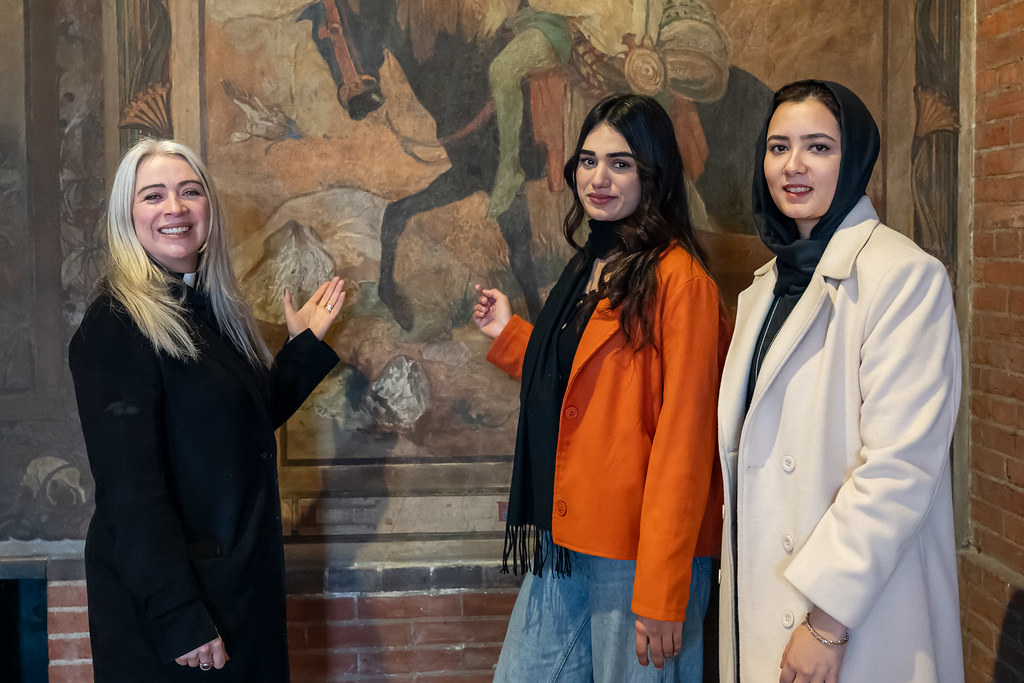
Reverend Emily Koltveit with two of the restoration team
DN: Hello Philip.
PD: Hello, hi, just give me a minute. Can you hear me ok
DN: I can hear you fine. Thank you very much for coming.
PD:Excellent, oh great, okay, good, right I’m in your hands
DN: That’s fine Philip. I thought, it’s only 20 minutes, so what I thought I would do is just ask you to tell me a little bit about the work of the Commonwealth Heritage Forum, what Courtauld Institute of Art and you are hoping to achieve at St Jude’s on the Hill, and then I’m up in London in March and April actually with Reverend Emily, I can talk to the two women restoration artists who are doing some of the work and maybe do another interview with them for May issue.
PD: Oh that’s great.
DN: Thank you so much for your time. Could you just tell me a little bit about what the Commonwealth Heritage Forum is, and why you set it up?
PD: Right, well this goes back to about 2017 when I founded the Forum and I took lots of soundings from other organisations here in the heritage sector and more widely, including government and Foreign Office, and everyone agreed that there was a gap in terms of practical support for Britain’s shared heritage overseas, if you like.
It was largely excluded from any grant support from existing sources here. So, also when I’ve been travelling around the Commonwealth doing work on architectural research for the last 40-50 years, everyone was saying to me wherever I went, ‘well why isn’t the UK doing more to help us with our heritage?’
‘It’s a shared heritage, we value it and we want to help save it.’
So that was one of the drivers for me setting up the Forum and initially for the first couple of years we just did newsletters and talks and the like and then I secured funding from a private sponsor of £12.26 million, for heritage skills training around the Commonwealth on heritage at risk.
And this isn’t just colonial heritage in the broadest sense or British heritage, it’s actually heritage of all periods across the Commonwealth. So that was set up and we launched that three days before Covid19 hit us all. It was the last big gathering in London;
Australia House with the high commissioners there and everything, so it got a good send-off but then we hit immediate problems. But in spite of that we’ve carried on and secured agreement from the Cabinet Office for the whole programme to have the prefix Queen Elizabeth’s Second Platinum Jubilee Commonwealth Heritage Skills Training Programme. And we were the only national organisation to achieve that, to secure that, the requirement of the late Queen.
So that’s a measure of its significance, if you like, as a charity. And since then we’ve worked on about 70 projects across the Commonwealth in 30 different countries providing heritage skills training, not just in those countries but also bringing people here to City & Guilds training schools and Dumfries House in Scotland for training. Also this summer, again another bout at City & Guilds and Wentworth Woodhouse in Yorkshire which is a twin-centred one, and another one in Singapore which is again, for Southeast Asia.
And we also support heritage champions in various countries as well who intended to develop the heritage agenda and work with us to facilitate the work in those countries. And that’s been quite successful.
So where we are at the moment is to say we’ve done about 70 projects in 30 countries, all overseas.
And the work at St. Jude’s is the only project we’re doing in the UK. The reason for that is that we had a task list at the beginning of this programme, the whole programme, of the particular skills that we should be concentrating on and assisting with. Frescoes and murals being one of them.
And we have for the last couple of years done a major programme in Lahore, supporting frescoes and murals restoration and Kashkari work in Pakistan, very successfully in Lahore. And another further phase will be carried out over the next year or so. And it was very evident, clear to us that the cultures may be different if you like, but the skills are very much the same across lots of different sort of religious backgrounds.
And the standard of conservation and restoration in Pakistan was superb in Lahore. So it occurred to me that there’s an opportunity to do something using Commonwealth students or trainees in the UK on a specific church where those murals and frescoes are at risk. So it’s a good example of shared experience, shared expertise, across different Commonwealth countries.
And I know the church very well, it’s on my doorstep, I’ve known it for years and I’ve long since thought that the murals needed to have some serious work done on them. I commissioned a report when I was the Director of English Heritage on their importance and some further analysis done at that stage. So what we’ve done, we’ve agreed to pay £300,000 towards the first major phase of the restoration; of the murals in the walls of the nave, basically.
The nave was the first phase. Later there’s higher level works. So that’s what we’re doing.
We’ve brought two trainees over, advanced trainees who are very talented from Pakistan. They will start work pretty much next week (Beginning of March 2026), actually, on the main programme under supervision of Cliveden Conservation, a conservatory called Polly Westlake, who’s a very, very experienced and capable supervisor and conservationist in her own right. And then, since this isn’t too complicated, complementing our work, if you like, and moving along in parallel, is the work in the Lady Chapel, which is the first phase of the work that Walter Starmer did.
DN: yes
And that’s sort of self-contained. I mean, the Courtauld are using it for training also, and also for analysis of the techniques that were used and thinking through the best restoration techniques,
DN: hmm
because the techniques that were used by Starmer varied throughout the church. So it’s essentially spirit fresco,) but in a variety of different sort of forms.
And that will help inform the whole process of the restoration of not just this phase, but future phases as well.
DN: You have to forgive me, I’d never heard of Walter Starmer before.
PD:No, well, it’s interesting. He’s not a famous muralist. He was, first of all, a war artist, did work from the front. His paintings are in the Imperial War Museum.
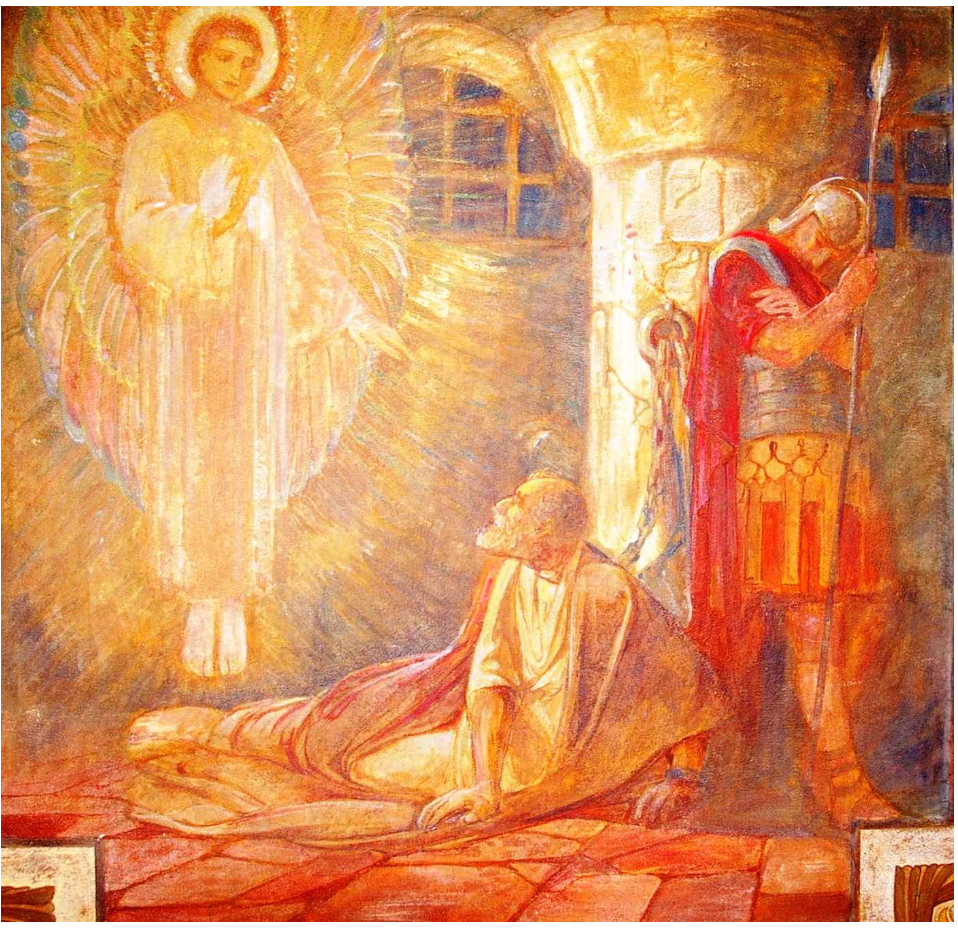
He was a cartoonist, he was a stained glass artist, and he was a muralist. And the story, I don’t know if you’ve had the chance to read up much about the background to this, but he, but Edwin Lutyens you know. The design of the church is Edwin Lutyens great ecclesiastical masterpiece. And Starmer was brought in by the then vicar to look at doing the Lady Chapel, where the Courtauld would be working as a first example of a war memorial, essentially.
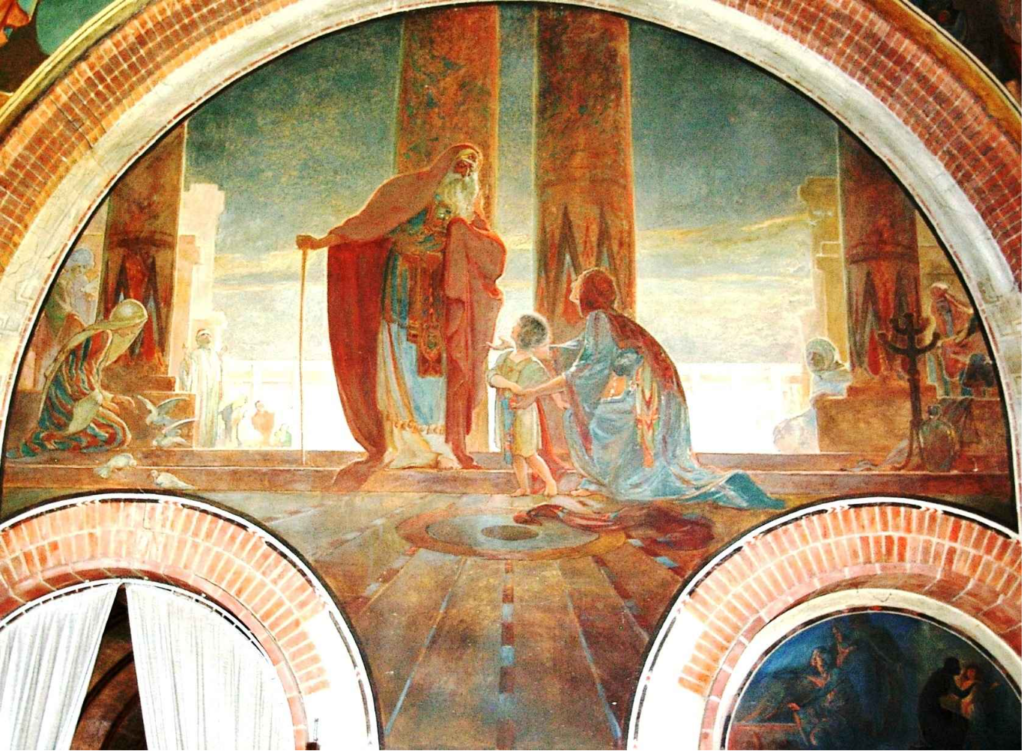
And what makes it so interesting is that that chapel, and indeed the rest of the church, sort of celebrates the role of women in society, which is highly unusual at the time, and obviously very topical at the time. So although it’s a war memorial, essentially, it celebrates the role of women in supporting the troops and the like in the First World War, but also highlights the wider role of women in society. So it depicts specific individual people from Queen Victoria to Edith Cavell and others in the saucer dome at the top.
DN: But the whole area there, was developed and promoted by a woman.
PD: Well, indeed, that’s the point, I think. And it’s, you know, the role of women in promoting social reform. Henrietta Barnard, of course, was involved with Toynbee Hall in Whitechapel. And the whole vision behind the suburb was this sort of multi-class district, where all the classes could mix together, a mixture of different housing, and a temperance movement was behind this, there were no pubs on the suburb, there were allotments, it was, you know, a very visionary concept, the whole idea of the Garden Suburb that came out of the garden suburb movement, the garden city movement of the sort of 1870s and 80s. And St. Jude stands absolutely at the centre of the whole community, visible across North London, it’s like the Cathedral of North London, if you like.
And the centrepiece of the central square, and Lutyens, a great ecclesiastical masterpiece. And, you know, I’ve done work in, you know, colonial architecture and commonwealth architecture, the work of Lutyens in New Delhi, for instance. And Lutyens was actually sort of summoned from work on the suburb to go out to New Delhi to work on the buildings there. And there’s a building opposite St. Jude’s called the Free Church, which is very, very closely related to one of the buildings in New Delhi, designed by one of Lutyens’ acolytes.
DN: This is interesting to us as a magazine, because the New Art Examiner started in Chicago, and its history is very much associated with Jane Addams, who was the second person ever to win the Peace Prize, Nobel Peace Prize, because Jane Addams, her great-grandniece, was the co-founder of the magazine. And what you’ve just said about women and social justice was exactly where Jane Addams was in the 1920s. I wonder if she knew Henrietta, or if they talked or in some way were aware of each other.
PD: They might have been aware, at the very least.
DN: Yeah, yeah. So (18:14) I would love to pull that out a little bit, for the sake of people who know the New Art Examiner. But I’d also like to know sort of what challenges you’re facing, particularly with the frescoes in St. Jude’s. Are they in very bad shape? Are they in a state you would have thought, yes, they do need some love and care, and we can do this? um…
PD: The short answer to that is, yes, they certainly do need some tender, loving care and sensitivity, and high levels of expertise. Their condition is variable. Some have suffered quite severely through atmospheric pollution, through damp penetration through the walls in areas, through areas of sort of heating, radiators and the like. Other areas are actually not too bad.
So there’s been a full condition survey of all of them over so many years, actually, to work out what the priorities are for restoration. And that’s what we’re concentrating on in the first phase. So this will include the aisles, which depict various scenes in panels from the New Testament, and spandrel panels above, and some of the timber work, which is essentially decorative from the period, but needs attention.
So we’ve done a sample panel, and the main programme will start next week. The sample panel has come up quite well, and that’s just been careful cleaning, but not specific restoration. So I think we’re striking the right balance between conserving what is there, and not making sort of unthinking) interventions.
In the past, you can see the results of some sort of rather poorly managed, or cack-handed, I think, interventions by amateurs.
DN: Yeah, it’s a common story.
PD: Yeah, and the area, the worst area, which is the area on axis down the nave, is there’s a wonderful apse depicting the Last Supper.
And something has been done to that in the past, and there’s some water penetrations causing damage there for several years. And whether it was coated with something, or varnished, we’ve yet to establish. So that would be part of a further phase.
And I think, I hope, our aspiration is that if we can get this up and running, in terms of doing the work to the aisles, that that will then attract funding from other sources. I think it’s quite likely to, as a gesture of sort of confidence in the future. And there’s, you know, this question’s been asked about why are we concentrating on doing murals when the building has structural problems, which have also, to a certain extent, been addressed. But I think, you know, the short answer is this is a once-in-a-generation opportunity to save the murals. And if we don’t do it now, they probably won’t survive in their current form, in the areas that are in worse condition. So lots of reasons for bringing this forward.
And of course, it’s opportunistic, because we can help support, we can provide funding to help support the work specifically on the frescoes and murals, because that’s one of our targets
DN:And this is a several years project, I presume?
PD: Yes, it is, yeah. So I mean, the first phase to the aisles will be for a year from now, with assistance of the trainees we brought over from Pakistan. And then there will be further phases following on from that. So we think probably about a three-year project.
DN: I mean, my only worry, as you were talking, my only worry was I know Reverend Emily’s got some problems with the roof, but I don’t know if that’s ingress of water or whatever, but I know she’s got to do something with it.
PD: Yeah, there’s some localised problems there.
I think there’s things like floor problems as well, but that doesn’t affect the roof. The roof certainly does, I think that’s being monitored.
DN: And in your personal opinion, do you appreciate Stalmer’s work? Was it unique to him to do this? Did any of this come out of his feelings for his experiences in the First World War, when he saw such horrors and he wanted the quietness and peacefulness of a church to work in?
PD: I mean, he was brought in to do the Lady Chapel and then quite soon afterwards was commissioned to carry on doing the rest of the church. And there is this issue about Lutyens, maybe he always envisaged the large surfaces to simply be painted white, part of his sort of normal approach to these things. And from the correspondence, since there’s been quite a lot of research into the work Starmer did and the relationship with Lutyens’, that seems to be of overblown. Lutyens was certainly accepting of the fact that the murals would be executed and carried out. And it was pretty much a 10-year programme. And I commissioned a report, I was Director of English Heritage at the time, I commissioned a report 25 years ago or so, which put them in their context as being among the most important 20th century ecclesiastical murals in Britain.
It’s the style, it’s very much the style of Starmer, which was a broad brush approach to things. It’s not a great amount of detail, but it’s very clear what the panels and the scenes depict from the Old and New Testament actually. And he was an intensely spiritual person as well.
DN: If I were to describe them as somewhat naive, would that be fair? In terms of the style? I mean, they’re not there to make you feel that that person is going to walk out of the wall and shake your hand. They are depictions of a dreamy kind of religious iconography.
PD: Yes, I think that’s right.
DN: Philip, it’s 20 minutes and I don’t want to take up your valuable time. But I’m coming up on the 13th to 15th of next month and again, 22nd to 26th. And I’m actually staying in St Jude’s.
PD: Oh, right.
DN: So I will be able to carry on a discussion with the two conservators if that’s okay.
PD: I’d be delighted if you did.
DN: I think it would be great to give them some coverage.
PD: And also involve the Courtauld, so the lady who’s overseeing. And our two trainees are acting as observers with the Courtauld work.
There’s no sort of overlap, but they’re sitting in and seeing what’s been carried out to help enrich their experience.
DN: Yeah, no, that’s fine. That would be fine. And thank you so, so much for your time. Now, what I will do is I’ve got a data sheet from Emily with what’s happening. I shall put that in the magazine, this issue. Our discussion. I’ll say this is part one, part two is coming in May. I will send this to you.
PD: I’m sure it’ll be fine. And then when you are up here, depending on where I’m going to be. (26:42) I’d love to meet you.
DN: Absolutely love to meet you. And I could easily meet you up there at some stage. Thank you very, very much and take care of yourself.
PD: Great to speak to you.
DN: And great to speak to you. Bye for now.
PD:Cheerio. Bye.
St Jude on theHill (Hampstead Garden Suburb) is launching a major Restoration Project with the Commonwealth Heritage Forum (CHF) and the Courtauld Institute of Art. The project will save and conserve the spectacular, early20thcentury Walter Starmer frescoes inside this Grade I listed, Lutyens designed church; one of the finest 20th century churches in Britain and a prominent London landmark.
We will be following the progress and interviewing the restoration experts over the next few years.
With thanks to Reverend Emily Kolltveit, Vicar of St Jude and Philip Davies OBE, Founder & Chief Executive, Commonwealth Heritage Forum