book review
Frances Oliver
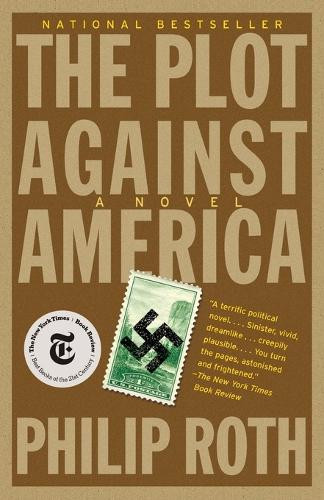
The Plot Against America by Philip Roth was first published in 2004, in America by Houghton Mifflin and in Britain by Jonathan Cape, and then by Vintage in 2016. It was recently read as a Book at Bedtime on Radio 4 and is back in the bookshops. No book could be more apposite for the Age of Trump.
Roth’s narrator is a young Jewish boy, named Philip like his creator. He is 7 years old in 1940, when the book begins. Newark, New Jersey where Philip lives is mainly inhabited by Jews, from all walks of life, some religious, some not. Like the rest of Americans they admire and adulate the handsome young hero Charles Lindbergh, whose first round the world flight has made history. When the Lindberghs’ tiny baby is kidnapped and then found murdered, they join in the national sympathy and grief and Lindbergh becomes not only hero but martyr.
For the Jewish community the enchantment soon fades. Lindbergh gets a medal from Hitler in 1936, and when war breaks out in 1939 is nominated to run for president as an anti-war Republican candidate against the incumbent Roosevelt. Conducting his own populist campaign, Lindbergh runs on a platform of ‘Lindbergh or war’ which taps into the country’s increasing isolationist and anti-Semitic sentiment. He is endorsed by a right-wing Rabbi Bengelsdorf who proffers what we would now call ‘alternative facts’; that Lindbergh only accepted the Nazi medal and toured Nazi Germany because he was acting as an undercover agent for the U.S. Government.
Lindbergh’s victory is overwhelming. He soon signs friendly peace accords with Germany and Japan. Anti-Semitism grows in the U.S., and Philip’s father, not one to hide his political sentiments but rather loudly proclaim them everywhere, soon finds himself called a ‘loud-mouthed Jew’ and narrowly escapes a beating-up. Tensions also grow in Philip’s extended family. His fatherless cousin Alvin, who has been Philip’s parents’ ward while attending high school, refuses the chance of a university education paid for by another, much richer, uncle. Alvin, having worked for this uncle, considers him tyrannical and corrupt. Instead of university he runs off to Canada to enlist and fight against the Nazis.
Meanwhile Lindbergh has founded a ‘Just Folks’ youth group for city boys to work on farms in summer. The scheme is promoted by Rabbi Bengelsdorf to integrate Jews into All-American society. Philip’s flamboyant Aunt Evelyn becomes the Rabbi’s assistant and clearly also his mistress. Sandy, Philip’s older brother, liking the idea of a country adventure, goes off on a ‘Just Folks’ holiday and comes back full of enthusiasm, having happily eaten bacon and pork and contemptuous of what he now thinks is his parents’ ghetto mentality.
Soon there is an unavoidable visit from Aunt Evelyn and her lover and boss, the Lindbergh associate Rabbi, who lectures the family. Philip’s father can bear this only so long and finally must tell the Rabbi what he thinks of the new regime. The Rabbi has his revenge; brother Sandy is made the star recruiter for Lindbergh’s ‘Just Folks’ scheme and is pleased to accept. Meanwhile cousin Alvin is back from Canada ill and embittered and without a leg.
Next the Lindbergh government comes out with a new scheme ‘Homestead 42’ to scatter and ‘assimilate’ the Jewish communities. As part of this, Metropolitan Life is sending employees like Philip’s father to towns in the West or Midwest where there are virtually no other Jews. Mr Wishrow, father of Seldon, a lonely boy who adores Philip, but for whom Philip has no liking, tells Philip what he believes will happen. First this dispersion, then when the Nazis win, other countries like Britain, also later America, will be given a choice between takeover or doing their own executions of Jews. The Wishrows, like other Jewish families, plan to emigrate to Canada, but before the emigration can take place Mr Wishrow hangs himself.
Philip’s mother, thinking their situation as Jews in America increasingly precarious, tries to persuade her husband to join the Canada exodus, but he refuses. He refuses also his firm’s offer of a better job in Kentucky, resigns from Metropolitan Life and goes to work for one of his brothers as a seller in the produce market.
Made more and more anxious and distressed by the grim divisions in his family, with his father loathing the Lindberghs and his admired older brother Sandy rubbishing family fears and longing for life in Kentucky, Philip decides to run away and present himself as an orphan at the Christian orphanage nearby. His flight is short-lived; he is kicked by a startled horse as he crosses a dark field and lands in hospital unconscious and with a badly cut head. When he recovers, the family returns to a near normal routine, mother back in her role as pacifier and housekeeper, saying many tearful goodbyes to families leaving for Canada or a ‘Homestead 42’ placement out West, father in his market job, Alvin gambling with dissolute cronies and Sandy dropping all his enthusiasm for Lindberghian assimilation schemes to engage in a new passion, the pursuit of girls.
All the Newark Jewish families, whatever their politics, listen intently to gossip columnist Walter Winchell’s nightly broadcast, now a lone media voice ardently denouncing the government’s policies. Not surprisingly, Winchell is soon taken off the air, and in a move that is surprising, announces he will run for President. Winchell tours the US, braving all the Republican cities. Wherever he goes, anti-Semitic riots erupt, the worst anti-Semitic riots outside of Nazi Germany. After Winchell is assassinated in Kentucky, Philip’s family, hearing shots one night, await the worst. Here Roth’s black dystopic comedy reaches an apogee; but then it turns out this is not a pogrom but a battle between Newark police supposed to protect the Jews and an unofficial ‘Jewish police’, mainly hoodlums drafted by a local Jewish Mafia boss.
Winchell’s many followers give him a spectacular funeral – but a cry arises – “Where is Lindbergh?” It turns out that Lindbergh’s plane has disappeared on a routine flight from Long Island to Louisville. For those who like intricate plot twists and conspiracy theories, I will not spoil the denouement by saying more about it, only that as the book ends we are back in real history. The Japanese attack Pearl Harbour, America is at war with the Axis, and Roosevelt president again.
The ambiguity of how Roth’s story concludes, and the way it follows the bewilderment, growing anxiety and alienation of the child caught up in the adults’ fears and bitter political controversies are two of the best things in this book. The best thing of all is – we can say now – its perspicacity. In this age of X/Twitter, Apps and Google it doesn’t need a handsome young hero as President, only a vengeful demented old TV celebrity with some cunning powerful oligarchs behind him, for Fascism to reach America. Roth’s dark fantasy has become only too real.