
Pablo Halguera

Because modern art is generally defined as starting in the late 1800s, very few items in MOMA’s holdings predate that period— including a 1842 daguerreotype from the dawn of photography. However, the museum’s design collection includes a small black teacup designed by the English potter Josiah Wedgwood in 1768.
The cup’s minimalist, elegant, and unornamented form predates the Bauhaus by more than a century and a half, yet it articulates with remarkable clarity principles that would later become central to modern design: the separation of design from fabrication, the standardization of form, and the rejection of superfluous ornament. Were one to encounter this cup today at a Crate & Barrel, it is unlikely that its eighteenth-century origins would even register.
This small cup has long served as a touchstone for my thinking about artworks that seem to arrive ahead of their historical moment, and more specifically about artists whose work, if exhibited in a contemporary gallery today, would not prompt us to question its contemporaneity. There are, of course, nineteenth-century artists whose work continues to feel strikingly current in spirit – Goya and Hogarth, for instance – particularly in their critical acuity, their irony, and their engagement with power, violence, and social contradiction. Yet despite this resonance, their works remain formally anchored in the pictorial, allegorical, and narrative conventions of their time. They feel contemporary, but they do not appear so.
I had assumed I understood this distinction – between works that resonate with the present and those that formally belong to it – until the question resurfaced in an unexpected and far more trivial context.
Like many others, I occasionally indulge in the guilty pleasure of scrolling through short videos on social media. One such moment brought me a video by the Mexican TikToker Minynaranja, who is known for her viral ‘face dance’ performances, in which the face becomes a hyper-controlled, glitching interface – simultaneously expressive, mechanical, and resistant to emotional readability.
Her rendition of Mapopo Shalala, a song by the Tanzanian Bongo Flava performer Mavokali, became a massive TikTok success, generating millions of views.
Minynaranja’s performances resemble a form of facial gymnastics. “She is a Disney cartoon come to life,” one viewer commented on YouTube – a remark that captures the peculiar charm of seeing a real person execute expressions that seem lifted from Pixar animation. The humor and appeal lie precisely in this mismatch: a human face performing movements that appear almost too elastic, too calibrated, to be natural.
Ironically, Minynaranja’s videos were quickly absorbed by AI systems and replicated through machine-generated imitations, further entangling questions of authorship and blurring the boundary between human expressivity and algorithmic reproduction. What begins as a singular bodily performance – already a lip-synched interpretation of another artist’s song – is folded into a rhizomatic echo chamber, where gesture circulates freely between human and machine. Watching these iterations, I realized that I had encountered this problem before – not on TikTok, but in the museum.
Long before algorithms learned to read faces, an 18th century artist had already subjected his own visage to a rigorous, systematic regime of distortion, repetition, and control. That artist, whose works feel uncannily contemporary, was nonetheless active in the very year Wedgwood’s black cup was produced. His name is Franz Xaver Messerschmidt.
Messerschmidt is often treated as a wild outlier in art history – an eccentric footnote whose notoriety rests as much on biography as on form. Yet it is precisely because of this perceived oddity that he remains so memorable to anyone who has studied art history. What his work reveals, however, is something more consequential: an artistic practice that does not merely anticipate modern concerns, but operates according to formal logics that remain fully legible within the contemporary exhibition context. If Messerschmidt’s sculpted heads were shown today in a gallery in Chelsea, there is little reason to believe they would be read as historical artifacts at all, but as equivalent pieces to those of of Ron Mueck or Marc Quinn’s early self-portraits.
Messerschmidt was born in 1736 in Swabia, southern Germany, and attended the academy of fine arts in Vienna in 1755. It was a time of the dominance of the rococo aesthetic, exemplified by Tiepolo and Fragonard; in sculpture, the French artist Étienne-Maurice Falconet represented the dominant rococo classicism. He became known for his portraiture and made a number of imperial portraits, some commissioned by Maria Theresa of Austria.
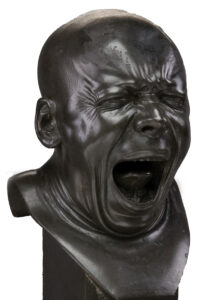
Messerschmidt’s most memorable works emerge on his last decade of life, seemingly a result of a personal crisis. In 1774, he failed to receive a permanent position at the academy and was in fact dismissed from it, with contemporaneous correspondence of authorities discussing that his mental state was not good for the institution. Messerschsmidt was at the time starting to suffer from what might appear was Crohn’s disease, an inflammatory gastrointestinal ailment which can produce pain that generates hallucinations. It is around this time that Messerschmidt started making his Character Heads.
According to the German writer Friedrich Nicolai, who went to visit Messerschmidt at his studio in 1871, found him in a largely empty house with not much other than a dozen or so self-portraits with extreme facial features, with grotesque distortions in their lips and wrinkles.
According to the art historian Anastasiia Kirpalov,
‘The artist claimed he studied occult works to excel in his art and got so good at it, that his mastery angered the Spirit of Proportion. Every night the Spirit came to Messerschmidt and tortured him as a punishment for his knowledge. While Messerschmidt created his sculptures, he felt intense pain in those parts of his own head that corresponded to the area of a sculpture he was working on.
According to Nicolai, the reason behind the collection of heads was mostly ritualistic. Messerschmidt intended to create sixty-six busts that would ward off the evil spirit, two of which, called the Beaked Heads, were the direct representations of the Spirit itself. The rest of the busts represented animalistic senses incarnated in human flesh. To achieve the desired grotesque effect, Messerschmidt would pinch himself or inflict pain in other ways while looking in a mirror.’
Messerschmidt’s obsessive pursuit of extreme facial expression, can be more productively understood as an early form of rule-based, post-conceptual inquiry. His Character Heads do not operate as expressive portraits but as the results of a rigorously self-imposed system: a finite set of actions performed on a single body, repeated, refined, and fixed through sculptural reproduction. In this sense, the heads function less as images than as documents of a procedure – evidence of an embodied experiment carried out under strict parameters. This logic closely aligns Messerschmidt with later artistic practices in which a defined set of principles governs an action that is experienced live, yet ultimately survives through mechanical or material inscription.
Such an approach resonates strongly with postwar body-based and performance practices, from the Viennese Actionism, whose dictum that “the human body, a laid table, or a room becomes the picture surface” reframed the body as a site of inscription, to artists such as Ana Mendieta, Marina Abramović, and Carolee Schneemann, who pushed the body to physical and psychic extremes within clearly legible constraints. In each case, the intensity of the gesture is amplified precisely because it unfolds within easily identifiable parameters: Mendieta’s face pressed against glass, Abramović’s exposed and vulnerable body subjected to durational endurance, Schneemann’s deliberate testing of bodily limits. Messerschmidt’s grimaces operate in a comparable register. Their force lies not in excess for its own sake, but in the friction between extremity and system – between the unruly body and the strict conditions under which it is made visible.
It is also striking that Messerschmidt appears to have used sculpture as a form of exorcism – an attempt to ward off or neutralize the forces he believed were assailing him – while at the same time giving those very forces durable form. The Character Heads do not simply banish the ‘evil’ they address; they render it visible, repeatable, and preserved. This ambivalence – between expulsion and representation, defense and fixation – feels distinctly contemporary, aligning Messerschmidt with artistic practices that understand making not as resolution, but as a means of holding contradiction in place.
I wanted to ask many questions to Minynaranja. I learned from her that she hails from Xalapa, Veracruz (a region of Mexico that excels in its music and dance traditions). She shared that her videos are not just spontaneous performances but the result of rigorous practice for each song (“people don’t understand that this is like putting together any other kind of choreography that comes with steps, rhythm and expression”). She also has come to accept that her videos have become food for the algorithm: “I have learned to see the positive side of things and take advantage of this situation to give more virality to my profile in the web, but it really bothers me that they use my image for apps that never asked for my permission, specially for publicity purposes.”
I had also been thinking about asking her whether if she had ever considered doing facedance not with contemporary pop music but with 18th century music. But almost as if anticipating my question, that same day she posted the following video on her feed, performing the Allegro non molto movement of Inverno, from Vivaldi’s Four Seasons:–
After speaking with Minynaranja, my mind went back to that small black eighteenth-century teacup designed by Josiah Wedgwood. The cup’s endurance does not stem from an ambition to be timeless, but from its capacity to move comfortably across contexts – at home in a modern museum, in a design store, or in daily use – without ever insisting on its historical identity. It does not perform its age; it simply works. Its relevance is not asserted but absorbed, recalibrated with each new setting it enters.
Something similar seems to be at play in Minynaranja’s facial performances and in the grimacing heads of Franz Xaver Messerschmidt, despite the vast distance between them. Miny’s expressions register as a small rebellion against the algorithm even as they flirt with technological mimicry, recalling the elastic distortions of Looney Tunes animation or Pixar exaggeration. Messerschmidt’s faces emerge from an intensely personal and ritualized search – an attempt at warding off invisible forces – yet they remain oblivious to the fact that they would endure as objects of fascination long after the belief system that generated them had faded. In all three cases, what endures is not a conscious refusal of convention, but a kind of productive misalignment with it. The absence of self-awareness – of strategic positioning within the fashions or rules of the moment – may be precisely what allows these works to travel so freely across time. What begins as a rebellion, an experiment, or a necessity becomes durable not because it aims for permanence, but because it answers its present – whether an English teacup, a rococo sculpture, a twenty-second TikTok meme – so exactly that it remains legible long after that present has passed.