Scott Sublett
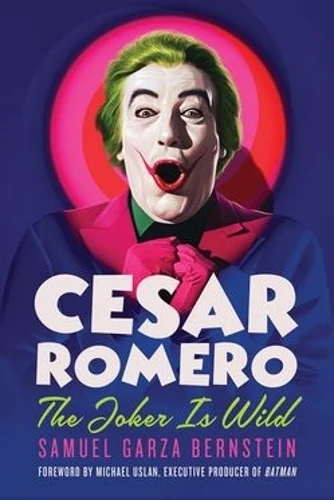
The rule of thumb in Hollywood is that just about everyone fails, and you’re a success if you can stay in the game for ten years. Then there was the six-foot-three-inch, queer, Latino dreamboat Cesar Romero, who in his six-decade career made over a hundred feature films, and was in more than twice that many scripted TV shows. “Butch” Romero’s precarious expedition through Hollywood’s Golden Age of glamor was a fascinating affair. He went everywhere, knew everyone, and did everything, as film historian Samuel Garza Bernstein reports in the charmingly empathetic new biography, Cesar Romero: The Joker is Wild (University of Kentucky Press). But despite his hefty feature film resume, the impossibly suave, deftly closeted Latino is remembered not for dance numbers with Betty Grable or for passionately kissing Marlene Dietrich, but for one of the most vivid performances in the history of what people then called The Boob Tube: he was The Joker on Batman. Romero’s peculiar place in entertainment history, and his enigmatic personal life, are more interesting than one realized before reading Mr. Bernstein’s surprisingly engaging little book—the book being “little” because the Joker played the cards he was dealt close to the vest. But it’s for sure no one will ever get closer to the intriguing truth than Bernstein has.
Born in 1907, Cesar was the son of a Spanish-born Cuban father who became rich in sugar, then was squeezed in the sugar panic of 1920, crushed harder by the sugar collapse of 1925, and lost the rest along with everyone else in the crash of ‘29. The old man would never recover mentally, and Romero, willingly, stalwartly, made it his lifelong duty to provide for his parents and siblings. Even when sugar was scarce, Papa had made sure little Cesar—on and off, at least—attended Manhattan’s poshest private schools, hence his aristocratic bearing and social ease among the elite. The boy may also have had a sense of destiny from knowing that his mother was the biological daughter of the great Cuban poet and revolutionary José Martí. Young Cesar was kind, gorgeous, and danced divinely. The writer John O’Hara knew Romero when O’Hara, Romero, George Murphy (later a movie star and then a Republican senator from California), along with some mysterious figure named “Campbell” and maybe Cary Grant as well, all lived together in a crummy rooming house on West 43rd in Hell’s Kitchen. According to O’Hara, writing in The New Yorker, no one would have guessed Romero and Campbell lived in a slum because “their clothes always looked as though they were on their way to have lunch with the admissions committee of the Racquet Club.”
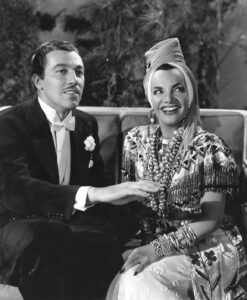
Romero had formed a dance act with a fabulously rich New York debutante that got the two of them to Broadway. Everybody liked Cesar Romero, because he was a gentleman, and thanks to an acquaintanceship with society columnist Cholly Knickerbocker—Romero’s ferocious socializing garnered him countless connections—it was off to the provinces, touring in Preston Sturges’s Broadway hit Strictly Dishonorable. And then to Hollywood. He paid his dues in lesser parts, notably as a villain opposite William Powell and Myrna Loy in The Thin Man (1934), then Josef von Sternberg cast him opposite Marlene Dietrich in The Devil Is a Woman (1935). He was to be the next Rudolph Valentino. But the movie flopped spectacularly—no fault of Romero’s—ending von Sternberg’s legendary career, seriously damaging Dietrich, and consigning Romero henceforth to leads only in “B” pictures and programmers. In “A” pictures he would be second or third lead: the guy who doesn’t get the girl, although she’s tempted. Though he would never be a top star, he was adroit at publicity, quite famous, worshipped by women, and got large character parts in major hits. For example: John Ford’s wonderful 1937 Shirley Temple vehicle Wee Willie Winkie; Week-End in Havana (1941 with Carmen Miranda); Captain from Castile (1947, as Cortez, supporting Tyrone Power), Oceans Eleven (1960, with Frank Sinatra and the Rat Pack), and The Computer Wore Tennis Shoes (1969). Also, there were a couple of legendary duds: That Lady in Ermine (Ernst Lubitsch’s last film, 1948) and The Beautiful Blonde from Bashful Bend (1949), the picture that killed Preston Sturges’s brilliant career.
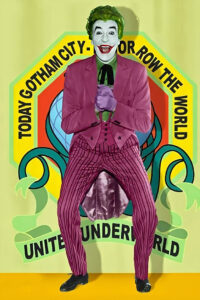
Then came Batman. Jose Ferrer was first choice for The Joker, and Gig Young was second choice. Neither was available, so the third choice booked the job that got him ambushed in airports for the rest of his life by fans begging him to laugh like The Joker. Grateful and gracious, Romero never complained. Bernstein’s book has the executive producer William Dozier claiming he was attracted to the goofy material because comic strips reminded him of the Pop Art Star Roy Lichtenstein. He said he was interested in the “pop art technique of the exaggerated cliché,” which if it’s true is delicious. With straight-faced irony, Lichtenstein had appropriated the look of comic strips, and now TV would ape Lichtenstein’s irony, but with an innocent silliness that denuded it of Lichtenstein’s cool critique of pop culture’s melodrama and emptiness. Irony without irony. High art’s attack on pop had become itself pop: cheerfully corporate and selling scads of merch, as if Campbell’s soup had started designing its cans in homage to Warhol. Susan Sontag’s essay Notes on ‘Camp’ was published two years before Batman debuted in 1966 and she never wrote specifically about the show, but its extreme stylization, the gleeful artificiality, the intentional badness of its self-aware camp, were things she had identified in her essay, and for which America apparently was ready. The UK was ready, too; Batman was a smash on ITV and Romero was presented to Prince Philip.
In its first season it was a colossal cultural phenomenon, but Batman’s ratings dipped alarmingly in its second, and soon the fad was over because, well, one assumes people were thinking, “OK, I get it.” No more same Bat-Time and same Bat-Channel next week, yet it would be remembered forever and it was a hoot while it lasted. Fun for the kids, and for the grown-ups, and the cast, an amiable, mindless slumming. Bernstein catalogs the actors who played recurring and one-off villains, and they’re boldface names worth dropping: Burgess Meredith, Eartha Kitt, Milton Berle, Tallulah Bankhead, Victor Buono, Joan Collins, Art Carney, Maurice Evans, Glynis Johns, George Sanders, Eli Wallach, Shelley Winters, Roddy McDowell, Ethel Merman, Otto Preminger, and more. As for Romero, he’d be in one more hit, itself a bit campy: the over-the-top night-time soap Falcon Crest, as the love interest of then-president Reagan’s ex-wife, Oscar-winner Jane Wyman. Work, work, work.
Despite his faultless discretion, his exclusive sexual preference for men was an open secret in Hollywood, yet the content of his personal life—apart from his parents and siblings—is hard to glean. In public, he played the game but only up to a point. Famous for dancing till dawn at night spots with virtually all the beautiful women in Hollywood (which wasn’t an onerous task because he loved dancing and women), he never did what other gay and lesbian stars did: marry a “beard,” or contract a “lavender marriage.” The narrative in the press was that Romero took seriously his responsibility to provide for his parents and siblings; or that he hadn’t met the Right One; and sometimes that The One had jilted him and he was gun-shy. Eventually the press accepted him as a “confirmed bachelor,” and straight women said, “What a waste.”
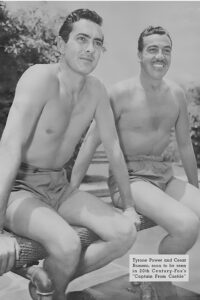
It’s pretty clear that the love of his life was Tyrone Power, but to what degree it was reciprocal is hard to suss. Despite three marriages that produced three children, Hector Arce’s biography The Secret Life of Tyrone Power labeled him energetically bisexual, and while Fred Lawrence Guiles’s biography The Last Idol, published the same year as Arce, was more coded, in-the-know readers knew what he was implying. In those days, the studios made it their business to keep tabs, so 20th Century-Fox no doubt knew about Romero and Power, both of them contract players: Romero useful but dispensable, Power, on the other hand, Fox’s biggest star, his name a synonym for male beauty the way Brad Pitt’s is today. Both men would have known the story of MGM star William Haines, and Romero would have known Billy personally through their mutual close friend Joan Crawford. One of the top five silent movie stars of the late ‘20s, Haines successfully transitioned into talkies and remained a top star, but in 1932 was arrested at the YMCA, where it’s fun to stay, with a sailor he’d picked up in Pershing Square. Mogul Louis B. Mayer ordered him into a sham marriage. Haines quit, and with his lover Jimmie Shields opened a fantastically successful interior design business. They decorated for the Reagans when Ronnie was governor. Later, when Billy dies, Ronnie will send Jimmie a sweet letter of condolence. Rather a happy ending for Haines, but clearly not what Romero envisioned for himself. Why? Was it simply that he wanted only Tyrone Power, and if not Tyrone Power then nothing? We’ll never know.
It’s hard to guess what Fox was thinking when the studio sent Power on a ten-week publicity tour of Latin America, a foreign territory suddenly more important to the studios due to post-World-War-II film industry protectionism in Europe. Fox agreed he could bring his pal Cesar Romero. He and Butch had both served honorably during World War II in Pacific theater combat zones. Romero was on a Coast Guard supply ship, and publicity photos of him with the other sailors look like illustrations by Tom of Finland. Meanwhile, Power had been a Marine pilot, so he flew them around South America in a DC-3. The two movie stars dined with the Peróns. Romero liked to tell people that Eva was lovely but didn’t let Juan get a word in edgeways. In years to come, he would endlessly repeat stories about the trip. The happiest ten weeks of his life.
A massive heart attack would fell Power in 1958 at the age of 44. Romero would die in 1994 at 86, taking with him his deep secrets. Queerness has been erased from film history through euphemism, omission, “prudence,” and the horrifying phrase “no longer here to defend himself,” as though queerness could be nothing but a slanderous accusation. Bernstein’s empathetic biography gives us an artist who participated in his own erasure, as he and others had to if they wanted to stay in the game, but it’s also a portrait of a man who, through it all, held on to his dignity.