Liviana Martin
After captivating audiences with his major exhibition at the Palazzo Ducale in Venice, Anselm Kiefer once again delivers a work of powerful symbolic and material impact. The exhibition The Alchemists, installed in the Sala delle Cariatidi at Palazzo Reale in Milan from 7 February to 27 September 2026, brings together forty-two large-scale canvases dedicated to a pantheon of women connected, in different ways, to the European alchemical tradition.
The project, curated by Gabriella Belli and promoted by the Municipality of Milan – Culture in collaboration with Palazzo Reale and Marsilio Arte, forms part of the cultural programme of Milano Cortina 2026.
Kiefer conceived the installation as a site-specific work: not a simple exhibition display, but a direct dialogue with a space charged with historical memory.
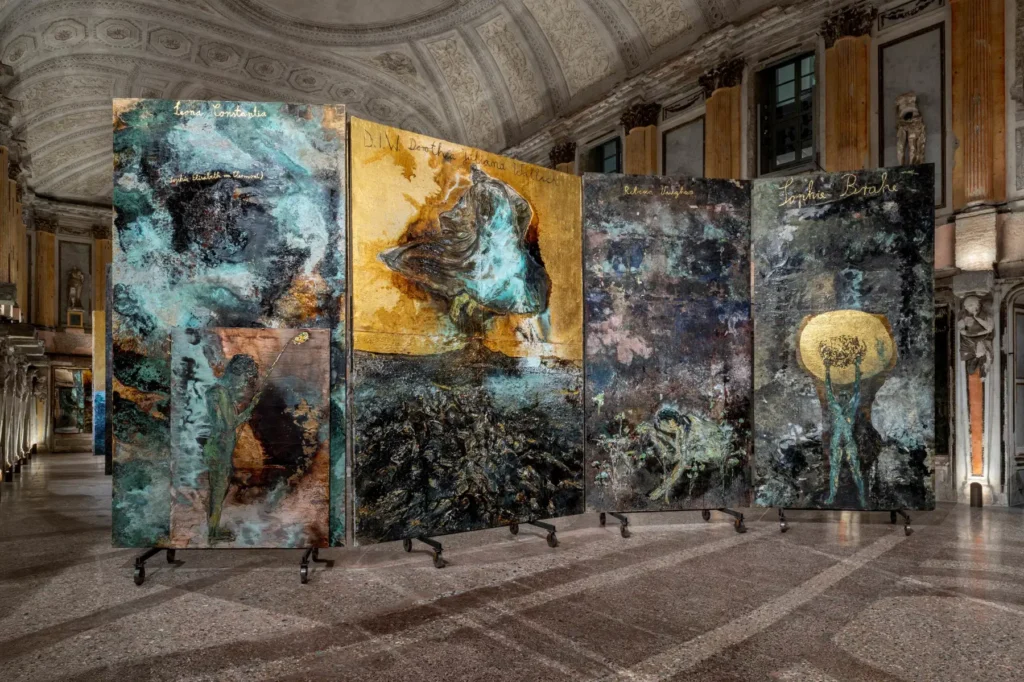
The Sala delle Cariatidi, designed in the eighteenth century by Giuseppe Piermarini, still bears the scars of the bombing of 15 August 1943, when an incendiary device caused a major fire and the collapse of the roof, destroying much of the stucco and fresco decoration. The forty Caryatids that symbolically support the hall still carry the marks of that devastation. Present at the opening, Kiefer remarked with irony, “I wanted to hang the canvases on the walls, but it wasn’t possible.” Indeed, the works—like most of the artist’s exhibitions—are monumental in scale, measuring approximately five by three metres, arranged as large panels that cut across the space in sequence, compelling visitors to follow an immersive path.
The confrontation is explicit: on one side, the mutilated Caryatids bearing the wounds inflicted by war; on the other, the female silhouettes painted by Kiefer, each inscribed at the top with her name in gold lettering, representing women alchemists who were underestimated, persecuted, and in some cases died in prison for their ideas. The overall effect is that of a solemn cortège, a secular procession restoring visibility to figures often marginalised or forgotten.
Photo Nina Slavcheva © Anselm Kiefer
For Kiefer, alchemy has never been reducible to the fabrication of gold. “The true alchemist,” the artist states, “is not interested in material things, but in transmutation, in the transformation of the spirit.” This concept runs through his entire oeuvre, from his early reflections on post-war German history to his large-scale installations in lead, straw, and concrete.
Born in 1945 in Donaueschingen, Kiefer belongs to the generation that grew up amid the moral and material ruins of post-Nazi Germany. His practice has consistently intertwined memory, myth, poetry, and history, through the persistent use of heavy materials – lead, ash, earth, organic sediment – rendering painting almost sculptural. It is well known that Kiefer subjects his canvases to harsh processes: he burns them, buries them, or exposes them outdoors to the elements until they achieve their intended form.
In the remarkable documentary that director Wim Wenders devoted to him, entitled Anselm, the origins of Kiefer’s creative process come into focus. As a child, Anselm rebuilt among the ruins of buildings destroyed by war; he used remnants and debris, transforming them into something meaningful, drawing form out of chaos. This is one of the central themes of his practice, linking it directly to alchemical thought: within ruin lies the seed of the future work; the work must be destroyed in order to rise again, just as in alchemy the humblest metal, lead, already contains within itself the most precious one, gold. All of this is clearly articulated in the exhibition: both technically and conceptually, scraps and residues occupy a central position in his oeuvre.
In the Milan canvases, the female figures emerge from thick, stratified surfaces marked by drippings, oxidations, and vegetal remains. Lead and gold coexist as symbolic poles: the metal of melancholy and that of light and perfection. Alongside the bodies appear books, crucibles, instruments, seeds, and medicinal plants. The sunflower – a plant that follows the sun and therefore gold – recurs several times, at times bent, as if in mourning. The imagery is consistent with alchemical grammar: disintegration, dissolution, combustion of matter, followed by the possibility of rebirth.
But who were the women alchemists evoked by Kiefer, and how did they operate? For some, biographical details are well documented; others have only recently been studied. They were generally women working at the margins of official science, often opposed, imprisoned, or burned as witches. The exhibition catalogue presents a broad and complex panorama spanning centuries and diverse contexts. They were not merely seekers of the philosopher’s stone, but physicians, apothecaries, noblewomen, natural philosophers, authors of books of ‘secrets,’and at times figures entangled in trials or judicial scandals. Women gathered plants, tended gardens, moved between alembics and stoves in domestic laboratories, invented instruments, and experimented.
Among the most renowned is Caterina Sforza (1463–1509), Lady of Imola and Countess of Forlì, to whom the manuscript Experimenti is attributed: over four hundred recipes ranging from cosmetics to distillation, from metallic dyes to therapeutic remedies. Her alchemy was concrete and material, intertwined with political power and with the governance of the body and health.
Isabella Cortese, active in Venice in the second half of the sixteenth century, is the name – likely a pseudonym – associated with one of the most famous books of secrets of the Renaissance, I secreti della signora Isabella Cortese (1561). The volume combines cosmetic and pharmaceutical practices with operations on metals, asserting knowledge tested firsthand and accessible to women.
Marie Meurdrac, author in 1666 of La Chymie charitable et facile, en faveur des dames, proposed a genuine chemical education addressed to a female audience. In her preface she declared that “les esprits n’ont point de sexe”: minds have no sex. It was a statement that directly referred to the exclusions of the women from academic institutions.
Other figures reveal the more hazardous dimension of alchemical practice. Anne Marie Ziegler, active at the court of the Duke of Brunswick in the sixteenth century, promised the philosopher’s stone and a so-called ‘lion’s blood’, an oil she claimed to have produced, which, in her view, could accelerate plant growth, transmute metals, and above all induce a gestation lasting only a few weeks. Tried on extremely serious charges, she was condemned to the stake in 1575.
The baroness Martine de Bertereau, engaged in mining engineering, was imprisoned in the Château de Vincennes, where she died around 1645.
The manuscripts of these women alchemists did not concern only recipes or therapeutic remedies, but also practices that could appear ambiguous or illicit, as they involved manipulation of the body and nature and the potential creation of poisonous substances. Many of these women recanted, concealed, or destroyed their own publications. Mary Ann Atwood (1817–1910), for example, burned all copies of her essay on alchemy for fear of having disclosed knowledge she regarded as sacred. The looming lead books that appear above many of Kiefer’s protagonists exemplify this attitude. They allude to what history has attempted to erase, yet which has continued to act like a fire ready to reignite.
In many cases, the alchemy practiced by these women focused on distillation, the preparation of spirits and salts, domestic pharmacopoeia, and the management of gardens and court laboratories. Anna Vasa of Sweden, in the early seventeenth century, organized a genuine botanical and pharmaceutical structure open to the sick and the poor.
The image that emerges from these biographies diverges sharply from the stereotype of the witch or isolated visionary. What appears instead is a network of female practices spanning courts, domestic laboratories, philosophical circles, and printing workshops. Some alchemists worked in obscurity, signing with initials or pseudonyms; others sought public recognition; still others, as noted, paid with imprisonment or their lives.
In Kiefer’s canvases, these histories are not illustrated in a narrative sense. The bodies, often nude or only faintly outlined, seem to merge with the painted matter. At times a branch or plant sprouts from the womb, an allusion to generation: the female body is associated with the vas hermeticum, the sealed vessel of alchemical practice within which the transmutation of matter and the conjunction of opposites took place.
The installation also exploits the historic mirrors of the hall, multiplying images and playing on the relationship between the visible and the concealed. The visitor moves among the panels as if through a laboratory or a symbolic forest, dense with meanings and stratifications.
The Alchemists is not an overtly militant exhibition, but it constitutes an act of restitution. Kiefer does not propose an ideological manifesto; rather, he constructs a book of material memories. In a space marked by war, he summons women who worked on the transformation of matter and the body, often under conditions of marginality. The result is a confrontation between ruin and rebirth, between historical destruction and the possibility of regeneration.
Within this tension between lead and gold, ash and light, the full meaning of the Milan project unfolds. Alchemy becomes a metaphor for a process that concerns not only the history of women, but European cultural memory as a whole: what has been burned, censored, or forgotten can still, like embers beneath ash, return to living matter.
ANSELM KIEFER , The Alchemists
Milano, Palazzo Reale, 7 febbraio- 27 settembre 2026