Liviana Martin
The Peggy Guggenheim Collection in Venice dedicates a major exhibition to Lucio Fontana, built entirely around his ceramics: works created between Argentina and Italy – above all in Albisola; which for decades represented the laboratory of his research. It’s an exhibition that overturns the usual narrative: before the cuts, before the Spatial Concepts, before the artist who opens the canvas as a passageway to the cosmos, here is a man sinking his hands into the earth, drawing from it forms in perpetual mutation. And it is there, in that clay that bakes, bursts, drips and cracks, that the true origin of Spatialism is concealed.
Lucio Fontana is known to history as ‘the artist of the cuts’: the monochrome slashed canvases, the idea of piercing and traversing the pictorial surface in order to open it to real space, in years when humanity was looking to the Moon and the conquest of the cosmos. This image is true, but incomplete. Fontana did not begin with a cutter in his hand, and nothing about the cuts can be understood without going back to the earth, to the clay, to the ceramics that accompany him throughout his life.
Born in Rosario de Santa Fé, Argentina, in 1899, the son of an Italian sculptor and an Argentine mother, Fontana grew up between two continents. After an initial education in Latin America, he returned to Milan and attended the Brera Academy. He exhibited with the Novecento group, moved between sculpture, ceramics and decoration, worked in Argentina and Italy, lived through both World Wars, signed the first Spatialist manifesto in 1947, and in the 1950s and ‘60s reached the works that would make him famous worldwide. He died in 1968 in Comabbio. But, from the standpoint of his research, the decisive fact is from the very beginning Fontana plunged his hands into clay and never stopped doing so.
The ceramics, produced in Argentina and above all in Albisola, were neither a secondary activity nor a fall-back compared to the slashed canvases. They were the ground where his language was built and continually regenerated. In Liguria, the artist worked side by side with kiln artisans in an environment where art, craft, and design naturally coexisted. Clay, a malleable and sensitive material, records fingerprints, accepts tearing, and undergoes risks and metamorphoses during firing, it is a direct confrontation with the physicality of form.
The early ceramics, from the late 1920s and early 1930s, are sober, flattened forms, lightly decorated, delicately incised. Simplified female figures, heads, small reliefs: a restrained language, as if the artist were knocking on the limits of the material to understand how far he could push it. Then, in the mid-1930s, comes the leap: the material explodes into acid colours, incandescent glazes, swelling reliefs, and drips that advance across the surface.
This is the period of natural marine forms: distorted shells, seahorses, crustaceans reinvented with total freedom. Alongside them, battles, intertwined bodies emerging and sinking into the same mass, and religious subjects – crucifixes, Depositions, Stations of the Cross – where the formal force surpasses any devotional intent: the ceramic becomes taut flesh, spasm, wound.
The production is, in the full sense, protean: it changes constantly, takes opposite directions, never crystallises. The feminine, the natural, the sacred, the martial: everything coexists within the same logic of continual transformation. The only constant is the matter that reacts and moves.
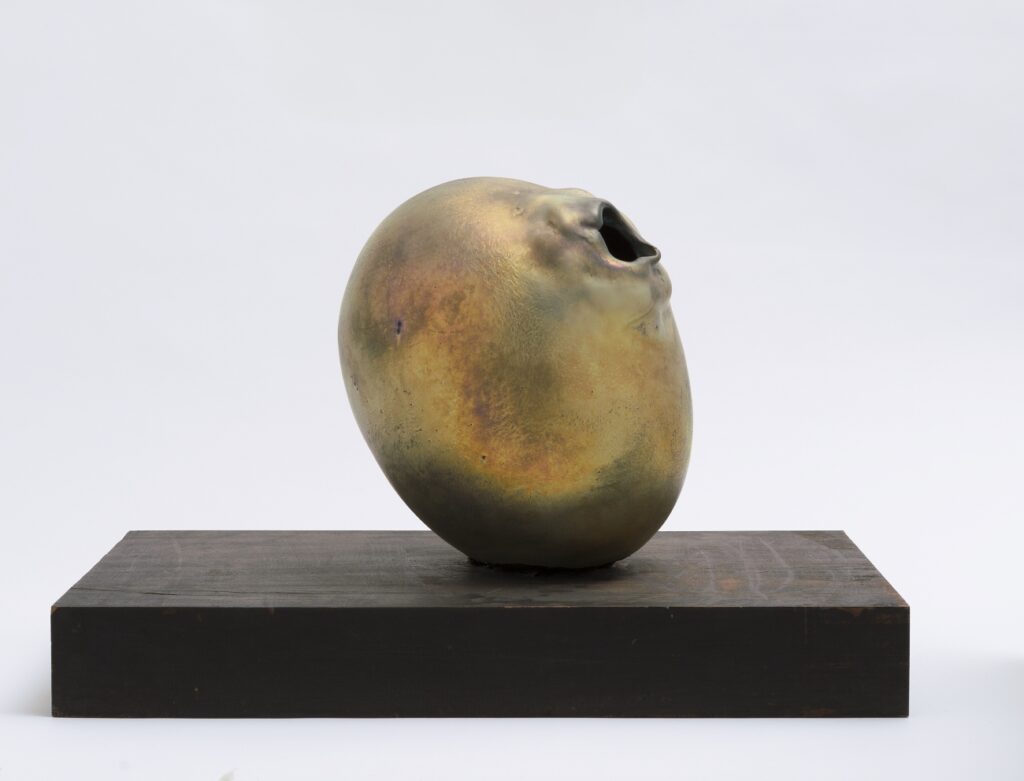
In the years when Fontana developed the Spatial Concepts, this relationship with clay did not disappear: it sharpened. The Nature, the clay spheres cut open in the 1960s, show the culmination of the path. The surface is no longer a boundary but a membrane; the void becomes structure. Spatialism is born from matter before it is born from idea.
The Venetian exhibition – curated with philological rigor and conceived as a systematic reconstruction of Fontana’s ceramic production – brings together over seventy works from public institutions, private collections, and historical archives. The installation follows a chronological-thematic order that allows the viewer to read the artist’s evolution not as a sequence of isolated turns but as an experimental continuum.
The main sections document: the early Argentine ceramics, sober and incised, most never before seen in Italy; the Albisola period, dominated by the explosion of glazes and absolute formal freedom; the religious subjects, presented in coherent groups showing continuous variations on a single iconographic structure; the battles and baroque figures, examples of a plastic theatricality that anticipates the three-dimensionality of spatial works; the Nature series, positioned at the conclusion as a direct bridge toward Spatialism.
A body of documents, photographs, letters and archival materials – many previously unpublished – highlights his constant collaboration with the Albisola workshops and the craftsmen who shared with Fontana the technical gestures of modelling and firing.
The exhibition also emphasises the role of ceramics as a theatre of material experimentation: poured glazes, intentional cracks, vibrating surfaces, controlled ruptures. Each work is presented as the result of an unrepeatable combination of hand, fire and matter.
This is why the exhibition at the Peggy Guggenheim Collection is so necessary : it reconstructs the other half of Fontana, the one without which the cuts would have neither roots nor meaning. It is a return to the earth before the cosmos, to the kiln before the void, to the gesture that precedes the myth. A long-overdue restoration that finally allows us to see the artist whole.
Hand-Made: The Ceramics of Lucio Fontana
Peggy Guggenheim Collection, Palazzo Venier dei Leoni, Venice 11 October 2025 / 2 March 2026.